
Close Menu
    Facebook X (Twitter) Instagram
    SciTechDaily
    • Biology
    • Chemistry
    • Earth
    • Health
    • Physics
    • Science
    • Space
    • Technology
    Facebook X (Twitter) Pinterest YouTube RSS
    SciTechDaily
    Home»Earth»Temperature of Ancient Seas May Shape Global Climate
    Earth

    Temperature of Ancient Seas May Shape Global Climate

    By Jim Shelton, Yale UniversityNovember 19, 20153 Comments3 Mins Read
    Facebook Twitter Pinterest Telegram LinkedIn WhatsApp Email Reddit
    Share
    Facebook Twitter LinkedIn Pinterest Telegram Email Reddit
    Temperature of Ancient Seas Shape Global Climate
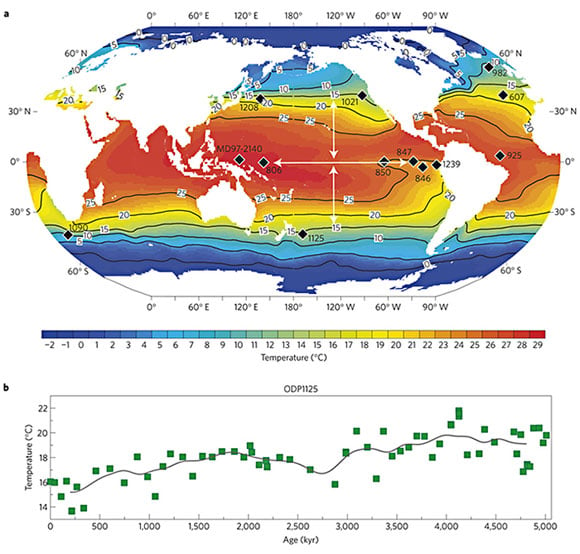
    Map of modern surface ocean temperatures and paleodata sites with data going back to 5 million years and used in this study. The new record comes from site 1125 in the South Pacific. Arrows indicate the surface temperature gradients explored by the researchers.

    In a newly published study, scientists from Yale University detail the differences in ocean temperatures over the last 5 million years by creating a historical record for sea temperature gradients and comparing it with state-of-the-art climate model simulations.

    The study is published in the journal Nature Geoscience.

    Sea temperature gradients (contrasts) in the tropics and subtropics are the engines of Earth’s climate. They control global atmospheric circulations, as well as the transport of water vapor for the planet.

    As part of the study, the researchers investigated climate evolution since the early Pliocene epoch, 4 to 5 million years ago. They looked at the development of gradients along the equator and mid-latitude regions to the north and south.

    The early Pliocene was the last time atmospheric carbon dioxide concentrations were as high as today’s levels, yet ocean temperatures during the Pliocene — from the subtropics to the Artic — were much warmer than today. The tropical Pacific, for example, had conditions resembling a modern El Niño that persisted for thousands of years.

    “The puzzle is how to explain this warmth during the Pliocene,” said lead author Alexey Fedorov, a professor of geology and geophysics at Yale. “Ocean temperature contrasts are a major part of this puzzle.”

    As part of their work, the researchers developed a temperature record for the mid-latitude South Pacific, where there had been no long-term temperature record. The new data shows that water temperatures during the Pliocene were about 5 degrees Celsius (9 degrees Fahrenheit) warmer than today.

    “It has been argued that temperature contrasts were weaker during the Pliocene, implying a weaker atmospheric circulation,” Fedorov said. “In our study, we confirm the reduced contrasts and show a tight link between ocean east-west (equatorial) and north-south (equator to mid-latitudes) temperature variations.”

    Co-authors of the study are Natalie Burls of George Mason University (formerly a postdoctoral researcher at Yale), Kira Lawrence of Lafayette College, and Laura Peterson of Luther College.

    The U.S. Department of Energy Office of Science, the National Science Foundation, the National Oceanic and Atmospheric Administration, and the David and Lucile Packard Foundation supported the research.

    Reference: “Tightly linked zonal and meridional sea surface temperature gradients over the past five million years” by Alexey V. Fedorov, Natalie J. Burls, Kira T. Lawrence and Laura C. Peterson, 16 November 2015, Nature Geoscience.
    DOI: 10.1038/ngeo2577

    Never miss a breakthrough: Join the SciTechDaily newsletter.
    Follow us on Google and Google News.

    Climate Science Earth Science Geology Geoscience Oceanography Yale University
    Share. Facebook Twitter Pinterest LinkedIn Email Reddit

    Related Articles

    This Overlooked Rock Stores 40 Times More Carbon Than We Thought

    Volcanoes Act as a Safety Valve for Earth’s Long-Term Climate – Stabilizing Surface Temperatures

    Erupted Sea Glass Allows Geologists to Take Earth’s Inner Temperature

    Scientists Provide Evidence for Why Earth’s Early Climate Was More Stable and Warmer

    Arctic Sea Ice Loss is Impacting Atlantic Ocean Water Circulation System

    Yale Researchers Find a Soft Spot in the Nazca Plate

    CryoSat Satellite Shows Increased Volume of Arctic Sea Ice

    New Timescale Firmly Implicates Volcanic Eruptions as the Dominant Drivers of Past Climate Variability

    NASA Study Provides New Estimates for the Global Water Cycle

    3 Comments

    1. GuyB on November 19, 2015 4:56 pm

      The hardest part? Was training all the volunteers to survive in the various conditions of the last five million years before they were loaded into the time machine.

      Reply
      • Bruzote on July 29, 2025 8:05 pm
        Reply
    2. Kurt on November 20, 2015 2:00 pm

      Here’s a thought… What if the oceans actually are a major factor in climate and the atmosphere is mostly just the means of transporting vapor inland, that expands and deepens when the oceans are warm because the same amount of sunshine provides a greater volume of water vapor. Then we might also see that glacier formation and ice ages are actually a result of too much warming of the seas, and that the excess heat is converted to kinetic energy and stored in inland fresh water resources as kinetic potential. And then the energy in running water and glaciers is actually not free energy, but has a source.

      Reply
    Leave A Reply Cancel Reply

    • Facebook
    • Twitter
    • Pinterest
    • YouTube

    Don't Miss a Discovery

    Subscribe for the Latest in Science & Tech!

    Trending News

    This Alien Planet Has Rock Clouds That Vaporize Before Sunset

    The Simple Habit That Could Lower Your Cancer Risk

    146,000-Year-Old Discovery Rewrites the Story of Human Creativity

    The Type of Alcohol You Drink Could Affect How Long You Live

    This Common Vitamin May Help Stop Prediabetes From Turning Into Diabetes

    Scientists Finally Solve the Mystery of “Clockwork” Earthquakes

    Breakthrough Parkinson’s Drug Targets Disease at Its Genetic Roots

    Just 4 Weeks of Simple Diet Changes Reversed Signs of Aging in Older Adults

    Follow SciTechDaily
    • Facebook
    • Twitter
    • YouTube
    • Pinterest
    • Newsletter
    • RSS
    SciTech News
    • Biology News
    • Chemistry News
    • Earth News
    • Health News
    • Physics News
    • Science News
    • Space News
    • Technology News
    Recent Posts
    • Scientists Create “Trojan Horse” Weight Loss Drug That Supercharges Results
    • Cats Have a Unique Kidney Chemistry That Could Be Harming Their Health
    • Scientists Warn Himalayan Rivers Are Becoming Increasingly Unstable
    • Scientists Discover Major Errors in Al Gore-Founded Climate Pollution Database
    • Scientists Discover Common Medications May Secretly Alter Your Gut for Years
    Copyright © 1998 - 2026 SciTechDaily. All Rights Reserved.
    • Science News
    • About
    • Contact
    • Editorial Board
    • Privacy Policy
    • Terms of Use

    Type above and press Enter to search. Press Esc to cancel.