
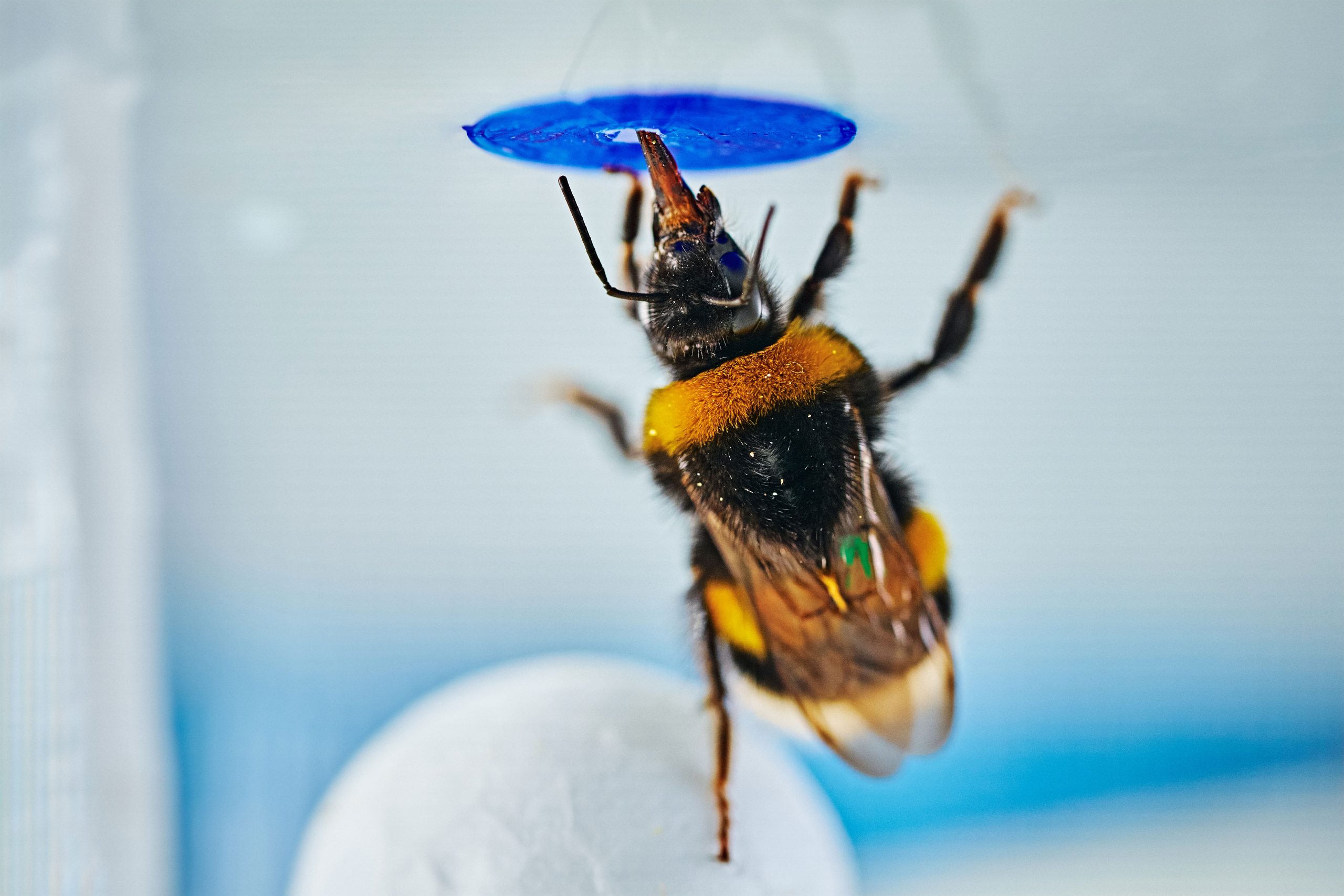
Bumble bees demonstrated an unexpected ability to solve a novel object-based challenge without training.
A bee’s brain is smaller than a sesame seed, yet in a new experiment, some bumble bees appeared to solve a problem that required more than simple instinct. They had to move an object into position, climb onto it, and use it to reach a reward, even though they had never been taught that solution.
More than 100 years ago, psychologist Wolfgang Köhler became famous for experiments showing that chimpanzees could solve unfamiliar problems by using objects in new ways. In one classic setup, chimps stacked boxes to reach a banana that was otherwise out of reach. Those studies helped shape the idea that insight, the sudden linking of separate pieces of information into a useful solution, was mainly a feature of large-brained animals.
Now, researchers from the University of Oulu, the University of Helsinki, and the University of Turku in Finland report that bumble bees can show a strikingly similar kind of flexibility.
Solving a Problem Without Training
In the study, published in Science, bumble bees (Bombus terrestris) were presented with a task they had never encountered before. The insects first learned that a blue artificial flower contained a reward. During testing, the flower was placed on the ceiling of a transparent arena, making it inaccessible.
To reach the reward, the bees had to come up with a new solution. They needed to move a ball beneath the flower and then climb onto it to reach the target. The bees had never been trained to perform this sequence of actions.
“This is essentially an insect version of the classic ‘box-and-banana’ problem,” says senior author Olli Loukola, Docent at the University of Oulu. “The animal must realize that an object can be repositioned and then used as a tool to reach an otherwise inaccessible goal. What stands out about the result is that this kind of spontaneous problem-solving is now demonstrated in an insect.”
This movie shows a bee solving the task in Experiment 3. The beginning of the video (habituation phase, without the ball present) is shown at accelerated speed. Following habituation, the arena is briefly illuminated with red light (not visible to bees) while the ball is placed between two visually occluding compartments. During the test phase, the bee moves the ball toward the side behind which the flower is located, positions it beneath the flower, climbs onto the ball, and contacts the flower on the arena ceiling. Video: Olli Loukola / University of Oulu. Credit: Video: Olli Loukola / University of Oulu
“What makes this behavior especially remarkable is that the bees had never been trained to roll the ball. This was a completely new challenge. Their behavior appeared goal-directed with successful individuals showing more directed movement patterns,” says lead author Akshaye Bhambore from the University of Oulu.
The bees were never taught to place the ball beneath the flower. Instead, they learned only two separate facts: that the blue flower contained a reward and that the ball was a movable, harmless object.
When confronted with the new task, many bees combined those previous experiences in a way that went beyond anything they had been trained to do.
“Another important aspect is that our bees were fully naïve,” Loukola adds. “In many previous studies of insight-like problem-solving, the animals have had extensive experience with objects, test environments, or other problem-solving tasks. Here, the bees had never been trained to use the ball to reach the flower, and they had no previous experience with this kind of solution. We also designed the experiments to rule out simpler explanations such as accidental success, play behavior, trial-and-error learning, or direct visual guidance.”
Ruling Out Simpler Explanations
The researchers also carried out a series of control experiments designed to eliminate simpler explanations for the bees’ success.
In some of the more challenging tests, the flower was hidden while the bees moved the ball. This prevented them from simply guiding the ball toward a visible target. Even so, the bees were still able to move the ball to the correct location.
“By analyzing the bees’ behavior across unusually stringent control experiments, we could show that they were not simply reacting to visual stimuli or moving the ball randomly,” says lead author Bhambore.
“One moment the animal is exploring seemingly without direction, and the next it performs a highly efficient sequence of actions leading directly to the solution,” says co-author Ece Nur Akmeşe from the University of Helsinki. “Watching the bees solving the task was genuinely fascinating.”
What the Findings Mean
The findings add to a growing body of evidence that bees possess more advanced cognitive abilities than their small brains might suggest. Previous studies have shown that bees can learn tool use from one another, solve puzzle-like challenges, cooperate, and adapt their behavior to changing situations.
The researchers stress, however, that the results do not mean bees possess human-like reasoning or consciousness.
“We are not claiming that bees think like humans,” says Loukola, who is currently a Senior Researcher at the University of Turku. “But our findings show that miniature brains can generate flexible solutions to novel problems in ways we are only beginning to understand.”
The study suggests that spontaneous, goal-directed problem-solving can arise in animals with brains far smaller than those of the vertebrates that have traditionally been the focus of insight research.
“For over a century, spontaneous object-based problem-solving has mostly been studied in vertebrates,” says Loukola. “Our study suggests insects may belong in that conversation too.”
Reference: “Spontaneous problem-solving in bumble bees” by Akshaye A. Bhambore, Ece N. Akmeşe, Emma Häkkinen, Milla K. Jussila, Juha-Heikki Kantola and Olli J. Loukola, 4 June 2026, Science.
DOI: 10.1126/science.ady1618
Never miss a breakthrough: Join the SciTechDaily newsletter.
Follow us on Google and Google News.