
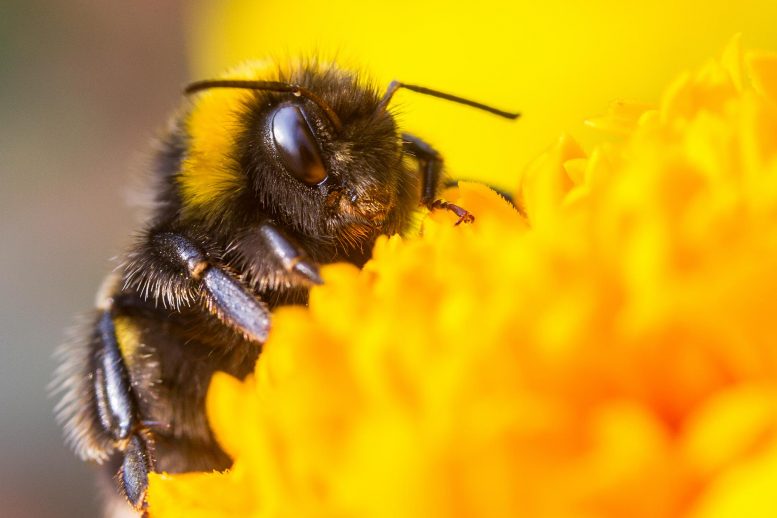
Facing a scarcity of pollen, bumblebees will nibble on the leaves of flowerless plants, causing intentional damage in such a way that accelerates the production of flowers, according to a new study, which reports on a previously unknown behavior of bumblebees.
The leaf-damaging bumblebee bites have a drastic effect on plant flowering, compelling some to bloom two weeks to a full month earlier. Although the mechanisms by which deliberate bee damage accelerate flowering remain unclear, the results reveal bumblebees as powerful agents in influencing the local availability of floral resources.
“An encouraging interpretation of the new findings is that behavioral adaptations of flower visitors can provide pollination systems with more plasticity and resilience to cope with climate change than hitherto suspected,” writes Lars Chittka in a related Perspective. Plants and pollinators rely on one another for survival.
Just as pollinators, like bumblebees, depend on flowers for crucial nutrition, plants need pollinators to reproduce. This symbiotic relationship is kept in balance by the synchronous timing of the emergence of hibernating insects and spring blossoms as spring temperatures rise and the days get longer. But this fragile arrangement is threatened by climate change. For instance, warming early season temperatures could cause pollinators to wake up too soon, before the springtime bloom, and without a source of food.
Foteini Pashalidou and colleagues discovered an adaptive strategy used by food-deprived bumblebees to manipulate the timing of a plant’s flowering. Pashalidou et al. observed bumblebee workers from pollen-starved colonies use their mouthparts to cut distinctively shaped holes in the leaves of flowering plants, which resulted in them flowering significantly earlier.
The authors were not able to reproduce the flower-stimulating effects by mimicking the damage on their own, however, suggesting a yet-unknown feature distinct to the bees’ approach. “Understanding the molecular pathways by which one could accelerate flowering by a full month, as reported [by Pashalidou et al.], would be a horticulturalist’s dream,” Chittka writes.
Reference: “Bumble bees damage plant leaves and accelerate flower production when pollen is scarce” by Foteini G. Pashalidou, Harriet Lambert, Thomas Peybernes, Mark C. Mescher and Consuelo M. De Moraes, 22 May 2020, Science.
DOI: 10.1126/science.aay0496
Never miss a breakthrough: Join the SciTechDaily newsletter.
Follow us on Google and Google News.
6 Comments
I have to tell you that the easiest way to “force” a bloom on most flowers is to let them dry out a bit. If the plant is “afraid” that it is threatened it will go to work on producing flowers and re-seeding itself. If a plant on its own starts to bloom early then you have to check the root system or any other place that might be infested with something not good for the plant’s overall survival. I am guessing that hungry bees that chew on something on the plant do sustain themselves and indirectly produce the results needed to produce a bloom.
Maybe it is a part of the amazing overall design of plants, animals and dare I say it, all creation. Give that a thought and answers will come
Nature is amazing for sure. Millions of years of evolution shows that there is I feed no need for a higher power to control things. Good point David.
I love this story as I have two Bumblebee hives and buy new colonies every year.It is fascinating to watch them work .
Thank you for this amazing article. There is intelligence present in nature, no doubt. Now we know that it’s not dormant, but rather alive and relevant despite so many changes and fluctuations. It guides all living beings, helps to thrive in difficult conditions. Migrating birds, bees etc. And who would be a better guide than the person who has created it?
Marvelous. Now I understand the whole sugya of חרדל in BB 18a, especially according to Tosfos. They’re talking about growing mustard variously for greens and seeds. Wonderful!