
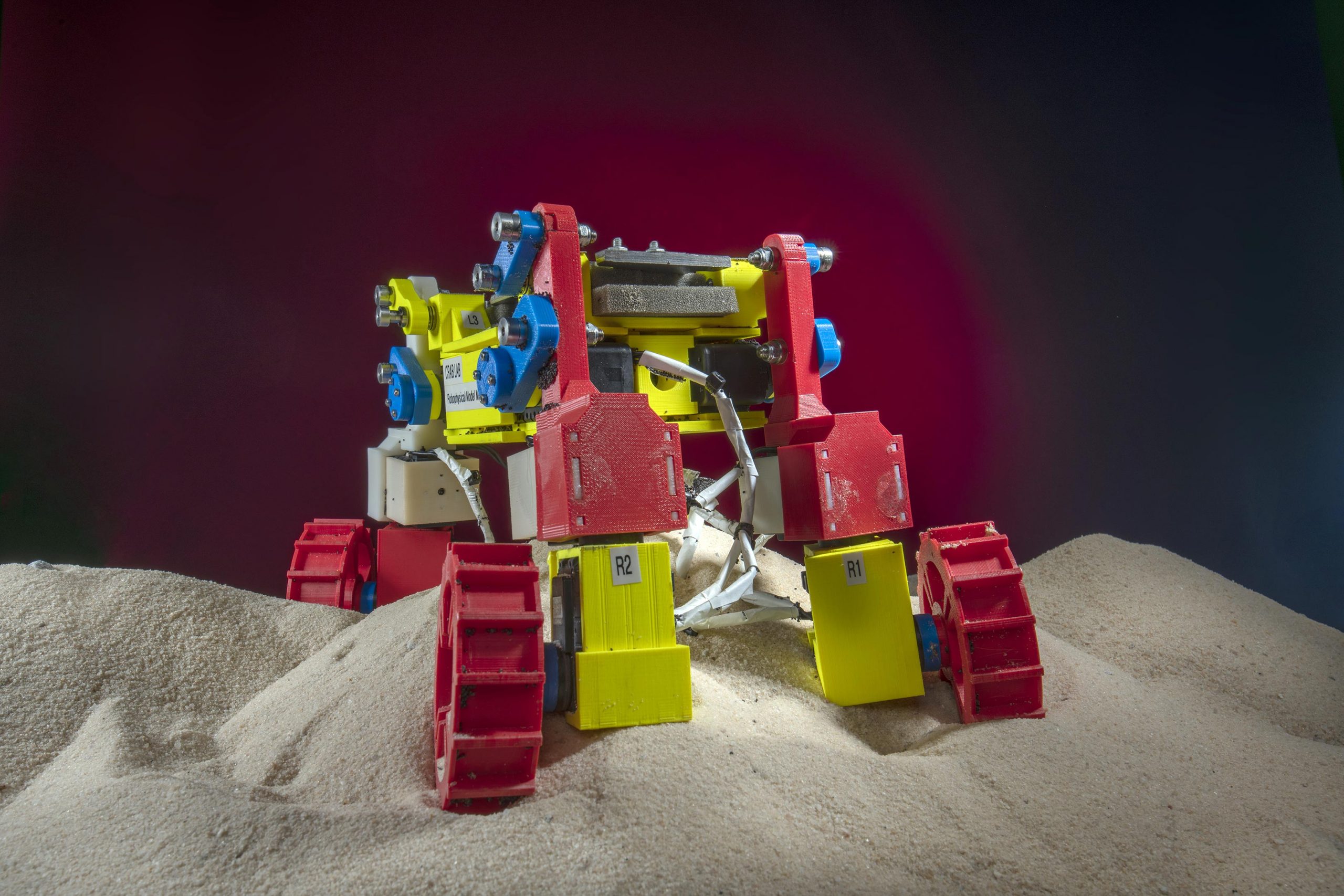
Built with wheeled appendages that can be lifted, a new robot developed with U.S. Army funding has complex locomotion techniques robust enough to allow it to climb sand covered hills and avoid getting stuck. The robot has NASA interested for potential surveying of a planet or the Moon.
Using a move that researchers at Georgia Institute of Technology dubbed rear rotator pedaling, the robot, known as the Mini Rover, climbs a slope by using a design that combines paddling, walking, and wheel spinning motions. The rover’s behaviors were modeled using a branch of physics known as terradynamics.
The journal Science Robotics published the research as a cover article. The Army Research Office, an element of the U.S. Army Combat Capabilities Development Command’s Army Research Laboratory and NASA, through the National Robotics Initiative, funded the research.
“This basic research is revealing exciting new approaches for locomotion in complex terrain,” said Dr. Samuel Stanton, a program manager at ARO. “This could lead to platforms capable of intelligently transitioning between wheeled and legged modes of movement to maintain high operational tempo.”
According to the scientists, when loose materials like sand flow, that can create problems for robots moving across it.
“This rover has enough degrees of freedom that it can get out of jams pretty effectively,” said Dan Goldman, the Dunn Family Professor in the School of Physics at the Georgia Institute of Technology. “By avalanching materials from the front wheels, it creates a localized fluid hill for the back wheels that is not as steep as the real slope. The rover is always self-generating and self-organizing a good hill for itself.”
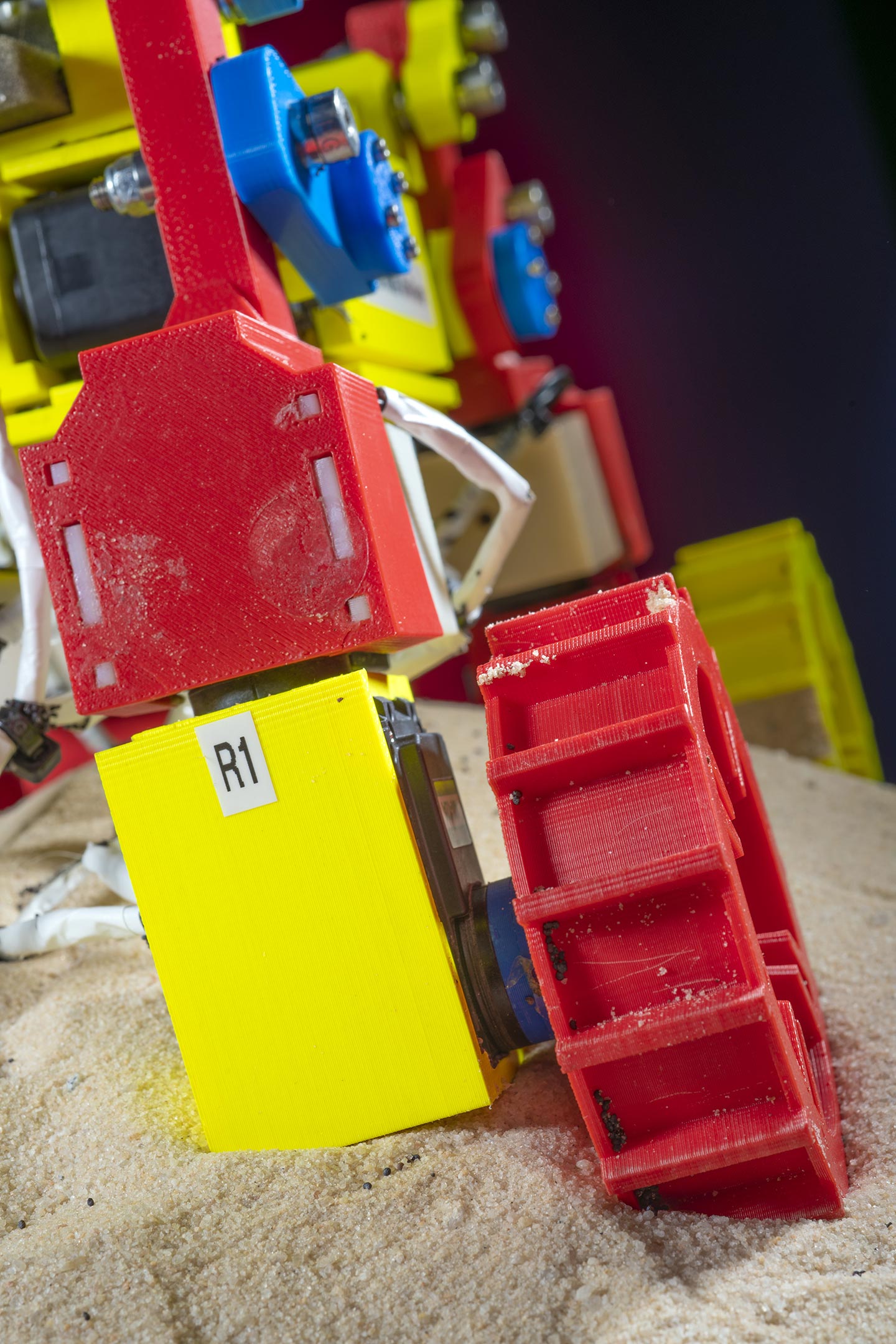
A robot built by NASA’s Johnson Space Center pioneered the ability to spin its wheels, sweep the surface with those wheels and lift each of its wheeled appendages where necessary, creating a broad range of potential motions. Using in-house 3-D printers, the Georgia Tech researchers collaborated with the Johnson Space Center to re-create those capabilities in a scaled-down vehicle with four-wheeled appendages driven by 12 different motors.
“The rover was developed with a modular mechatronic architecture, commercially available components, and a minimal number of parts,” said Siddharth Shrivastava, an undergraduate student in Georgia Tech’s George W. Woodruff School of Mechanical Engineering. “This enabled our team to use our robot as a robust laboratory tool and focus our efforts on exploring creative and interesting experiments without worrying about damaging the rover, service downtime, or hitting performance limitations.”
The rover’s broad range of movements gave the research team an opportunity to test many variations that were studied using granular drag force measurements and modified Resistive Force Theory. The team began with the gaits explored by the NASA RP15 robot, and experimented with locomotion schemes that could not have been tested on a full-size rover.
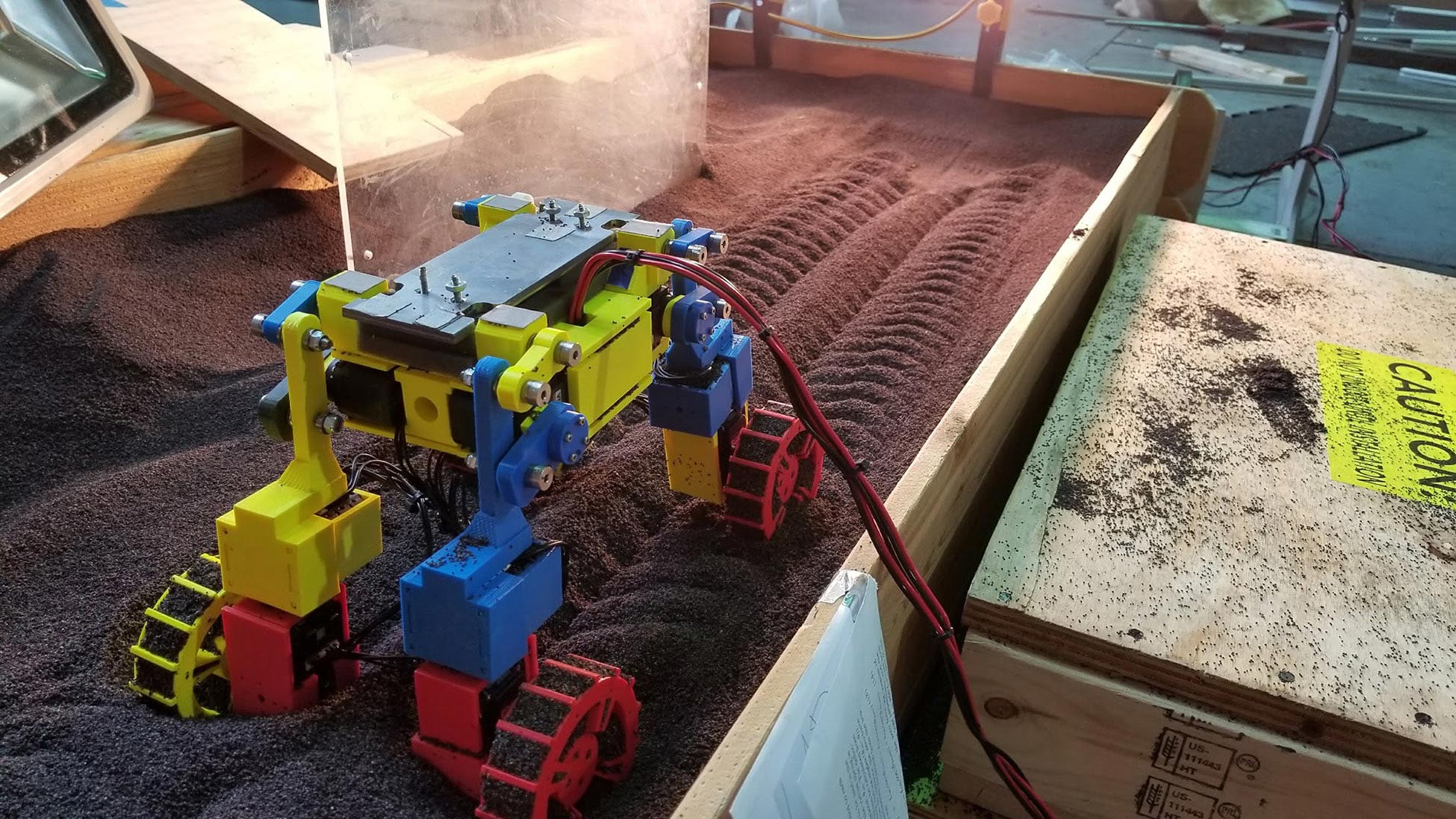
The researchers also tested their experimental gaits on slopes designed to simulate planetary and lunar hills using a fluidized bed system known as SCATTER, or Systematic Creation of Arbitrary Terrain and Testing of Exploratory Robots, that could be tilted to evaluate the role of controlling the granular substrate.
In the experiments, the new gait allowed the rover to climb a steep slope with the front wheels stirring up the granular material – poppy seeds for the lab testing – and pushing them back toward the rear wheels. The rear wheels wiggled from side to side, lifting and spinning to create a motion that resembles paddling in water. The material pushed to the back wheels effectively changed the slope the rear wheels had to climb, allowing the rover to make steady progress up a hill that might have stopped a simple wheeled robot.
“In our previous studies of pure legged robots, modeled on animals, we had kind of figured out that the secret was to not make a mess,” Goldman said. “If you end up making too much of a mess with most robots, you end up just paddling and digging into the granular material. If you want fast locomotion, we found that you should try to keep the material as solid as possible by tweaking the parameters of motion.”
But simple motions had proved problematic for Mars rovers, which famously got stuck in granular materials. Goldman says this gait discovery might be able to help future rovers avoid that fate.
“This combination of lifting and wheeling and paddling, if used properly, provides the ability to maintain some forward progress even if it is slow,” Goldman said. “Through our laboratory experiments, we have shown principles that could lead to improved robustness in planetary exploration – and even in challenging surfaces on our own planet.”
The researchers hope next to scale up the unusual gaits to larger robots, and to explore the idea of studying robots and their localized environments together.
Though the Mini Rover was designed to study lunar and planetary exploration, the lessons learned could also be applicable to terrestrial locomotion – an area of interest to the Army.
Read Planetary Exploration Rover Features Complex Locomotion Techniques to Avoid Traps for more on the Mini Rover.
Reference: “Material remodeling on granular terrain yields robustness benefits for a robophysical rover” by Siddharth Shrivastava, Andras Karsai, Yasemin Ozkan Aydin, Ross Pettinger, William Bluethmann, Robert O. Ambrose and Daniel I. Goldman, 13 May 2020, Science Robotics.
DOI: 10.1126/scirobotics.aba3499
Never miss a breakthrough: Join the SciTechDaily newsletter.
Follow us on Google and Google News.