
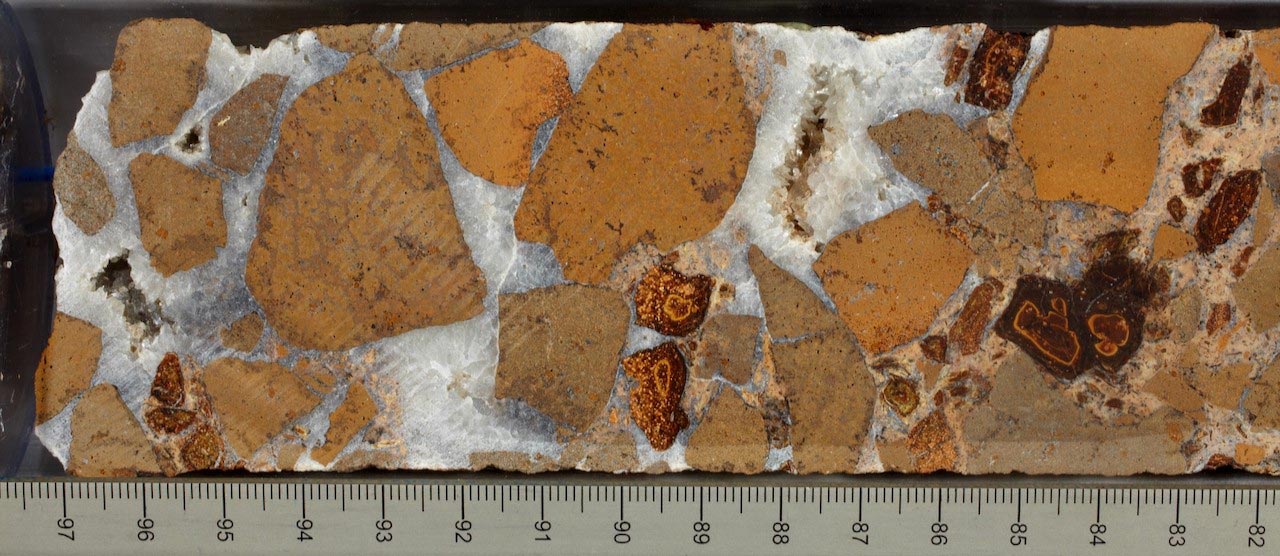
New drilling results from the South Atlantic have uncovered ancient lava rubble that stores far more CO2 than expected, revealing an overlooked mechanism in Earth’s long-term carbon cycle.
Sixty-million-year-old rock cores collected from far beneath the ocean surface are offering new insight into how large quantities of carbon dioxide can remain locked away for thousands of years inside broken lava deposits on the seafloor.
A research team examined lava material drilled from deep below the South Atlantic Ocean to measure how much CO2 becomes trapped as seawater reacts with the rock. Their findings show that loose accumulations of lava fragments, created as underwater mountains gradually erode, act as natural reservoirs for carbon.
The study, led by the University of Southampton, is the first to fully recognize how effective these rubble layers are at storing CO2. The results shed new light on how Earth’s long-term carbon cycle operates and how the planet regulates carbon through geological processes.
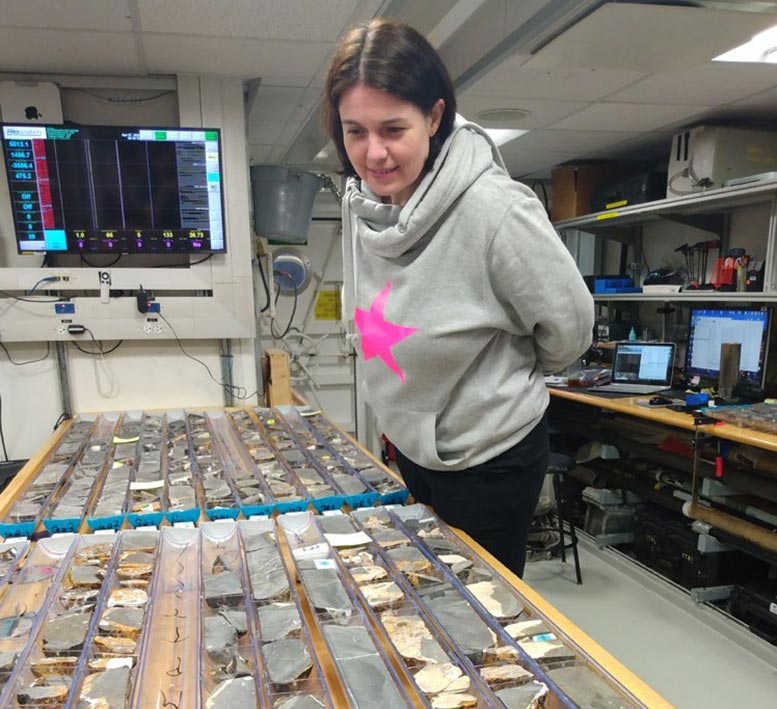
Lead author of the research Dr. Rosalind Coggon, Royal Society Research Fellow at the University of Southampton, said: “We’ve known for a long time that erosion on the slopes of underwater mountains produces large volumes of volcanic rubble, known as breccia – much like scree slopes on continental mountains.
“However, our drilling efforts recovered the first cores of this material after it has spent tens of millions of years being rafted across the seafloor as Earth’s tectonic plates spread apart.
“Excitingly, the cores revealed that these porous, permeable deposits have the capacity to store large volumes of seawater CO2 as they are gradually cemented by calcium carbonate minerals that form from seawater as it flows through them.”
Understanding past changes in the long-term carbon cycle
The slow exchange of carbon among Earth’s interior, the oceans, and the atmosphere over millions of years determines the amount of CO2 present in the air, which in turn influences the planet’s climate.
To track how Earth’s climate has shifted in the past, researchers examine how carbon enters and leaves each component of the planet’s system and how these transfers have changed over time.

Dr. Coggon explained: “The oceans are paved with volcanic rocks that form at mid-ocean ridges, as the tectonic plates move apart creating new ocean crust. This volcanic activity releases CO2 from deep inside the Earth into the ocean and atmosphere.
“However, ocean basins are not just a container for seawater. Seawater flows through the cracks in the cooling lavas for millions of years and reacts with the rocks, transferring elements between the ocean and rock. This process removes CO2 from the water and stores it in minerals like calcium carbonate in the rock.”
The study determined how much CO2 is stored in the ocean crust, due to this process.
“While drilling deep into the seafloor of the South Atlantic, we discovered lava rubble that contained between two and 40 times more CO2 than previously sampled lavas,” said Dr. Coggon.
“This study revealed the importance of such breccia, which forms due to the erosion of seafloor mountains along mid-ocean ridges, as a sponge for carbon in the long-term carbon cycle.”
Reference: “A geological carbon cycle sink hosted by ocean crust talus breccias” by Rosalind M. Coggon, Elliot J. Carter, Lewis J. C. Grant, Aled D. Evans, Christopher M. Lowery, Damon A. H. Teagle, Pamela D. Kempton, Matthew J. Cooper, Claire M. Routledge, Elmar Albers, Justin Estep, Gail L. Christeson, Michelle Harris, Thomas M. Belgrano, Jason B. Sylvan, Julia S. Reece, Emily R. Estes, Trevor Williams and on behalf of The South Atlantic Transect IODP Expedition 390 & 393 Scientists, 24 November 2025, Nature Geoscience.
DOI: 10.1038/s41561-025-01839-5
The research was part of Expedition 390/393 of the International Ocean Discovery Program.
Never miss a breakthrough: Join the SciTechDaily newsletter.
Follow us on Google and Google News.
1 Comment
Is it 40-times more or 40% more? It looks like the calcite-filled voids are in the range of 40% of the total volume to me.