
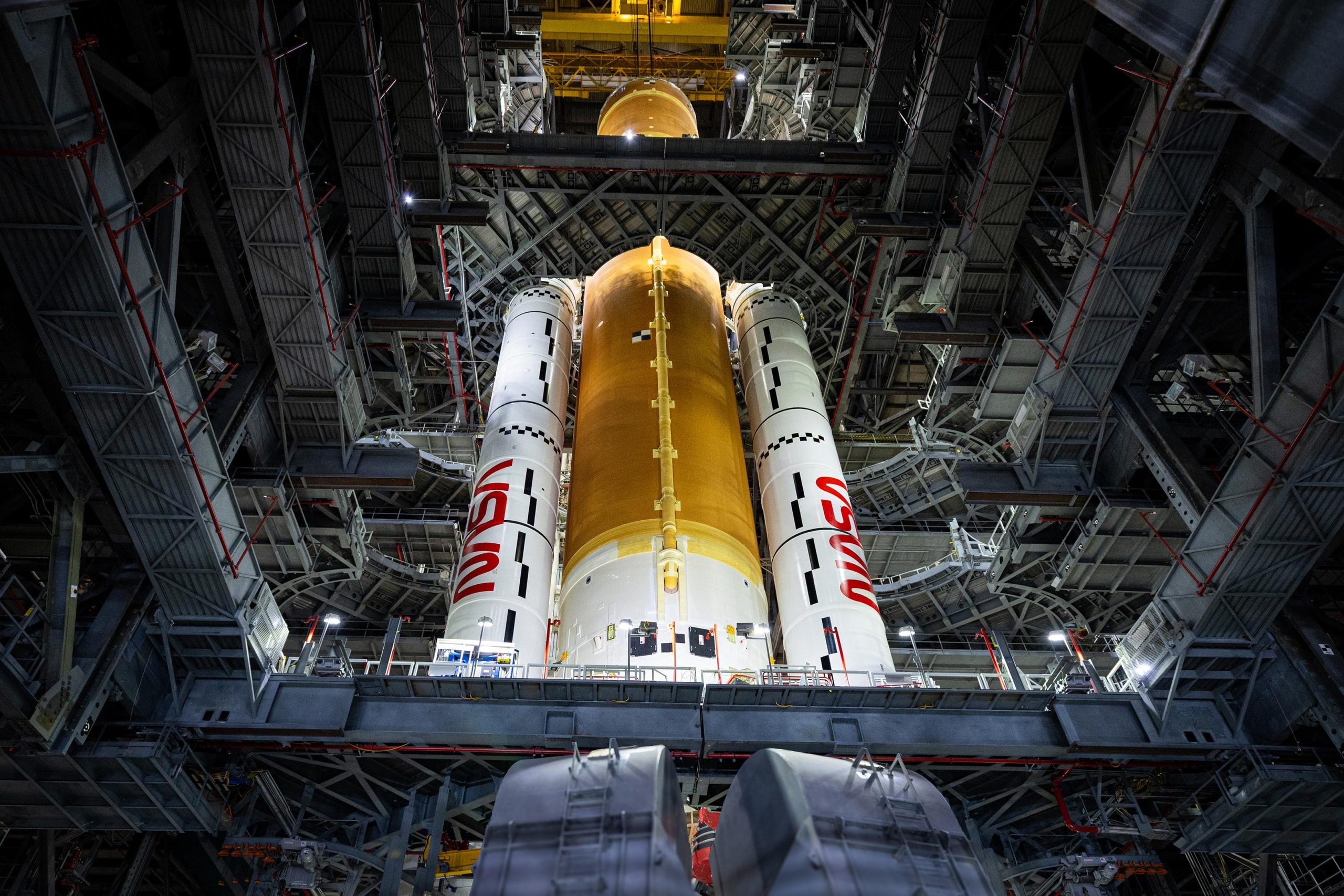
NASA has taken a major step toward deep space exploration with the integration of the SLS rocket and solid rocket boosters for the Artemis II mission.
This upcoming launch will be the first to carry astronauts as part of the Artemis program, which aims to establish a sustainable human presence on the Moon and lay the groundwork for future missions to Mars.
Preparing the Rocket for Artemis II
On March 23, 2025, technicians from NASA and its primary contractor, Amentum, joined the Space Launch System (SLS) rocket with its stacked solid rocket boosters at NASA’s Kennedy Space Center in Florida. The core stage, measuring 212 feet tall and weighing approximately 219,000 pounds with its engines, is the rocket’s largest and most essential component. It forms the backbone of the launch system, supporting the launch vehicle stage adapter, interim cryogenic propulsion stage, Orion stage adapter, and the Orion spacecraft.
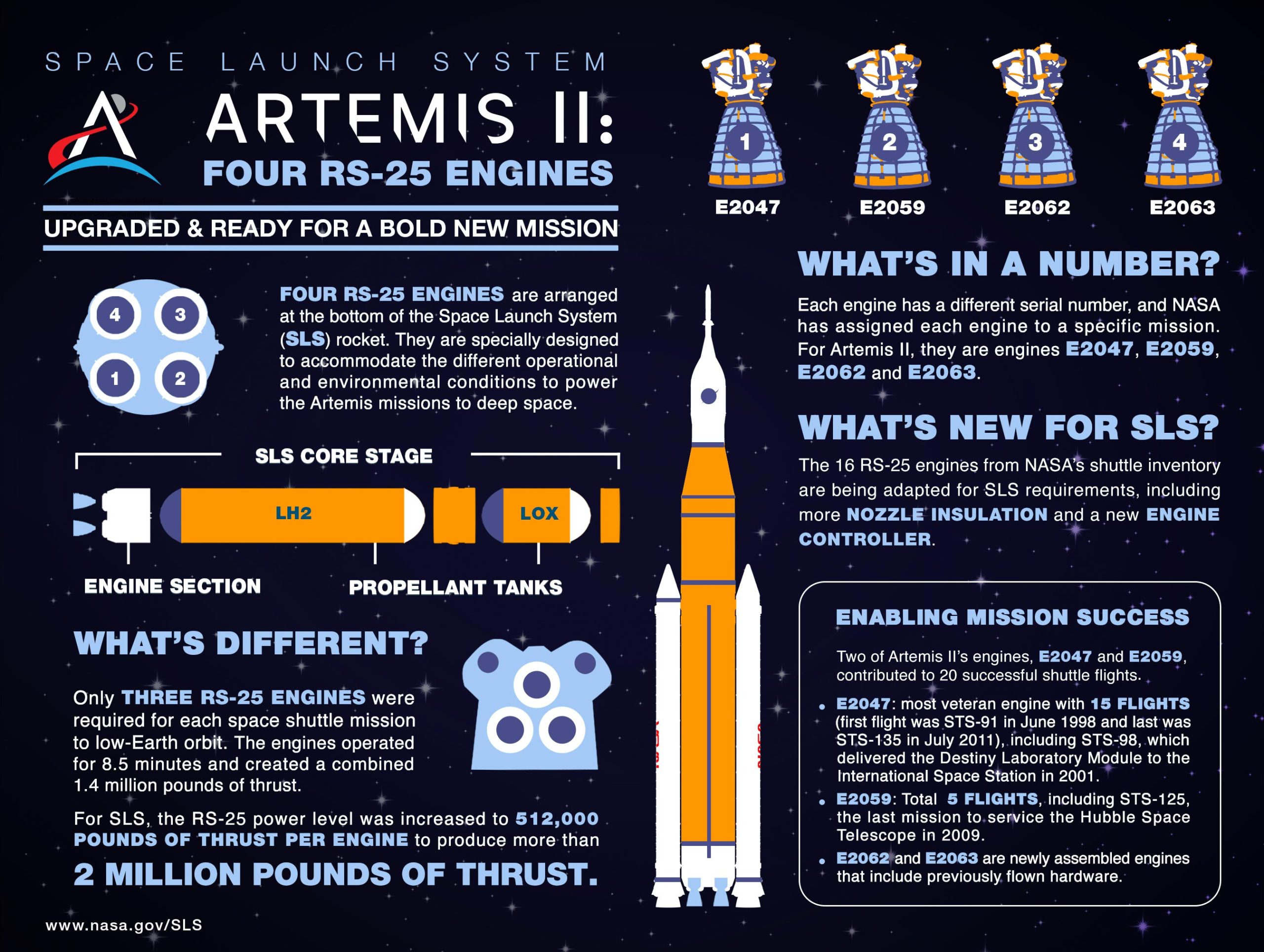
Artemis II: A Giant Leap Toward Mars
Artemis II will be the first crewed test flight in NASA’s Artemis program. It marks a major step toward returning humans to the Moon and lays the groundwork for future crewed missions to Mars.
NASA’s Space Launch System (SLS)
NASA’s Space Launch System (SLS) is the agency’s most powerful rocket, built to launch astronauts and cargo beyond low-Earth orbit and into deep space. Designed specifically for the Artemis program, SLS can carry the Orion spacecraft, astronauts, and heavy payloads to the Moon and eventually to Mars. With its advanced propulsion systems and modular design, SLS is central to enabling NASA’s long-term goals for human space exploration.
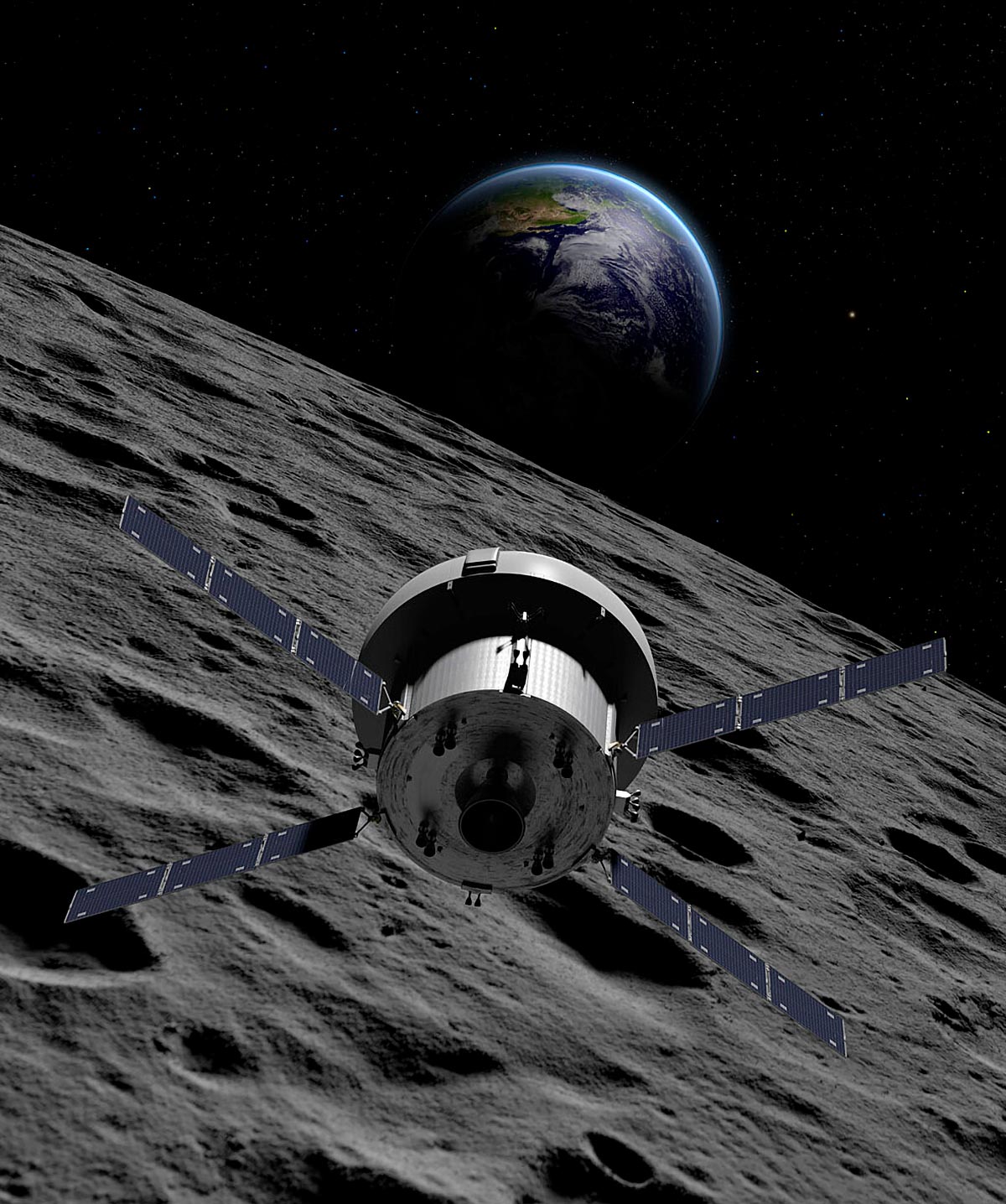
NASA’s Artemis Program
NASA’s Artemis program is the agency’s ambitious effort to return humans to the Moon and pave the way for future exploration of Mars. Named after the twin sister of Apollo in Greek mythology, Artemis aims to land the astronauts on the lunar surface. The program includes a series of increasingly complex missions designed to test new spacecraft, rocket systems, and technologies for deep space travel, ultimately building a sustainable human presence on and around the Moon.
Never miss a breakthrough: Join the SciTechDaily newsletter.
Follow us on Google and Google News.
7 Comments
This is so DUMB. We need to get away from fighting Earth’s gravity to get into space.
We need to build a space elevator to ferry people and supplies to a LARGE space station in orbit, where ships will then take off from to the Moon and other planets.
Doesn’t NASA read SF books?
The F in SF stands for fiction. That might be a reason why…
The F in SF has often predicted future developments and given a real advantage to those paying attention.
That may true fiction has lead to great scientific knowledge, but it requires a lot more information and research in order for it to come true and source not discovered.
Wow, why ask for a elevator when asking for SF Applications of concepts instead of going for beaming to the space port.
Engineers and astrophysicist will be mankind’s path to the stars and we have a very long way to go to realize that aspiration.
It cannot be achieved until the peoples of Earth become united for the survival of the species from our single point of failure.
Yes the space elevator might and probably is the answer but, before we can do that, doing what we know we can do is the best option until the space elevator is viable and economical to build/use. Get the world to work together on that and not want to kill each other for our differences, then you will see progress.
The main issue with the elevator is that the station has to be built in a geo orbit to start with. Until we have more support than one country that will not be practical. Can you imagine the number of material launches it would take to move material to the site, not to mention the physics to place and stabilize the station. Once the station is built then you can start building the elevator to the ground.
I agree that SF does inspire the S of to future, but it takes a lot longer to make it science fact.