
Many parents mistaken about their child’s video game behavior; families report different gaming patterns for teen boys than girls.
Eighty-six percent of parents agree that teens spend too much time gaming, but many may be mistaken about the extent of their own child’s video game habits, a new national poll suggests.
Parents also report very different gaming patterns for teen boys than girls, according to the C.S. Mott Children’s Hospital National Poll on Children’s Health. Twice as many parents say their teen boy plays video games every day compared to parents of teen girls. Teen boys are also more likely to spend three or more hours gaming.
Overall, parents surveyed say gaming often gets in the way of other aspects of their teen’s life, such as family activities and interactions (46%), sleep (44%), homework (34%), friendship with non-gaming peers (33%) and extracurricular activities (31%).
“Although many parents believe video games can be good for teens, they also report a number of negative impacts of prolonged gaming,” says Mott Poll co-director and Mott pediatrician Gary Freed, MD, MPH.
“Parents should take a close look at their teen’s gaming behavior and set reasonable limits to reduce harmful impacts on sleep, family and peer relationships, and school performance.”
But parents may not always have the most accurate perception of their teen’s gaming tendencies. Among parents of daily gamers, 54% report their teen plays three or more hours a day (compared to only 13% of teens that do not play every day.) Just 13 percent of these parents believe their teen spends more time gaming than others, while 78% believe their teen’s gaming is less than or about the same as their peers.
“Many parents of frequent gamers have a misconception that the amount of time their teenager spends playing video games is in line with their peers,” Freed says.
While 71% of parents believe video games may have a positive impact on their teens, some (44%) try to restrict video game content. Parents of teens ages 13-15 (compared to those with older teens) are more likely to use rating systems to try to make sure games are appropriate (43% versus 18%), encourage their teen to play with friends in person rather than online and to ban gaming in their teen’s bedroom.
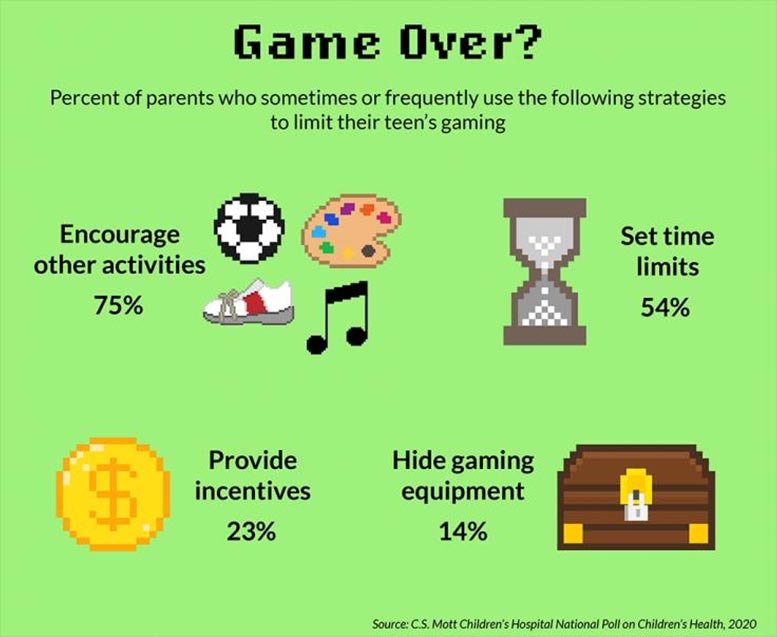
Parents polled also use different strategies to limit the amount of time their teen spends gaming, including encouraging other activities (75%), setting time limits (54%), providing incentives to limit gaming (23%), and hiding gaming equipment (14%).
Freed notes that while gaming may be a fun activity in moderation, some teens -such as those with attention issues — are especially susceptible to the constant positive feedback and the stimulus of video games. This may lead to prolonged play that is disruptive to other elements of a teen’s life.
He recommends parents show interest by playing video games with their kids while also communicating healthy limits and ensuring that they have strong privacy settings. In some situations, he notes, games can help parents connect with older kids and may occasionally help open the door to other conversations and interactions.
But parents should also help teens understand that limits and rules around gaming are tied to safety, health, school, and relationships.
“Parents can play an important role by setting clear rules about appropriate content and how much time is too much time spent on video games,” Freed says.
“While many parents see benefits in gaming, the activity should not be at the expense of face-to-face time with family, friends, and teachers who play a pivotal role in promoting a teen’s learning and healthy development.”
The Mott Poll report is based on responses from 963 parents who had at least one child aged 13-18 years.
Never miss a breakthrough: Join the SciTechDaily newsletter.
Follow us on Google and Google News.
1 Comment
I believe that responsible gaming should be taught because most kids really don’t even know their limits in gaming. Of course, it’s entertaining, and with pages like https://dmarket.com/trade-rust-skins, it can be even profitable, but it still develops an addiction, and it can be pretty dangerous, so it’s important to know when it’s enough.