
Close Menu
    Facebook X (Twitter) Instagram
    SciTechDaily
    • Biology
    • Chemistry
    • Earth
    • Health
    • Physics
    • Science
    • Space
    • Technology
    Facebook X (Twitter) Pinterest YouTube RSS
    SciTechDaily
    Home»Technology»Faster, Smaller, Smarter and More Energy-Efficient Chips: World’s Smallest Atom-Memory Unit Created
    Technology

    Faster, Smaller, Smarter and More Energy-Efficient Chips: World’s Smallest Atom-Memory Unit Created

    By University of Texas at AustinNovember 28, 2020No Comments3 Mins Read
    Facebook Twitter Pinterest Telegram LinkedIn WhatsApp Email Reddit
    Share
    Facebook Twitter LinkedIn Pinterest Telegram Email Reddit
    Smallest Memristor
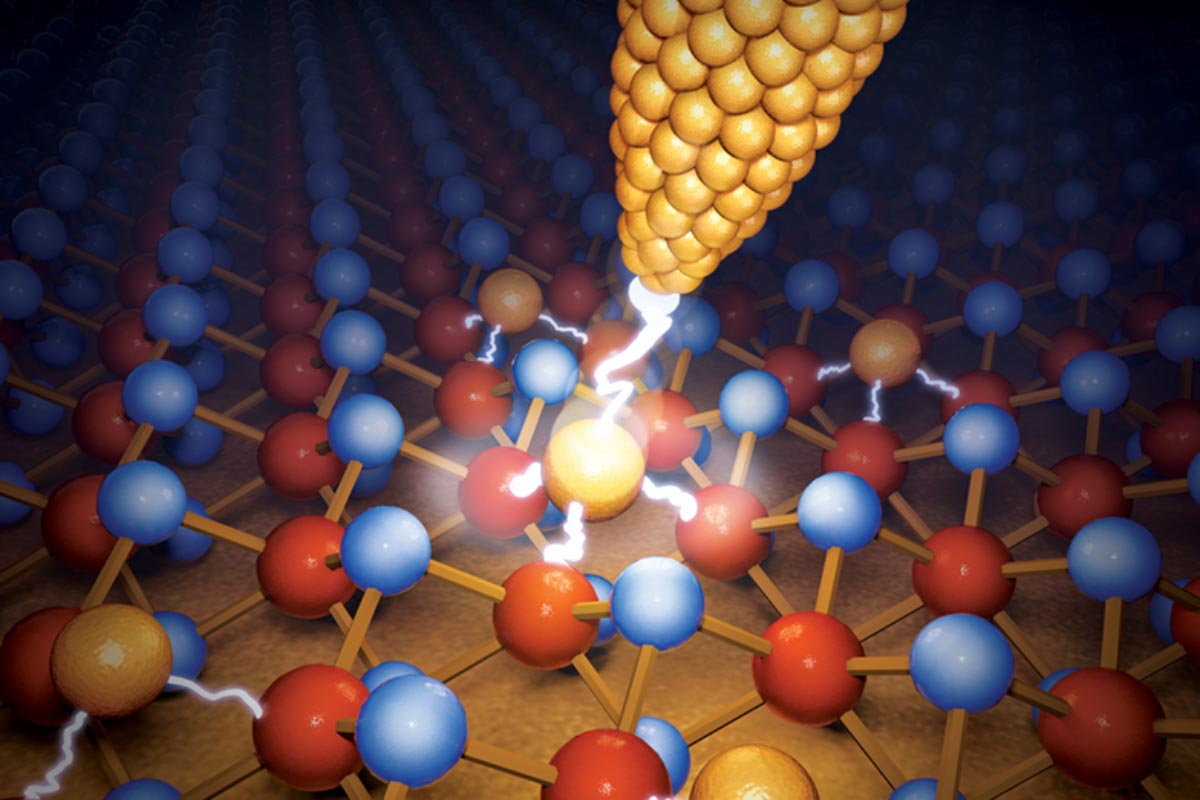
    Faster, smaller, smarter, and more energy-efficient chips for everything from consumer electronics to big data to brain-inspired computing could soon be on the way after engineers at The University of Texas at Austin created the smallest memory device yet. Credit: Cockrell School of Engineering, The University of Texas at Austin

    Faster, smaller, smarter, and more energy-efficient chips for everything from consumer electronics to big data to brain-inspired computing could soon be on the way after engineers at The University of Texas at Austin created the smallest memory device yet. And in the process, they figured out the physics dynamic that unlocks dense memory storage capabilities for these tiny devices.

    The research published recently in Nature Nanotechnology builds on a discovery from two years ago, when the researchers created what was then the thinnest memory storage device. In this new work, the researchers reduced the size even further, shrinking the cross section area down to just a single square nanometer.

    Getting a handle on the physics that pack dense memory storage capability into these devices enabled the ability to make them much smaller. Defects, or holes in the material, provide the key to unlocking the high-density memory storage capability.

    “When a single additional metal atom goes into that nanoscale hole and fills it, it confers some of its conductivity into the material, and this leads to a change or memory effect,” said Deji Akinwande, professor in the Department of Electrical and Computer Engineering.

    Though they used molybdenum disulfide – also known as MoS2 – as the primary nanomaterial in their study, the researchers think the discovery could apply to hundreds of related atomically thin materials.

    The race to make smaller chips and components is all about power and convenience. With smaller processors, you can make more compact computers and phones. But shrinking down chips also decreases their energy demands and increases capacity, which means faster, smarter devices that take less power to operate.

    “The results obtained in this work pave the way for developing future generation applications that are of interest to the Department of Defense, such as ultra-dense storage, neuromorphic computing systems, radio-frequency communication systems, and more,” said Pani Varanasi, program manager for the U.S. Army Research Office, which funded the research.

    The original device – dubbed “atomristor” by the research team – was at the time the thinnest memory storage device ever recorded, with a single atomic layer of thickness. But shrinking a memory device is not just about making it thinner but also building it with a smaller cross-sectional area.

    “The scientific holy grail for scaling is going down to a level where a single atom controls the memory function, and this is what we accomplished in the new study,” Akinwande said.

    Akinwande’s device falls under the category of memristors, a popular area of memory research, centered around electrical components with the ability to modify resistance between its two terminals without a need for a third terminal in the middle known as the gate. That means they can be smaller than today’s memory devices and boast more storage capacity.

    This version of the memristor – developed using the advanced facilities at the Oak Ridge National Laboratory – promises capacity of about 25 terabits per square centimeter. That is 100 times higher memory density per layer compared with commercially available flash memory devices.

    Reference: “Observation of single-defect memristor in an MoS2 atomic sheet” by Saban M. Hus, Ruijing Ge, Po-An Chen, Liangbo Liang, Gavin E. Donnelly, Wonhee Ko, Fumin Huang, Meng-Hsueh Chiang, An-Ping Li and Deji Akinwande, 9 November 2020, Nature Nanotechnology.
    DOI: 10.1038/s41565-020-00789-w

    Never miss a breakthrough: Join the SciTechDaily newsletter.
    Follow us on Google and Google News.

    Electrical Engineering Nanotechnology Popular University of Texas at Austin
    Share. Facebook Twitter Pinterest LinkedIn Email Reddit

    Related Articles

    Smarter Artificial Intelligence Technology in a New Light-Powered Chip

    Researchers Create a Single-Molecule Switch – Key to Incredibly Tiny Molecular Computers

    Good Vibrations for New Energy: Nanogenerator “Scavenges” Power From Surroundings

    Researchers Extract More Energy From Sunlight – Could Boost the Efficiency of Solar Panels by 50%

    Transistor-Integrated Microfluidic Cooling for More Powerful Electronic Chips

    New Electronic Skin Can React to Pain Like Human Skin – For Better Prosthetics and Smarter Robots

    Powerful Photon-Based Processing Units Enable Complex Artificial Intelligence

    Order From Disorder: Harnessing Turbulence in Light to Create a High-Precision Laser

    Revolutionary Light-Emitting Silicon – “Holy Grail” Breakthrough After 50 Years of Work

    Leave A Reply Cancel Reply

    • Facebook
    • Twitter
    • Pinterest
    • YouTube

    Don't Miss a Discovery

    Subscribe for the Latest in Science & Tech!

    Trending News

    JWST Finds a “Star” 100 Billion Times Brighter Than Any Star Should Be

    Scientists Find a Hidden Biological Link Across Different Forms of Autism

    Astronomers Discover a Ghostly River of Stars That Could Reveal Dark Matter

    Why Is Colorectal Cancer Rising in People Under 50? New Clues Point to the Environment

    Quantum Fluctuations Break a Crystal’s Symmetry Rules

    Why Does an Irregular Heartbeat Strike 40 Years Early in Some People?

    Scientists Reveal How ADHD Could Fuel Creative Thinking

    Scientists Find Just 3 Minutes of Sprinting Can Transform Blood Chemistry

    Follow SciTechDaily
    • Facebook
    • Twitter
    • YouTube
    • Pinterest
    • Newsletter
    • RSS
    SciTech News
    • Biology News
    • Chemistry News
    • Earth News
    • Health News
    • Physics News
    • Science News
    • Space News
    • Technology News
    Recent Posts
    • Hidden Brain Wiring May Help Preserve Thinking As Gray Matter Shrinks
    • Dual Stem Cell Treatment Restores Vision in First Human Trial
    • Your Waist Size May Reveal More About Your Health Than You Think
    • AI Decodes a Hidden DNA Signal Linked to Disease-Causing Mutations
    • Billions of Invasive Fish Have Taken Over the Great Lakes. Scientists Say We Can Still Stop Their Next Invasion
    Copyright © 1998 - 2026 SciTechDaily. All Rights Reserved.
    • Science News
    • About
    • Contact
    • Editorial Board
    • Privacy Policy
    • Terms of Use

    Type above and press Enter to search. Press Esc to cancel.