

Prototype device electronically replicates the way human skin senses pain.
Researchers have developed electronic artificial skin that reacts to pain just like real skin, opening the way to better prosthetics, smarter robotics, and non-invasive alternatives to skin grafts.
The prototype device developed by a team at RMIT University in Melbourne, Australia, can electronically replicate the way human skin senses pain. The device mimics the body’s near-instant feedback response and can react to painful sensations with the same lighting speed that nerve signals travel to the brain.
Lead researcher Professor Madhu Bhaskaran said the pain-sensing prototype was a significant advance toward next-generation biomedical technologies and intelligent robotics.
“Skin is our body’s largest sensory organ, with complex features designed to send rapid-fire warning signals when anything hurts,” Bhaskaran said. We’re sensing things all the time through the skin but our pain response only kicks in at a certain point, like when we touch something too hot or too sharp.
“No electronic technologies have been able to realistically mimic that very human feeling of pain — until now.
“Our artificial skin reacts instantly when pressure, heat, or cold reach a painful threshold. It’s a critical step forward in the future development of the sophisticated feedback systems that we need to deliver truly smart prosthetics and intelligent robotics.”
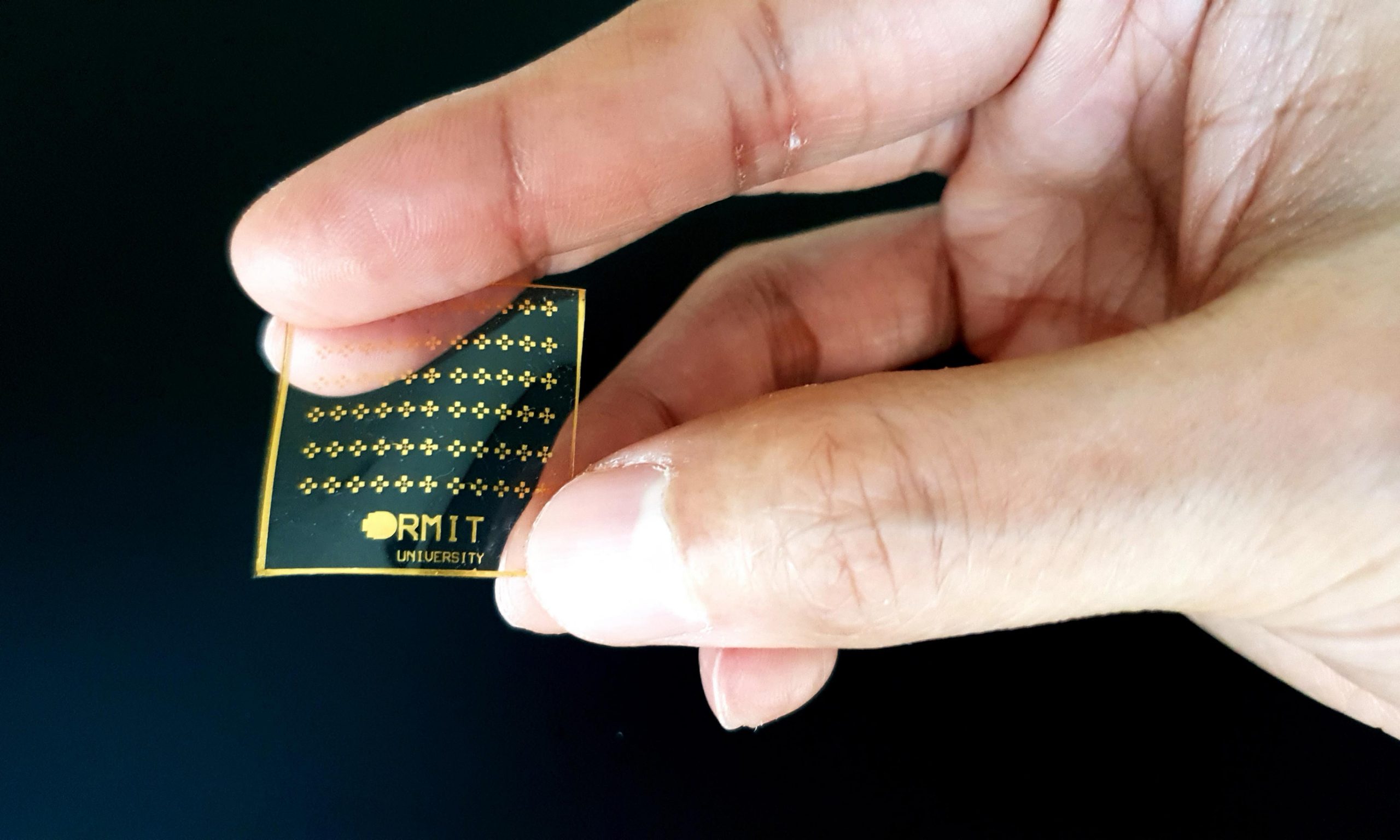
Functional sensing prototypes
As well as the pain-sensing prototype, the research team has also developed devices using stretchable electronics that can sense and respond to changes in temperature and pressure.
Bhaskaran, co-leader of the Functional Materials and Microsystems group at RMIT, said the three functional prototypes were designed to deliver key features of the skin’s sensing capability in electronic form.
With further development, the stretchable artificial skin could also be a future option for non-invasive skin grafts, where the traditional approach is not viable or not working.
“We need further development to integrate this technology into biomedical applications but the fundamentals — biocompatibility, skin-like stretchability — are already there,” Bhaskaran said.

How to make electronic skin
The new research, published in Advanced Intelligent Systems and filed as a provisional patent, combines three technologies previously pioneered and patented by the team:
- Stretchable electronics: combining oxide materials with biocompatible silicon to deliver transparent, unbreakable, and wearable electronics as thin as a sticker.
- Temperature-reactive coatings: self-modifying coatings 1,000 times thinner than a human hair based on a material that transforms in response to heat.
- Brain-mimicking memory: electronic memory cells that imitate the way the brain uses long-term memory to recall and retain previous information.
The pressure sensor prototype combines stretchable electronics and long-term memory cells, the heat sensor brings together temperature-reactive coatings and memory, while the pain sensor integrates all three technologies.
PhD researcher Md Ataur Rahman said the memory cells in each prototype were responsible for triggering a response when the pressure, heat, or pain reached a set threshold.
“We’ve essentially created the first electronic somatosensors — replicating the key features of the body’s complex system of neurons, neural pathways, and receptors that drive our perception of sensory stimuli,” he said.
“While some existing technologies have used electrical signals to mimic different levels of pain, these new devices can react to real mechanical pressure, temperature, and pain, and deliver the right electronic response.
“It means our artificial skin knows the difference between gently touching a pin with your finger or accidentally stabbing yourself with it — a critical distinction that has never been achieved before electronically.”
The research was supported by the Australian Research Council and undertaken at RMIT’s state-of-the-art Micro Nano Research Facility for micro/nano-fabrication and device prototyping.
Reference: “Artificial Somatosensors: Feedback receptors for electronic skins” by Md. Ataur Rahman, Sumeet Walia, Sumaiya Naznee, Mohammad Taha, Shruti Nirantar, Fahmida Rahman, Madhu Bhaskaran and Sharath Sriram 1 September 2020, Advanced Intelligent Systems.
DOI: 10.1002/aisy.202000094
Never miss a breakthrough: Join the SciTechDaily newsletter.
Follow us on Google and Google News.