
Close Menu
    Facebook X (Twitter) Instagram
    SciTechDaily
    • Biology
    • Chemistry
    • Earth
    • Health
    • Physics
    • Science
    • Space
    • Technology
    Facebook X (Twitter) Pinterest YouTube RSS
    SciTechDaily
    Home»Science»Paleontologists Believe 2.5 Billion T. rex Roamed the Earth Over the Cretaceous Period
    Science

    Paleontologists Believe 2.5 Billion T. rex Roamed the Earth Over the Cretaceous Period

    By American Association for the Advancement of ScienceApril 19, 20211 Comment3 Mins Read
    Facebook Twitter Pinterest Telegram LinkedIn WhatsApp Email Reddit
    Share
    Facebook Twitter LinkedIn Pinterest Telegram Email Reddit

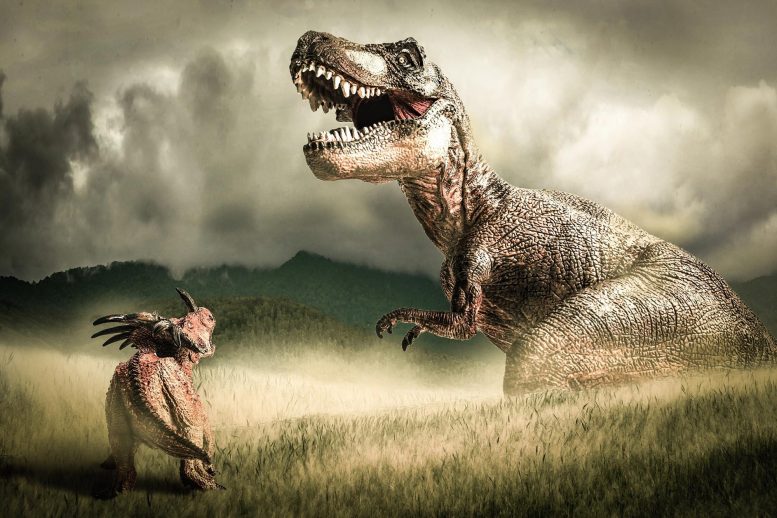
    Styracosaurus With Tyrannosaurus Rex

    Scientists estimate 2.5 billion T. rex lived over time, using a model based on body mass and population density.

    Over their entire late-Cretaceous reign, the total number of Tyrannosaurus rex that ever lived on Earth was roughly 2.5 billion individuals, according to a new study, which leveraged the relationship between body mass and population density observed in living animals to estimate the population traits of the iconic, long-extinct species.

    According to the authors, the framework they developed could be applied to any extinct creature given the appropriate data. It opens the door for a host of new investigations into other palaeoecological and taphonomic questions. Much can be learned from the fossil record about extinct species like the dinosaurs. However, due to the record’s fragmented nature, understanding ecological variables such as population density and abundance remains challenging.
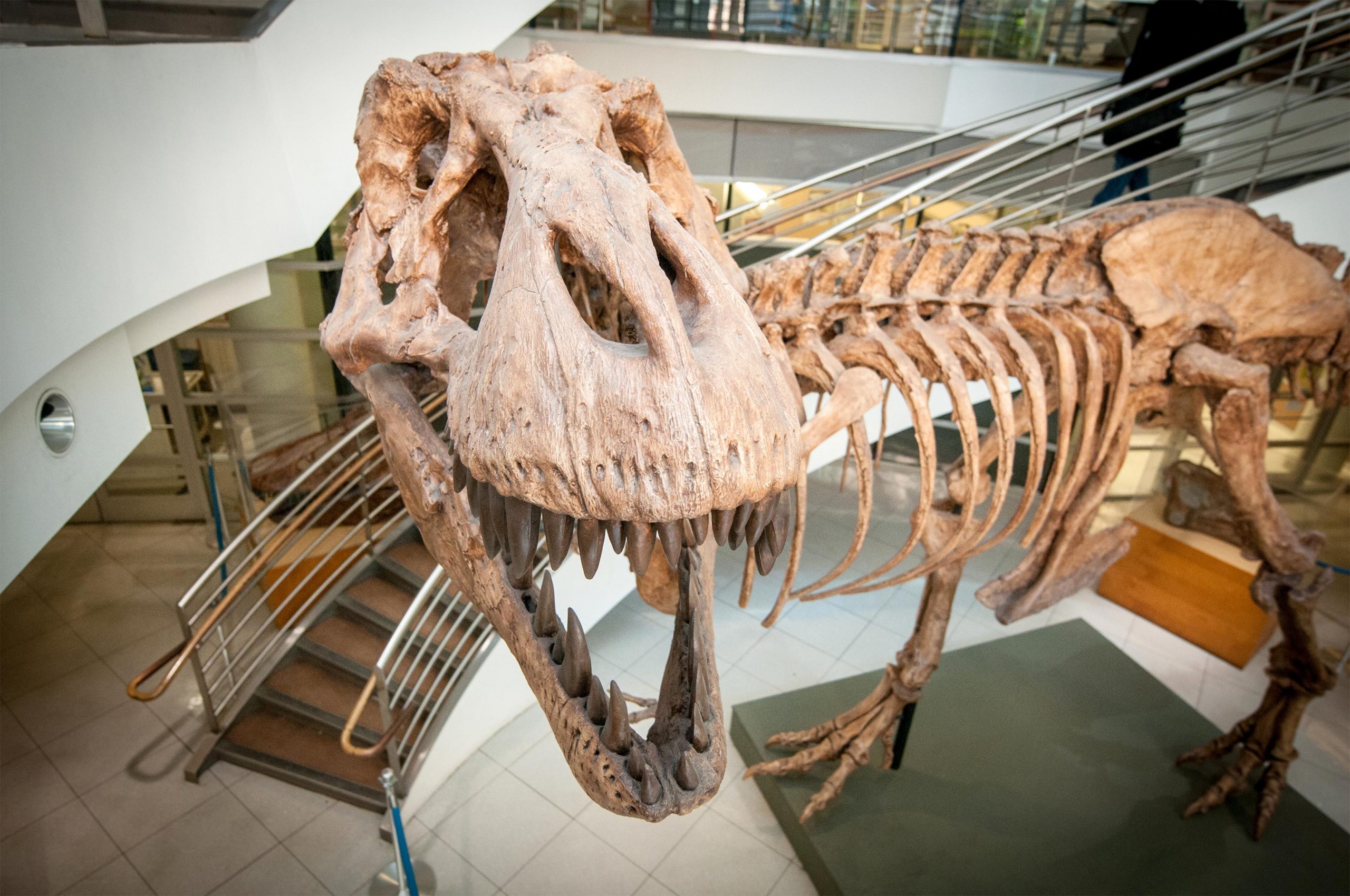
    T. rex Cast at UC Berkeley
    A cast of a T. rex skeleton on display outside the UC Museum of Paleontology at the University of California, Berkeley. The original, a nearly complete skeleton excavated in 1990 from the badlands of eastern Montana, is at the Museum of the Rockies in Bozeman, Montana. Credit: Keegan Houser, UC Berkeley

    Darmuth’s Law: Linking Body Size and Density

    In living species, one way to understand more about these variables is by using the established relationship between population density and body mass, or Darmuth’s Law, which states that the average population density of a species decreases with body size at a predictable rate. Using Darmuth’s Law and the large body of paleontological data for T. rex — one of the largest carnivorous theropods known — Charles Marshall and colleagues estimated population-level traits and the rate of fossil preservation for the species.

    Their findings suggest that nearly 20,000 T. rex lived concurrently at any given time during their tenure on Earth and persisted for ~127,000 generations, totaling 2.5 billion over their entire existence. What’s more, the authors estimate that the population density of the species equated to 3,800 T. rex in an area the size of California — or just two in an area the size of Washington D.C.

    The results also allowed Marshall et al. to determine that only about 1 in 80 million T. rex survived the eons as fossilized remains. Although the uncertainties of the estimations span over two orders of magnitude, the authors largely attribute the potential error to variance in the density-body mass relationship underlying Damuth’s Law rather than to variance in the palaeobiological data for T. rex.

    For more on this study, read Paleontologists Stunning Conclusion: 2.5 Billion T. Rexes Roamed North America Over the Cretaceous Period.

    Reference: “Absolute abundance and preservation rate of Tyrannosaurus rex” by Charles R. Marshall, Daniel V. Latorre, Connor J. Wilson, Tanner M. Frank, Katherine M. Magoulick, Joshua B. Zimmt and Ashley W. Poust, 16 April 2021, Science.
    DOI: 10.1126/science.abc8300

    Never miss a breakthrough: Join the SciTechDaily newsletter.
    Follow us on Google and Google News.

    American Association for the Advancement of Science Dinosaurs Paleontology Tyrannosaurus Rex
    Share. Facebook Twitter Pinterest LinkedIn Email Reddit

    Related Articles

    Paleontologist’s New Theory for Why T. rex Had Such Ridiculously Short Arms

    Who Was King Before T. rex? Dinosaur Fossil Reveals New Apex Predator

    When T. rex Dominated, Medium-Sized Predators Disappeared – Replaced by Juvenile Tyrannosaurs

    Young Tyrannosauru Rex Had a Powerful Bite – Exerting Much More Force Than Previous Estimates

    Paleontologists Stunning Conclusion: 2.5 Billion T. Rexes Roamed North America Over the Cretaceous Period

    Younger Tyrannosaurus Rex Were Incapable of Delivering the Ferocious Bone-Crunching Bites of Adults

    Evidence T. Rex’s Long Legs Evolved for Distance, Not Speed Like Previously Thought

    Growing Up Tyrannosaurus Rex: Researchers Learn More About Teen-Age T.Rex

    Feathered Yutyrannus Huali Specimen Found in China, Closely Related to Tyrannosaurus Rex

    1 Comment

    1. Clyde Spencer on April 19, 2021 7:38 am

      Why are so many articles being repeated? This ‘news’ item was last presented 4 days ago!

      Reply
    Leave A Reply Cancel Reply

    • Facebook
    • Twitter
    • Pinterest
    • YouTube

    Don't Miss a Discovery

    Subscribe for the Latest in Science & Tech!

    Trending News

    “I Couldn’t Do It Anymore” – Antarctic Guides Quit Their Dream Jobs After Witnessing Tourism’s Damage

    Scientists Say Eating Less Protein May Help You Live Longer

    Scientists Solve a Long-Standing Mystery About Bird and Dinosaur Eggs

    Belly Fat and Low Vitamin D May More Than Double the Risk of Early Death

    Lost in Space: Rare Cosmic Flare Exposes a Wandering Black Hole Far From Its Galaxy’s Center

    Dark Matter May Be Leaving a Signal in Earth’s Atmosphere

    Scientists Discover a 300-Million-Year-Old Geological Time Capsule Inside Fossilized Wood

    Oral Weight Loss Pill Helps Patients Lose up to 12% of Body Weight

    Follow SciTechDaily
    • Facebook
    • Twitter
    • YouTube
    • Pinterest
    • Newsletter
    • RSS
    SciTech News
    • Biology News
    • Chemistry News
    • Earth News
    • Health News
    • Physics News
    • Science News
    • Space News
    • Technology News
    Recent Posts
    • Industrial Chicken Farming Is Supercharging the Spread of a Dangerous Foodborne Bacterium
    • Honeybee Queens May Pass Toxic Chemicals to the Next Generation
    • This Common Amino Acid May Help the Body Fight Cancer and Viruses
    • Schizophrenia’s Brain Damage May Start in One Key Region
    • A Simple Treatment Could Save Extremely Premature Babies From Blindness
    Copyright © 1998 - 2026 SciTechDaily. All Rights Reserved.
    • Science News
    • About
    • Contact
    • Editorial Board
    • Privacy Policy
    • Terms of Use

    Type above and press Enter to search. Press Esc to cancel.