
Close Menu
    Facebook X (Twitter) Instagram
    SciTechDaily
    • Biology
    • Chemistry
    • Earth
    • Health
    • Physics
    • Science
    • Space
    • Technology
    Facebook X (Twitter) Pinterest YouTube RSS
    SciTechDaily
    Home»Science»Feathered Yutyrannus Huali Specimen Found in China, Closely Related to Tyrannosaurus Rex
    Science

    Feathered Yutyrannus Huali Specimen Found in China, Closely Related to Tyrannosaurus Rex

    By SciTechDailyApril 5, 2012No Comments2 Mins Read
    Facebook Twitter Pinterest Telegram LinkedIn WhatsApp Email Reddit
    Share
    Facebook Twitter LinkedIn Pinterest Telegram Email Reddit
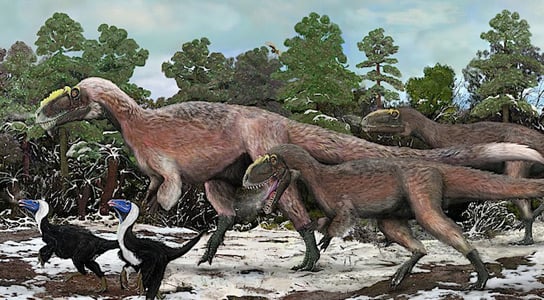
    yutyrannus-huali-artist-representation
    Artist’s illustration of Yutyrannus huali, ancestor of Tyrannosaurus rex.

    A newly discovered ancestor of Tyrannosaurus rex was discovered recently in China. Yutyrannus huali was covered in feathers, was 30 feet (9 meters) long, and weighed 3,000 pounds (1,400 kilograms). Y. huali isn’t as large as T. rex, which appeared 6 million years later, but it’s the largest feathered tyrannosaur that’s ever been discovered.

    Paleontologists think that this provides direct evidence of the presence of extensively feathered gigantic dinosaurs. The findings were published in the journal Nature.
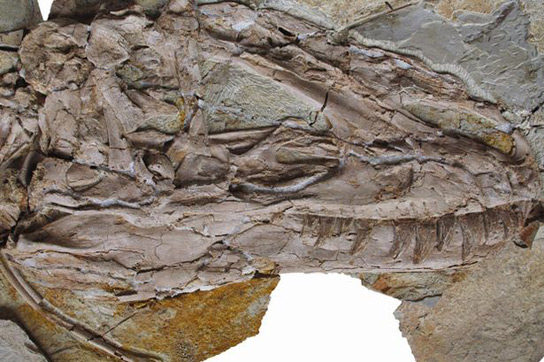
    yutyrannus-huali-skull
    Yutyrannus huali’s skull preserved in China.

    The scientific name, a mix between Latin and Mandarin, translates into beautiful feathered tyrant. Y. huali was discovered in the Yixian Formation, a large fossil deposit in northeastern China, that has yielded dozens of dinosaur skeletons over the last 20 years.

    Earlier feathered members of the tyrannosaur family were somewhat small. If the feathers were needed for insulation, larger tyrannosaurs might not have needed them, thanks to a small surface-to-volume body ratios. Microraptor used feathers as sexual displays to attract prospective mates.
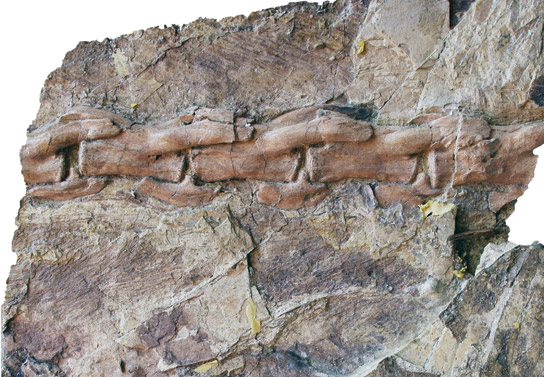
    yutyrannus-huali-tail
    Yutyrannus huali’s tail.

    While this remains possible in the case of Y. huali, there isn’t enough evidence to support this assertion. Y. huali lived during the middle part of the Early Cretaceous, 125 million years ago. During this period, temperatures worldwide were cooler than when T. rex lived, in the Late Cretaceous.

    It’s possible that T. rex went into the Arctic Circle and could have easily benefited from this kind of plumage for insulation. Y. huali could have used these protofeathers as a way to keep its nest eggs warm. Researchers might examine melanosomes, the tiny pigment-containing structures, which are still preserved in the feathers, in order to get a sense of what Y. huali looked like.

    Never miss a breakthrough: Join the SciTechDaily newsletter.
    Follow us on Google and Google News.

    Ancestor China Dinosaurs Early Cretaceous Feathers Paleontology Popular Tyrannosaur Tyrannosaurus Rex
    Share. Facebook Twitter Pinterest LinkedIn Email Reddit

    Related Articles

    Unlocking the Secrets of the Past: New Study Reveals Shocking Similarities Between Dinosaur and Bird Feathers

    Paleontologist’s New Theory for Why T. rex Had Such Ridiculously Short Arms

    Who Was King Before T. rex? Dinosaur Fossil Reveals New Apex Predator

    When T. rex Dominated, Medium-Sized Predators Disappeared – Replaced by Juvenile Tyrannosaurs

    Paleontologists Stunning Conclusion: 2.5 Billion T. Rexes Roamed North America Over the Cretaceous Period

    Younger Tyrannosaurus Rex Were Incapable of Delivering the Ferocious Bone-Crunching Bites of Adults

    Dinosaur Feather Study Debunked: Overwhelming Evidence Supports Jurassic Fossil Belongs to Archaeopteryx

    Evidence T. Rex’s Long Legs Evolved for Distance, Not Speed Like Previously Thought

    Growing Up Tyrannosaurus Rex: Researchers Learn More About Teen-Age T.Rex

    Leave A Reply Cancel Reply

    • Facebook
    • Twitter
    • Pinterest
    • YouTube

    Don't Miss a Discovery

    Subscribe for the Latest in Science & Tech!

    Trending News

    Wasp Colonies Explode Into Violence After Losing Their Queen

    Scientists Create “Living Plastic” That Self-Destructs in Just Six Days

    Your Blood May Carry a 700-Million-Year-Old Secret

    Scientists Discover Some “Zombie Cells” May Actually Help You Live Longer

    Earth May Be Seeding Venus With Life, According to New Research

    What Scientists Found Inside a 117-Year-Old Woman Reveals New Clues to Long Life

    Scientists Discover Mysterious Creature Living in the Great Salt Lake – and It Exists Nowhere Else on Earth

    It’s Alive? Surprising Discovery Changes What We Know About Fog

    Follow SciTechDaily
    • Facebook
    • Twitter
    • YouTube
    • Pinterest
    • Newsletter
    • RSS
    SciTech News
    • Biology News
    • Chemistry News
    • Earth News
    • Health News
    • Physics News
    • Science News
    • Space News
    • Technology News
    Recent Posts
    • MIT Engineers Solve a Major Lidar Problem That Has Stumped Researchers for Years
    • NASA’s X-59 Sonic Boom Killer Is Ready for Its Biggest Test Yet
    • Why Some Cancers Turn Deadly: Researchers Uncover a Hidden Trigger
    • The Best Exercise Combination for Longevity, According to a 30-Year Study
    • Popular Weight-Loss Drug Found To Slow Biological Aging in Landmark Human Trial
    Copyright © 1998 - 2026 SciTechDaily. All Rights Reserved.
    • Science News
    • About
    • Contact
    • Editorial Board
    • Privacy Policy
    • Terms of Use

    Type above and press Enter to search. Press Esc to cancel.