
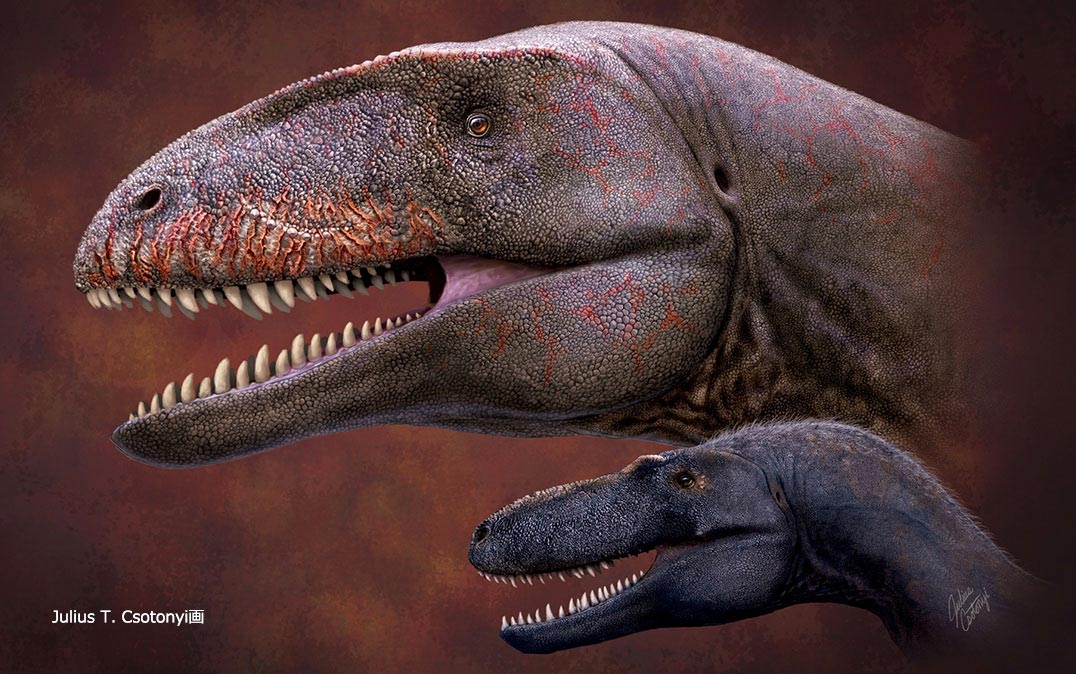
University of Tsukuba researchers have described a new apex predator from the lower Upper Cretaceous of Central Asia, Ulughbegsaurus uzbekistanensis, which coexisted with a smaller tyrannosauroid.
Iconic tyrannosauroids like T. rex famously dominated the top of the food web at the end of the reign of the dinosaurs. But they didn’t always hold that top spot.
In a new study published in Royal Society Open Science, a research team led by the University of Tsukuba has described a new genus and species belonging to the Carcharodontosauria, a group of medium- to large-sized carnivorous dinosaurs that preceded the tyrannosauroids as apex predators.
The new dinosaur, named Ulughbegsaurus uzbekistanensis, was found in the lower Upper Cretaceous Bissekty Formation of the Kyzylkum Desert in Uzbekistan, and therefore lived about 90 million years ago. Two separate evolutionary analyses support classification of the new dinosaur as the first definitive carcharodontosaurian discovered in the Upper Cretaceous of Central Asia.
“We described this new genus and species based on a single isolated fossil, a left maxilla, or upper jawbone,” explains study first author Assistant Professor Kohei Tanaka. “Among theropod dinosaurs, the size of the maxilla can be used to estimate the animal’s size because it correlates with femur length, a well-established indicator of body size. Thus, we were able to estimate that Ulughbegsaurus uzbekistanensis had a mass of over 1,000 kg (2,200 lb), and was approximately 7.5 to 8.0 meters (24.6 to 26.2 feet) in length, greater than the length of a full-grown African elephant.”
Ulughbegsaurus: Top Predator of its Ecosystem
This size greatly exceeds that of any other carnivore known from the Bissekty Formation, including the small-sized tyrannosauroid Timurlengia described from the same formation. Therefore, the newly named dinosaur likely topped the food web in its early Late Cretaceous ecosystem.
The genus’s namesake is fittingly regal; Ulughbegsaurus is named for Ulugh Beg, the 15th century mathematician, astronomer, and sultan of the Timurid Empire of Central Asia. The species is named for the country where the fossil was discovered.
The Carcharodontosaurian-Tyrannosauroid Transition
Before the Late Cretaceous, carcharodontosaurians like Ulughbegsaurus disappeared from the paleocontinent that included Central Asia. This disappearance is thought to have been related to the rise of tyrannosauroids as apex predators, but this transition has remained poorly understood because of the scarcity of relevant fossils.
Senior author Professor Yoshitsugu Kobayashi at the Hokkaido University Museum explains “The discovery of Ulughbegsaurus uzbekistanensis fills an important gap in the fossil record, revealing that carcharodontosaurians were widespread across the continent from Europe to East Asia. As one of the latest surviving carcharodontosaurians in Laurasia, this large predator’s coexistence with a smaller tyrannosauroid reveals important constraints on the transition of the apex predator niche in the Late Cretaceous.”
Reference: “A new carcharodontosaurian theropod dinosaur occupies apex predator niche in the early Late Cretaceous of Uzbekistan” by Kohei Tanaka, Otabek Ulugbek Ogli Anvarov, Darla K. Zelenitsky, Akhmadjon Shayakubovich Ahmedshaev and Yoshitsugu Kobayashi, 8 September 2021, Royal Society Open Science.
DOI: 10.1098/rsos.210923
Never miss a breakthrough: Join the SciTechDaily newsletter.
Follow us on Google and Google News.
2 Comments
Carcharodontosaurus is a tyrannosaur it has fuse frontal only found in mesoeucrocodylia .mesoeucrocodylia is the greatest dinosaur ever and the most advance dinosaur ever the greatest dinosaur predator ever the most advance tyrannosaur. Mite spell this wrong carcharodontosaurus has many surangular fenestra a advance tyrannosaur feature .it is not allosaurus .carcharodontosaurus and t.rex is not alive any more because of the gator .spinosauridae is a alive. mesoeucrocodylia is 200 million years old spinosauridae is oldest tetanuran 3 finger dinosaur they found because of the kink snout a primitive feature a fish eating feature the kink gone away from dinosaur because dinosaur become more of land animal that did not eat fish and have real ziphodont teeth the predator teeth .kink is found in the first thecodont proterosuchus they were semi aquatic .proterosuchus is not a dinosaur.coelophysis allso has a kink a 4 finger dinosaur it is not a tetanuran because of the 4 finger .