
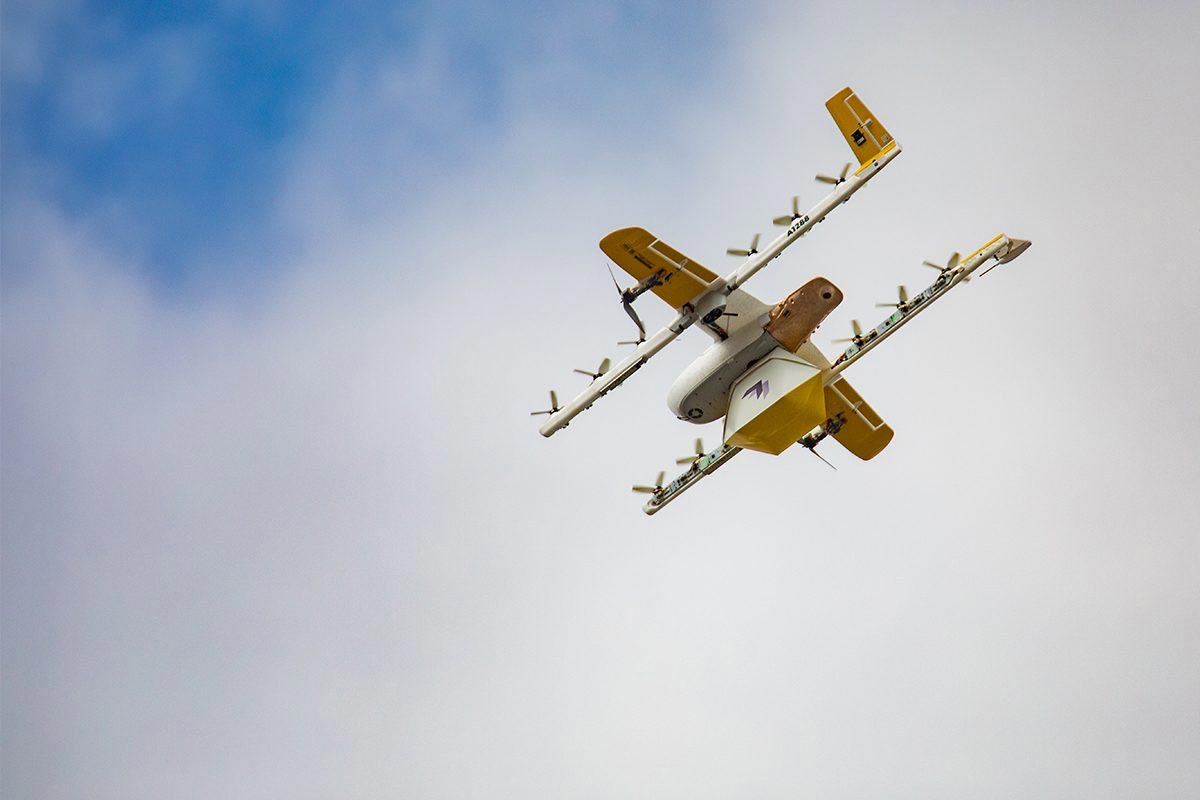
Drone delivery gets high marks from users in Christiansburg, with 87% expressing support.
The week of Thanksgiving last year, a postcard arrived in mailboxes in Christiansburg. A link to a survey was on the back. On the front, there was a picture that was, by then, very familiar to the residents of a town that made history in 2019 as the first place in the U.S. to have a residential drone delivery service: a yellow-winged drone with a small cardboard box tucked underneath it.
The survey’s 20 questions were designed to measure how Christiansburg’s 22,000 residents felt about drone delivery — the first time that this question had ever been posed to a community that had actually experienced the service. The survey was developed and conducted by researchers from the Virginia Tech Mid-Atlantic Aviation Partnership (MAAP), a federally designated drone test site, and Lee Vinsel, an assistant professor of science, technology, and society in the College of Liberal Arts and Human Sciences.
The primary finding: 87 percent of people who responded to the survey reported that they liked the idea of drone delivery. The resoundingly positive results, published in the spring issue of Issues in Science and Technology, plant a new stake in the ground for the future of a technology still at the beginning of its transition from research to retail.
Growing Interest Amid Regulatory and Commercial Shifts
Interest in drone delivery is rising. The service in Christiansburg, run by Wing, Alphabet’s drone-delivery subsidiary, is the most advanced of the handful of trial services operating today. But drone technology — and the laws that regulate it — are maturing, and it’s expected that services like these could become routine in the next few years.
Whether they’re successful or not will depend in large part on how the public responds. Delivering packages to homes unfolds in the public eye to a greater extent than many other applications for drones: People may see the drone in the commercial area where it picks up its cargo, at the customer’s house, and in the neighborhoods in between.
Accurate estimates of public opinion are critical for the regulatory agencies developing rules that will govern its use and state and local governments considering whether to encourage it, in addition to the companies pioneering these services and hoping to scale their businesses.
Until now, though, data has been limited, and usually not encouraging: The handful of surveys on this topic have pegged public support for drone delivery at around 50 percent in the U.S. and lower in Europe and the U.K.
But several factors suggest that those anemic results might not be definitive.
First, crucially, these surveys polled people who had almost certainly never received a delivery by drone, and were speculating about a service they were imagining rather than reporting on one they’d experienced. Second, many of the survey questions frame their questions in a way that implies risk, asking respondents to rate their level of concern about potential problems selected by the researchers in advance. Highlighting potential negative outcomes may prompt a more negative overall sentiment.
Christiansburg, then, represented a unique research opportunity.
“Gauging people’s reactions to new technologies can be really difficult, including because it’s so easy to bias respondents’ views,” Vinsel said. “We wanted to create a survey that was as neutral as possible to examine sentiments about drone delivery. And Christiansburg was a great opportunity for us because it was a unique population that had actually experienced these systems.”
The survey asked respondents about standard demographic factors and their typical response to new technologies. It asked about how familiar they were with drone delivery, how they’d found out about it, and what their general attitude toward it was. Instead of asking about specific risks and benefits, the researchers asked open-ended questions about what the respondents saw as positive and negative aspects of the technology.
The survey was approved by the Virginia Tech Institutional Review Board; Wing helped fund the survey development and distribution through an existing research contract with MAAP, but the analysis was funded entirely by Virginia Tech. Adeline Guthrie, a graduate student in statistics at the College of Science and collaborator with the Statistical Applications and Innovations Group, assisted with data analysis.
The results were resoundingly positive.
Not only did 87 percent of respondents report positive sentiment about drone delivery, 89 percent indicated either that they were likely to use the service or already had, and 49 percent reported liking the idea of drones used for package delivery more than drones used for other purposes.
All of these results are dramatically different from those of other surveys, in which positive sentiment never exceeded 51 percent and delivery was a relatively unpopular application when ranked against others.
Pandemic Highlights Practical Value of Drone Delivery
The survey also asked respondents if their opinions had changed since the pandemic. When COVID-19 hit Virginia in March, the number of people signing up for Wing’s service and ordering drone deliveries spiked. Wing partnered with additional local businesses and worked with a school librarian to deliver books.
The survey results suggested that these contributions had helped. The pandemic popped up frequently in the open-ended question about positive aspects of the technology. Fifty-eight percent of Christiansburg survey respondents said that their opinion of drone delivery had improved — a much bigger boost than was measured in a 2020 survey from the Consumer Technology Association that polled a general population sample.
Here again, Christiansburg residents’ experience with drone delivery may have contributed to the jump — seeing a favorite coffee shop find a new way to reach customers without in-person shopping or a neighbor’s child receiving a delivery of sidewalk chalk and crackers, may resonate more than an abstract appreciation for contact-free delivery.
MAAP worked with Wing to launch the drone delivery program under the federal UAS Integration Pilot Program, a drone-integration initiative that brought together state agencies, local governments, and companies to advance the rollout of drone applications that could have significant benefits for communities (the trial is continuing under the IPP successor program BEYOND). MAAP and Wing conducted months of community outreach before the service launched, talking to thousands of Christiansburg residents about what the service would look like.
“One of the goals of the IPP was to take a community-oriented approach to drone integration,” said Tombo Jones, MAAP’s director. “There’s not a shortcut here. You need careful, methodical research to demonstrate that the system is safe and reliable. Then you can take that information out into the community, and talk to people to learn what they’re looking for and what their concerns are. It’s rewarding to see how positive the results of this survey are, because they show that, when it’s done the right way, developing new applications for drones can have a genuinely positive impact on a community.”
The team is hoping that future research will reveal more detail about how people’s opinions evolve before and after they’re exposed to drone delivery, the aspects of drone delivery that inspire the greatest enthusiasm or strongest skepticism, and what factors help determine how someone will feel about the technology.
“The key thing is that speculation about technologies is different than actual experiences with them,” Vinsel said. “Lots of factors influence how we feel about the technologies in our lives, but something scholars have found repeatedly over the last 60 years is that familiarity breeds acceptance. To be at an early point in the rollout of this technology and be able to study a population that has actually experienced it is pretty exciting.”
Never miss a breakthrough: Join the SciTechDaily newsletter.
Follow us on Google and Google News.
6 Comments
Have we lost our minds? Or have we lost any control over making life increasingly dangerous? Fill the skies with drones delivering whatever? It’s a more dreadful idea than so-called self driving vehicles. And you thought that distracted driving due to people using cell phones is dangerous?
Noise. Disruption of visual space. Respondents are unlikely to be representative, simply because they responded. Surveys are notorious for getting the response surveyors want.
Once these things start going into residential areas there will be lawsuits over the noise and it will be over. If someone is flying a small toy quad in my neighborhood I can hear it. These things are big and under payload – will be very loud.
I’m sure people said the same thing when the wright brothers’ first flew kitty hawk. This is the future and like it or not it’s coming.
Sub-sonic projectiles will minimize deliveries!
“Drone delivery” for rural residents should not count. They do NOT represent the median US resident. Try asking the typical person in NJ how they feel about more traffic around them. OMG, the congestion will explode. First, drones will generally follow roads. People will be constantly distracted by overflying drones. Second, the noise will suck. Third, what little remains of wildlife will disappear due to *normal* behavioral response to an unknown potential threat in the air. Fourth, some people will take down the drones just for grins. Fifth, the visual ruination of our skies is already taking place thanks to space-borne satellite swarms. Now add in 10-1000 times the density of drones compared to satellites and even the daytime sky will never look the same. Imagine a radiant sunset crisscrossed with trails of delivery drones.