
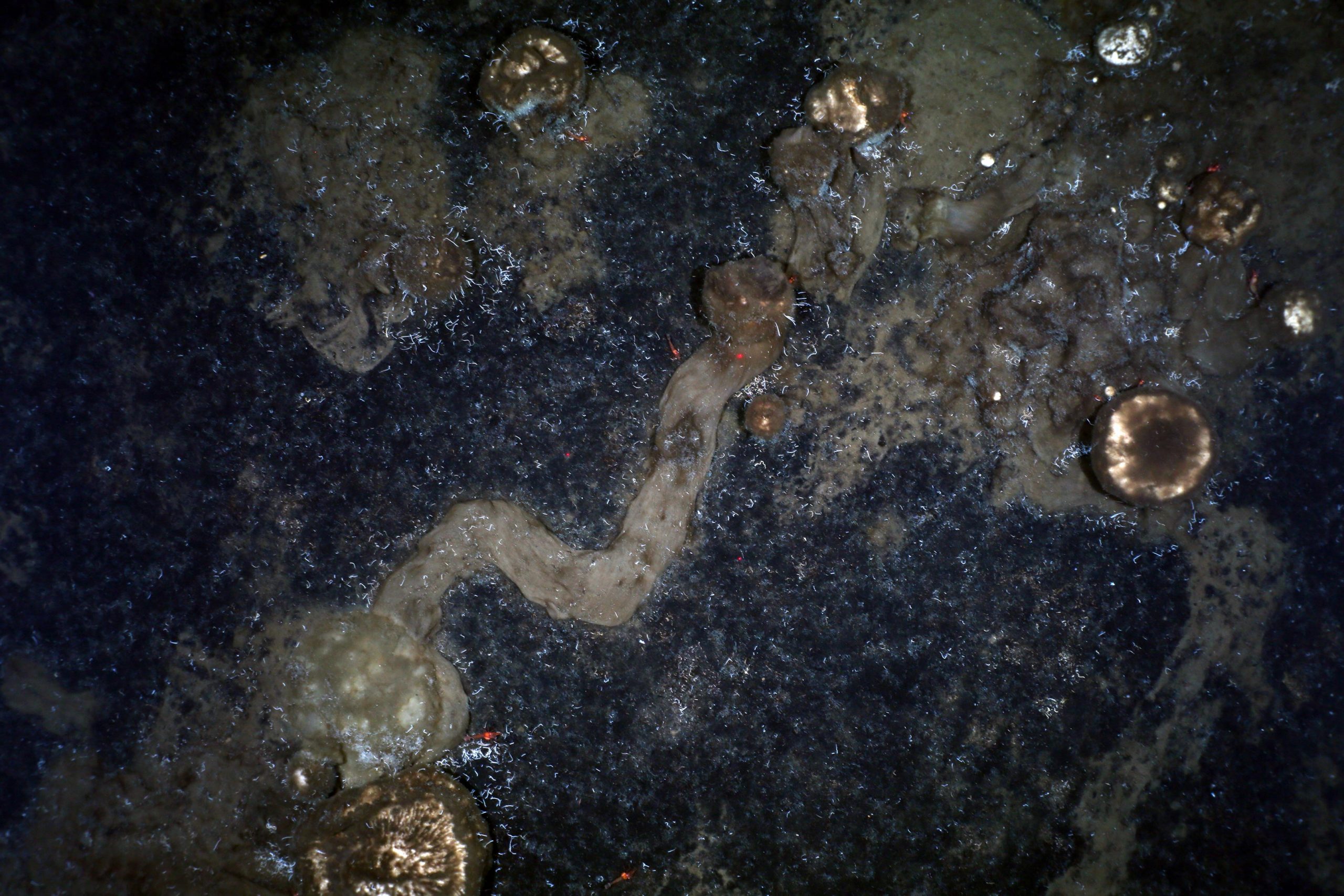
Arctic sponges may crawl slowly, leaving tracks and defying their reputation as stationary animals.
Sponges: They are considered to be one of the most primitive forms of animal life, because they have neither locomotion organs nor a nervous system. A team around deep-sea scientist Antje Boetius has now discovered that sponges leave trails on the sea floor in the Arctic deep sea. They conclude that the animals might move actively — even if only a few centimeters per year. They are now publishing these unique findings in the journal Current Biology.
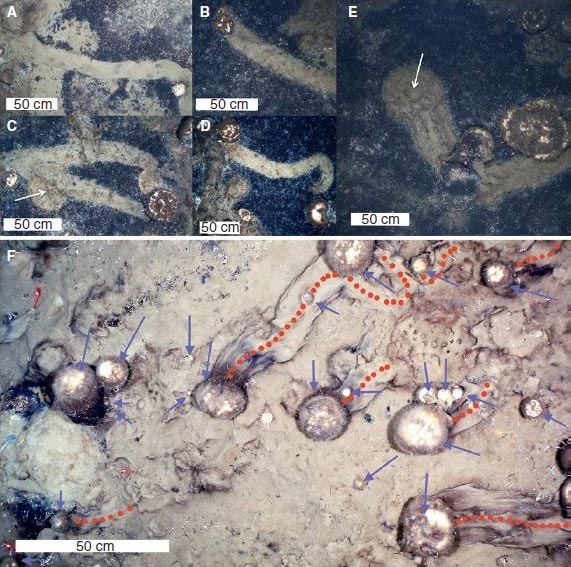
The surprise was great when researchers looked at high-resolution images of the sea floor of the Arctic deep sea in detail: Path-like tracks across the sediments ended where sponges were located. These trails were observed to run in all directions, including uphill. “We conclude from this that the sponges might actively move across the sea floor and leave these traces as a result of their movement,” reports Dr Teresa Morganti, sponge expert from the Max Planck Institute for Marine Microbiology in Bremen. This is particularly exciting because science had previously assumed that most sponges are attached to the seafloor or are passively moved by ocean currents and, usually down slopes.
“There are no strong currents in the Arctic deep sea that could explain the structures found on the sea floor,” explains expedition leader Prof. Antje Boetius, who works together with deep-sea biologist Dr Autun Purser from the Alfred Wegener Institute, Helmholtz Centre for Polar and Marine Research (AWI) in the HGF-MPG Joint Research Group for Deep-Sea Ecology and Technology. The recently published recordings were made during an expedition at 87 °North at the Karasik Seamount about 350 kilometers (220 miles) away from the North Pole with the research icebreaker Polarstern in 2016 with a towed camera system OFOBS (Ocean Floor Observation and Bathymetry System). “With OFOBS we can create 3D models from the deep sea. The seamount’s summit was densely populated with sponges. 69 percent of our images showed trails of sponge spicules, many of which led to live animals,” reports Autun Purser.
Many questions arise from these observations: Why do the sponges move? How do they orient themselves? Possible reasons for locomotion could be foraging, avoiding unfavorable environmental conditions, or to distribute offspring. Searching for food in particular plays a major role in nutrient-poor ecosystems such as the Arctic deep sea. Sponges have an important function there anyway. As filter feeders they can utilize particle and dissolved organic matter and are intensively involved in nutrient and matter recycling by means of their bacterial symbionts. Sponges also provide arctic fish and shrimp useful structures to use as a habitat. However, the scientists still have to investigate the mechanisms of locomotion.
For more on this research, read Mysterious Ocean-Floor Trails Show Arctic Sponges on the Move.
Reference: “In situ observation of sponge trails suggests common sponge locomotion in the deep central Arctic” by Teresa M. Morganti, Autun Purser, Hans Tore Rapp, Christopher R. German, Michael V. Jakuba, Laura Hehemann, Jonas Blendl, Beate M. Slaby and Antje Boetius, 26 April 2021, Current Biology.
DOI: 10.1016/j.cub.2021.03.014
Never miss a breakthrough: Join the SciTechDaily newsletter.
Follow us on Google and Google News.
40 Comments
“Of course you forget, Peter, I was present at an unexplained, undersea, mass sponge migration.”
In the absence of any obvious means of locomotion, have the researchers considered the possibility of the sponges being moved by some animal such as a dolphin, either playing, or trying to flush out fish or shrimp hiding in the sponge?
The location rules out dolphins and the trails Are not consistent with flipping or pushing as sediment would be distributed differently (roll marks/piles at the side) or the sponges would be upside-down. Finally nearly all sponges in the video have this trail. Its highly unlikely a preditor would be so thorough as to move each and every one.
TL/DR: yes people spent more than the 5 seconds you did jumping to dolphins under the freaking ARCTIC ICE CAPS.
Note that I did say, “such as.” I’m not a marine biologist, so I’m not intimately familiar with the range of all animals. But, I do know that seals, walrus, and whales — all air breathers — do forage “under the freaking ARCTIC ICE CAPS.”
The article does not mention the depth, only that it was the top of a seamount, which could be shallow enough for marine mammals to reach.
Your other points about the trails are germane and well taken. They would have been adequate.
Your nome de plume is appropriate — as advice to yourself.
Moved by something else is as plausible as anything offered in the article. “Foraging, avoiding unfavorable environmental conditions, or to distribute offspring”; a movement rate measured in cm per year obviously doesn’t accomplish any of those things…
Wow [think then speak]…they asked their question very nicely. No reason to do the whole tldr thing. Do you remember when teachers would say “no stupid questions”? That’s how people learn. You had 2 paths you could take there. You could’ve actually TAUGHT someone…or you could make them feel dumb for asking… Great choice.
Wow. Too bad the OP already hit you w the comment about your name. Your statement “debunking” flipping was a larger error than the OP’s. “They’d be upside down if they were flipped DUH” Question: what happens when something is flipped upside down, then flipped upside down?
Finally, realize we’re discussing movement that amounts to roughly half a cm every 3 months. 90 days to move .5 cm. Suggesting some outside force was responsible for that movement as opposed to a living organism’s entire existance the last 25 years was focused solely moving 50 cm in one direction seems a lot more thought out than your offering, clearly just to insult.
Which made me think: they are trying to tell us these sponges all move in various directions, yet each sponge only 1 direction their entire existance without deciding to abort the mission and travel a different direction? Strange to say the least.
That is a reasonable question. The story did say it was a deep sea camera yet, didn’t say at what depth this was found. Also, I think being pushed would have been a theory already investigated. Since it’s not in the story it was probably disproven as a probability.
Silly scientists, anyone who has seen Sponge Bob knows they can move, talk and cook. They could have learned all this watching TV instead wasting millions of dollars on jaunts to the Arctic!
Dolphins do not live in the artic nor can they handle water that deep. The pressure would kill them. Looking at the photos, i would say 100 percent guarenteed they are moving themselves.
How deep is the water? Humans dive for sponges in the Mediterranean.
I know for a fact that at least one has legs and his name is spongebob squarepants. There is even video showing him using a pineapple for a shelter.
Sorry couldn’t help myself.
Ladies and gentlemen – truth is more important than one-up-manship. A gentle “no dolphins in the Arctic” should be sufficient. In the meantime let’s talk about how things without extremities move. I saw an entire 4 foot tall bush move two feet over a year. There was a drought but a minor backyard plumbing leak was supplying water about ten feet from the bush. Really happened in my backyard. We could say growing roots could help the bush move in a way growth in sponges might not but I suspect physical growth is the means movement is happening.
What is promoting the movement? I can’t tell from the photos if all the paths are headed to a common area. Warmer currents with more food? Where are they headed and why? I bet old sponge divers have oral traditions re sponge movement.
BTW, Sponge Bob’s creator graduated from Humboldt State in northern CA, my alma mater. He was a biology major with an art minor.
“One of the largest seamounts of the Gakkel Ridge is the Karasik seamount, discovered in 2001 and rising from a depth of 5000 m to 650 m.” Thank you Google.
STAMPEDE!
If sponges ate plastics!
We use sponges to clean and filter…maybe the earth is being cleaned and filtered…?
Thank you all! I have been so amused reading these comments. I know I’ll keep reading about scientific expeditions in hopes of finding more laughs.
Anybody consider the Slug and Snails. Snails feasting on the micro nutrition on the aquarium glass…
That’s was freaking hilarious!
Those aren’t real pictures. At least not where they claim. I saw the paths that they are talking about before it got blurred out in Google Maps. The paths were much more mechanical in appearance, sometimes seeming to stop and make a perfect 90 degree angle turn. Sometimes would travel right into a ridge, I could tell because of the raised earth like you see in cartoons when Bugs Bunny tunnels. Mining the ocean floor perhaps? I know it’s not sponges, or swamp gas.
They need a science degree for that?? Trails behind animal so animal move?? Box jelly can see without a nervous system, move intelligently. Etc.
That was some alien poop
These same trails and exactly the same pattern are located all over the place. Off the coast of western United States. Only they are literally massive across. No one researches sh*t. Just go over the same things again and again. Check our google earth. You’ll Sh*t.
It’s freaking gold you idiots
At least SpongeBob cartoon didnt lie that they are moving
I’m reminded of the wandering stones I believe they’re in AZ. They basically move in a path the wind isn’t sufficient these are big rocks. It turns out to be the affect of frost forming and thawing unequally. I understand it’s underwater and pressure is high etc. Is there a chance sometimes a surface sub freezing current occasionally deposits some ice crystals near their bases. I know salt water lower freezing pt etc but I think it’s a thermodynamic effect I just don’t remember Marine invertebrate biology I wonder if there are frequently currents there that unevenly heat the sponges.
Q: Why do the sponges move?
A: to get to their job at the Krusty Krab, of course
Wow [think then speak]…they asked their question very nicely. No reason to do the whole tldr thing. Do you remember when teachers would say “no stupid questions”? That’s how people learn. You had 2 paths you could take there. You could’ve actually TAUGHT someone…or you could make them feel dumb for asking… Great choice.
Obviously heading to work at the Kristy Krab.
These signs might be of any other thing….these signs cannot explain locomotion
These signs might be of any other thing….these signs cannot explain locomotion,it is ludicrous…if i see a pen and some trails behind it,can i say that it showed locomotion
De ser utsom gull nuggets som ligger over hele havbunnen!?
Who lives in a pinneapple under the sea?
I’m with Abdul on this one. To say that such “trails” imply locomotion is a blatant disregard for the fundamals of science and biology. This is nothing more than a hyped up hypothis and at best a very foolish theory without a supporting hypothesis.
Newly independent, Larval sponges are capable of movement on their own and they don’t have any muscles either. Perhaps the adult sponges retain this ability to turn this ability on and off and move just like the larvae do.
Newly independent, Larval sponges are capable of movement on their own and they don’t have any muscles either. Perhaps the adult sponges retain this ability to move and utilize it when they need to bust a move.;-)
I bet they taste good with a xx and a lime 😏
I’ve noticed a lot of comments dismissing it or trying to debunk these finds but has anyone actually read the findings in Current Biology?
With soooo many other problems and damages being done to our planet, you would think that people with the intelligence and technology, would spend the he time and money on trying to fix our planet! Watching a sponge on bottom of the sea floor and discussing this subject might be entertaining, but, sadly, just another waste of tax payers money, and also shows that some people that have high IQ’s need to have their movements on the sea floor put to better use!