
New research shows that raindrop sizes are surprisingly consistent across planets, driven by physics more than chemistry.
Raindrops on other planets and moons are close to the size of raindrops on Earth despite having different chemical compositions and falling through vastly different atmospheres, a new study finds. The results suggest raindrops falling from clouds are surprisingly similar across a wide range of planetary conditions, which could help scientists better understand the climates and precipitation cycles of other worlds, according to the researchers.
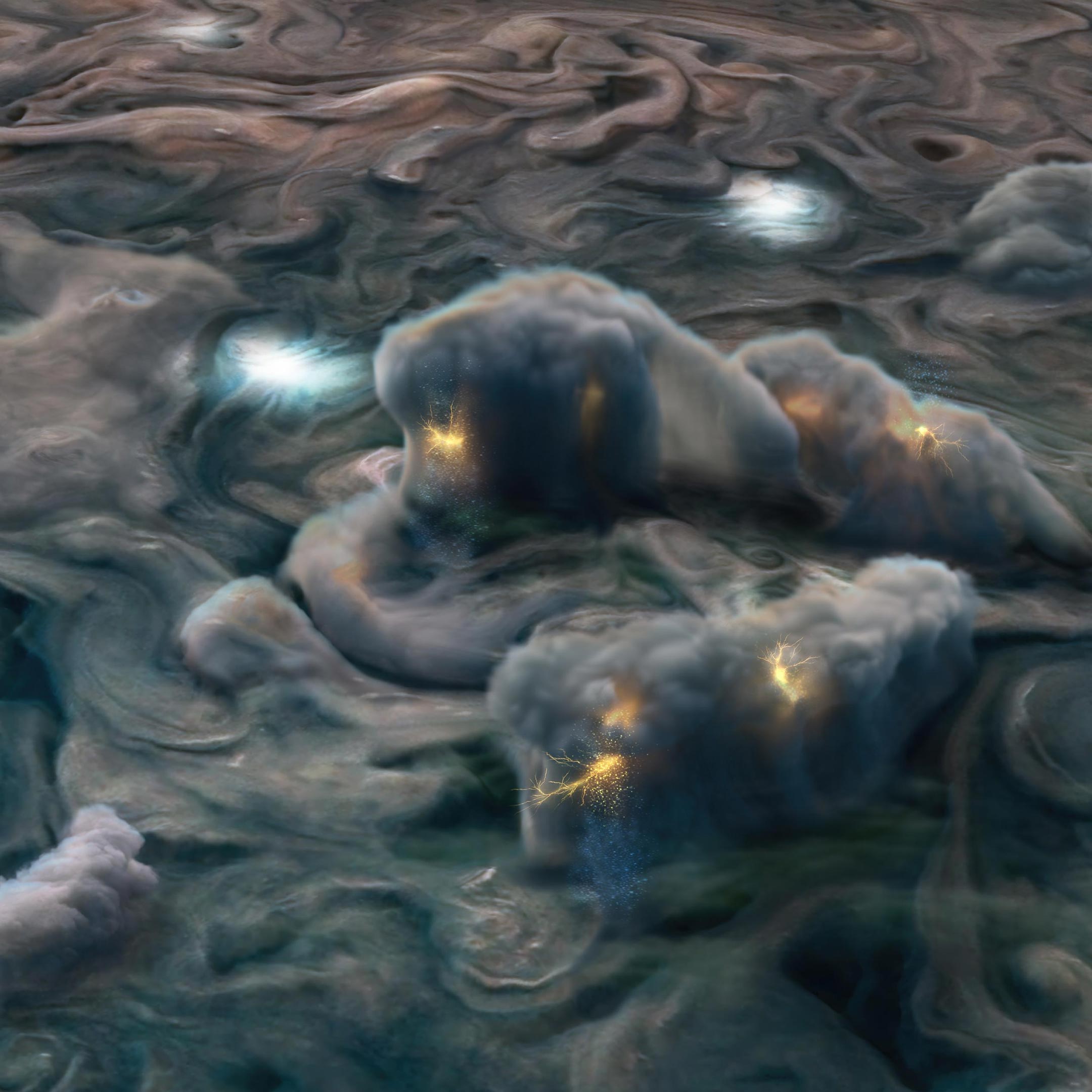
Raindrops on Earth are made of water, but other worlds in our solar system have precipitation made of more unusual stuff. On Venus, it rains sulfuric acid; on Jupiter, it rains helium and mushy ammonia hailstones. On Mars, it snows carbon dioxide, or dry ice. On Saturn’s moon Titan, it rains methane, or liquified natural gas. And on Neptune, scientists suspect it rains pure carbon in the form of diamonds. It could even rain iron or quartz on some planets if the conditions were right.
A new study looking at the physics of how liquid droplets behave while they fall from clouds finds only droplets in clouds within a limited size range – between about a tenth of a millimeter to several millimeters in radius – can reach the surface of rocky planets as rain. This is a fairly narrow size range, given that raindrops increase about a million times in volume during their formation inside a cloud.
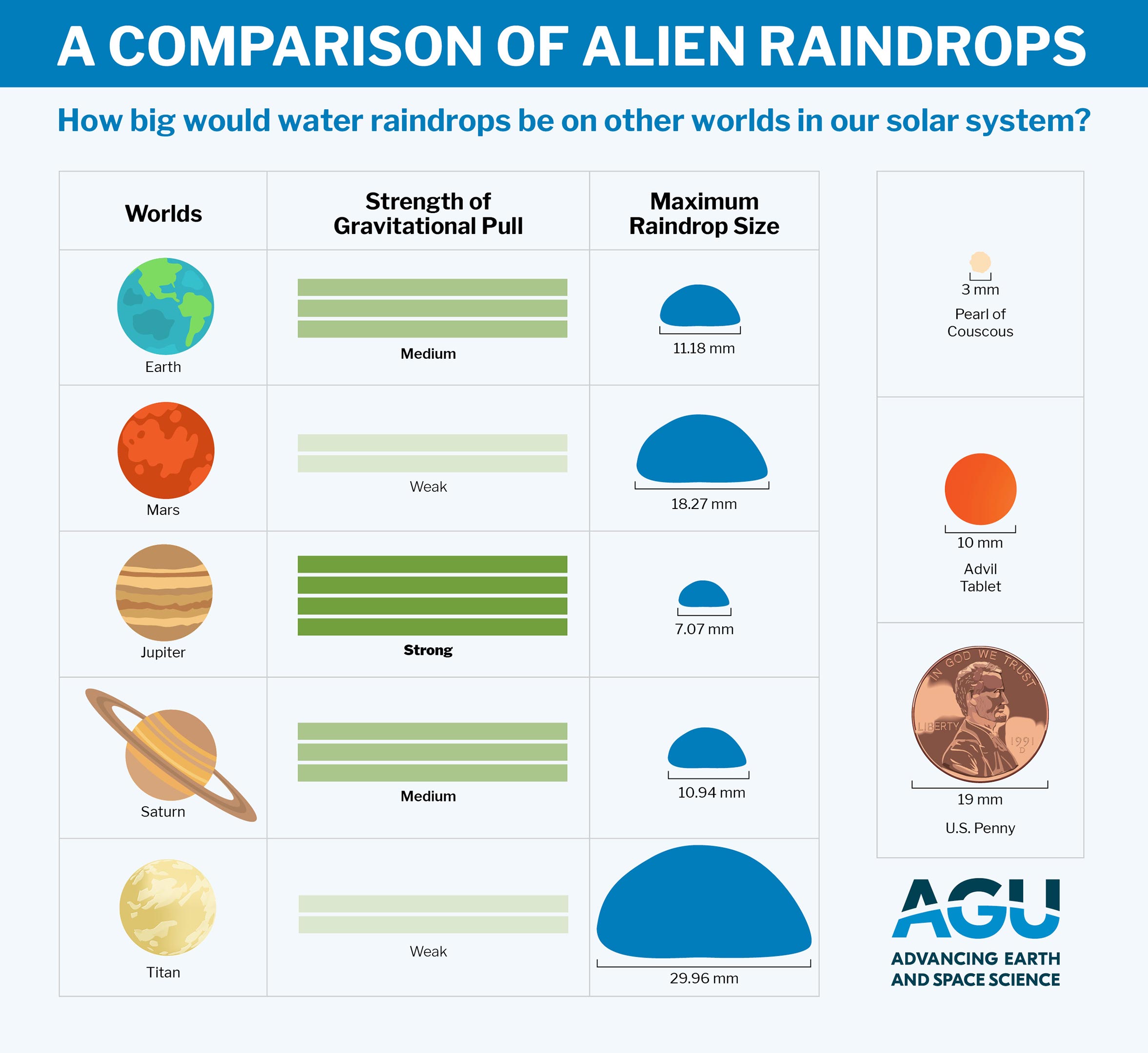
The results also show the maximum size of liquid droplets that fall as rain is similar across varying planetary conditions. Different types of liquid droplets would max out around half to six times the size of water rain on Earth, depending on the strength of the planet’s gravitational pull (the stronger the gravitational pull, the smaller the raindrop). Find an infographic comparing the size of raindrops on Earth, Mars, Jupiter, Saturn, and Titan above.
“There’s a fairly small range of stable sizes that these different composition raindrops can have; they’re all fundamentally limited to be around the same maximum size,” said Kaitlyn Loftus, a planetary scientist at Harvard University and lead author of the new study in AGU’s Journal of Geophysical Research: Planets, which publishes research on the formation and evolution of the planets, moons and objects of our solar system and beyond.
Rain on Other Worlds
In the new study, Loftus and colleague Robin Wordsworth used math and physics principles to model how liquid water droplets fall through planetary atmospheres. They wanted to determine the possible size ranges for droplets falling from a cloud to a planetary surface. Raindrops that are too big break up into smaller ones, while raindrops that are too small evaporate before they hit the ground.
They first determined the possible size ranges for water raindrops on rocky planets like Earth and Mars, given atmospheric conditions like temperature, air pressure, relative humidity, distance from the cloud to the ground, and the strength of the planet’s gravitational pull.
They found raindrops with a radius smaller than about a tenth of a millimeter evaporate before they ever reach the surface, and raindrops larger than several millimeters in radius break up into smaller droplets as they fall.
They then looked at how water raindrops would fall on much bigger planets like Jupiter and Saturn that have vastly different atmospheres. Comparing modern Earth, ancient Mars, and these bigger planets, they found raindrops move water through air similarly, even though what constitutes “air” varies widely among the planets.
Even when different liquids make up raindrops, these alien raindrops are not so different from familiar water raindrops, according to the researchers’ calculations. For example, the largest methane raindrops on Titan would be about twice the size of water rain on Earth. Loftus isn’t certain why the maximum raindrop size is so uniform, but she suspects it may be due to how a droplet’s surface tension relates to its density.
The findings will help scientists better simulate the conditions on other planets, as precipitation is a key component in a planet’s climate and nutrient cycles, Loftus said. Modeling what precipitation might look like on a distant world could also help researchers interpret observations of exoplanetary atmospheres made by space telescopes, said Tristan Guillot, a planetary scientist at the Observatoire de la Côte d’Azur in Nice, France, who was not connected to the new study.
“Now with instruments like [the James Webb Space Telescope], which hopefully will soon be launched, we will have the capability to detect really fine spectra of exoplanetary atmospheres, including ones that are quite cooler than ones we’re usually able to characterize, in which clouds and rain will occur,” Guillot said. “So these kinds of tools as they are developed will be very useful and important to interpret those spectra.”
Reference: “The Physics of Falling Raindrops in Diverse Planetary Atmospheres” by Kaitlyn Loftus and Robin D. Wordsworth, 15 March 2021, Journal of Geophysical Research – Planets.
DOI: 10.1029/2020JE006653
Never miss a breakthrough: Join the SciTechDaily newsletter.
Follow us on Google and Google News.