
Close Menu
    Facebook X (Twitter) Instagram
    SciTechDaily
    • Biology
    • Chemistry
    • Earth
    • Health
    • Physics
    • Science
    • Space
    • Technology
    Facebook X (Twitter) Pinterest YouTube RSS
    SciTechDaily
    Home»Space»Carbon-Rich Exoplanets May Be Made of Diamonds – “Unlike Anything in Our Solar System”
    Space

    Carbon-Rich Exoplanets May Be Made of Diamonds – “Unlike Anything in Our Solar System”

    By Arizona State UniversitySeptember 13, 20205 Comments4 Mins Read
    Facebook Twitter Pinterest Telegram LinkedIn WhatsApp Email Reddit
    Share
    Facebook Twitter LinkedIn Pinterest Telegram Email Reddit
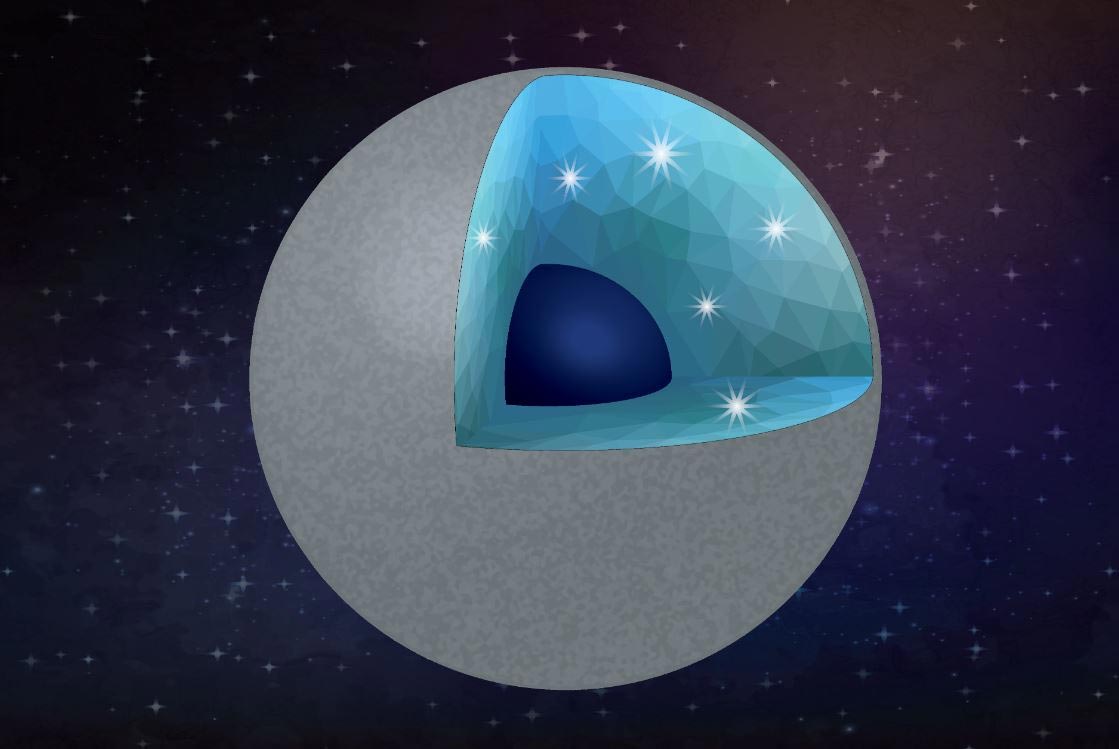
    Diamond Planet Rendition
    Illustration of a carbon-rich planet with diamond and silica as the main minerals. Water can convert a carbide planet into a diamond-rich planet. In the interior, the main minerals would be diamond and silica (a layer with crystals in the illustration). The core (dark blue) might be iron-carbon alloy. Credit: Shim/ASU/Vecteezy

    As missions like NASA’s Hubble Space Telescope, TESS, and Kepler continue to provide insights into the properties of exoplanets (planets around other stars), scientists are increasingly able to piece together what these planets look like, what they are made of and if they could be habitable or even inhabited.

    In a new study published recently in The Planetary Science Journal, a team of researchers from Arizona State University and the University of Chicago have determined that some carbon-rich exoplanets, given the right circumstances, could be made of diamonds and silica.

    “These exoplanets are unlike anything in our solar system,” said lead author Harrison Allen-Sutter of ASU’s School of Earth and Space Exploration.
    Carbon Rich Planet Slice
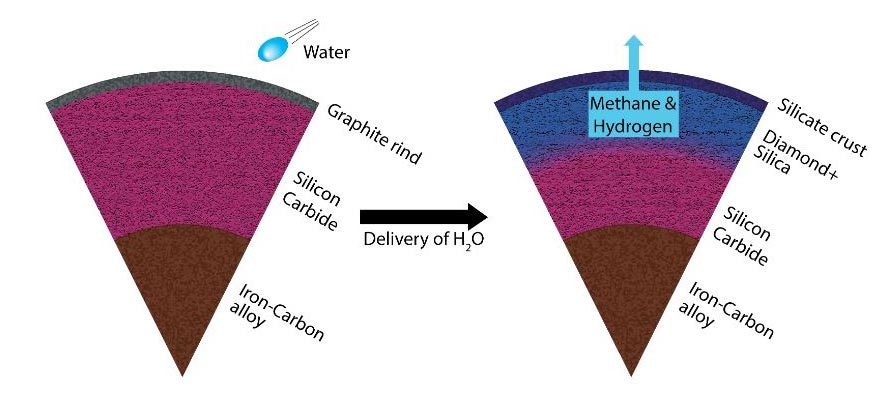
    An unaltered carbon planet (left) transforms from a silicon carbide dominated mantle to a silica and diamond dominated mantle (right). The reaction also produces methane and hydrogen. Credit: Harrison/ASU

    Diamond exoplanet formation

    When stars and planets are formed, they do so from the same cloud of gas, so their bulk compositions are similar. A star with a lower carbon-to-oxygen ratio will have planets like Earth, comprised of silicates and oxides with a very small diamond content (Earth’s diamond content is about 0.001%).

    But exoplanets around stars with a higher carbon-to-oxygen ratio than our sun are more likely to be carbon-rich. Allen-Sutter and co-authors Emily Garhart, Kurt Leinenweber, and Dan Shim of ASU, with Vitali Prakapenka and Eran Greenberg of the University of Chicago, hypothesized that these carbon-rich exoplanets could convert to diamond and silicate, if water (which is abundant in the universe) were present, creating a diamond-rich composition.
    Diamond Anvils Aligned
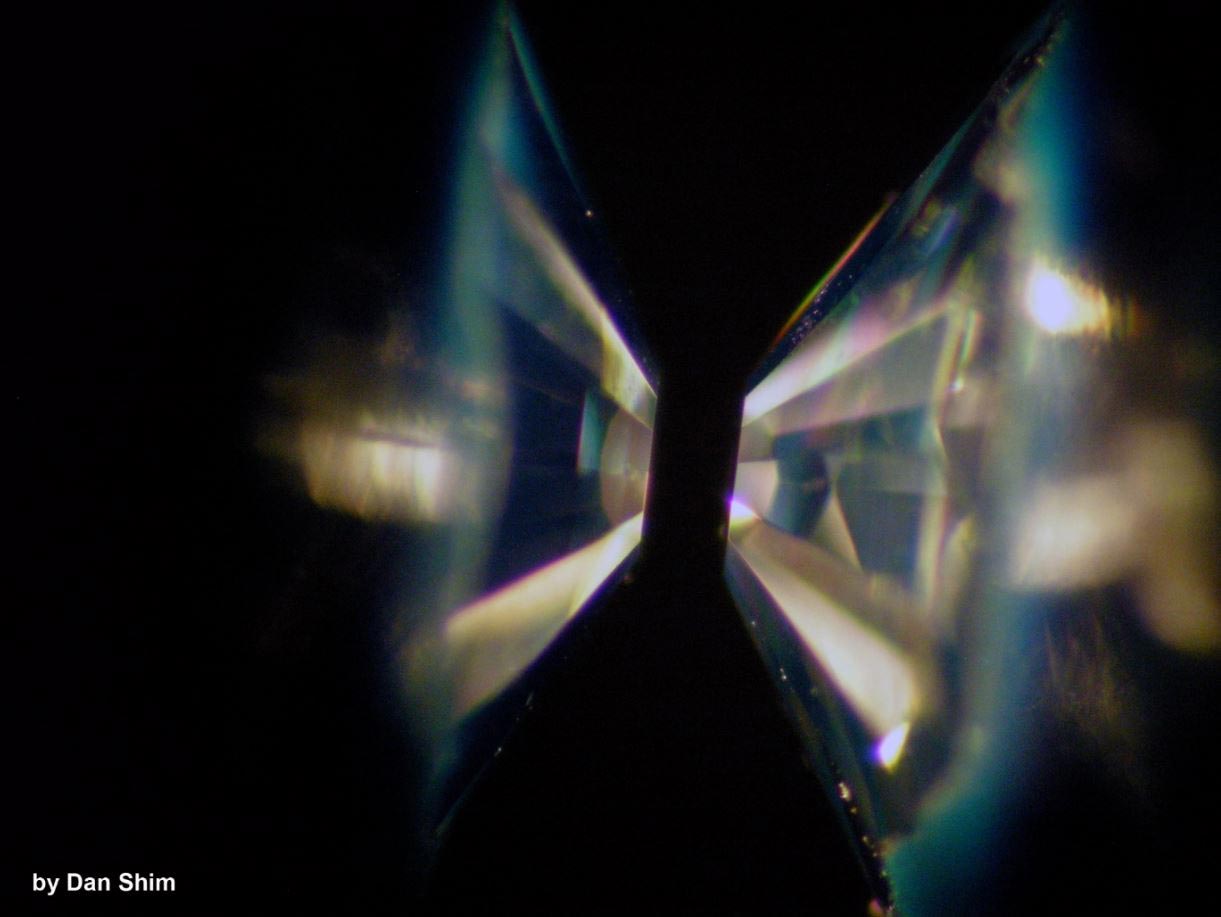
    In a diamond-anvil cell, two gem quality single crystal diamonds are shaped into anvils (flat top in the photo) and then faced towards each other. Samples are loaded between the culets (flat surfaces), then the sample is compressed between the anvils. Credit: Shim/ASU

    Diamond-anvils and X-rays

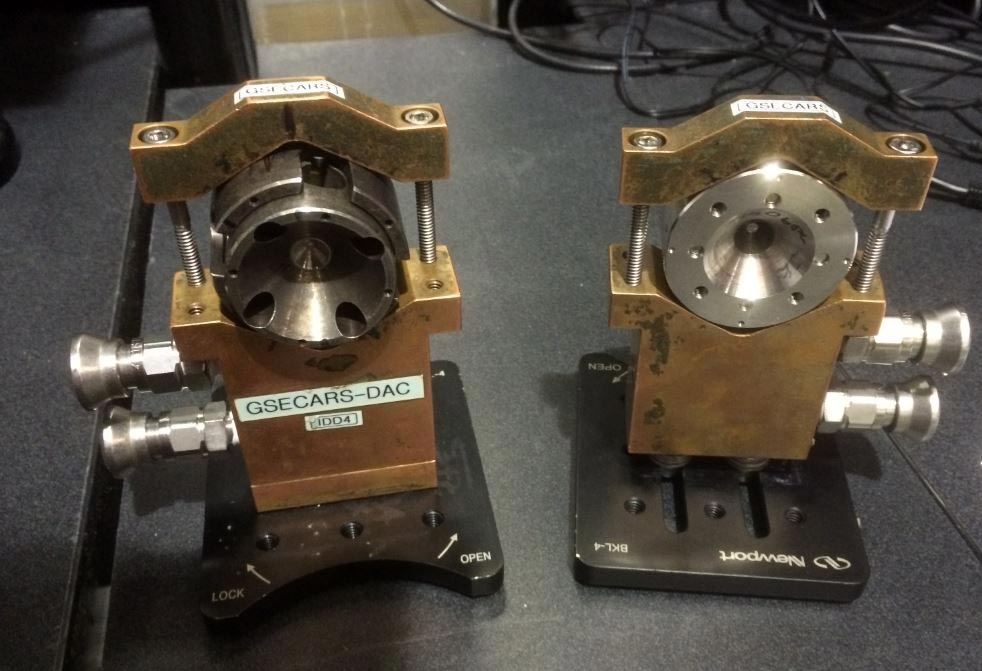
    To test this hypothesis, the research team needed to mimic the interior of carbide exoplanets using high heat and high pressure. To do so, they used high-pressure diamond-anvil cells at co-author Shim’s Lab for Earth and Planetary Materials.

    First, they immersed silicon carbide in water and compressed the sample between diamonds to a very high pressure. Then, to monitor the reaction between silicon carbide and water, they conducted laser heating at the Argonne National Laboratory in Illinois, taking X-ray measurements while the laser-heated the sample at high pressures.

    As they predicted, with high heat and pressure, the silicon carbide reacted with water and turned into diamonds and silica.
    Diamond Anvil Cells
    The cylinder-shaped objects in this photo are diamond anvil cells. The diamond-anvil cells are mounted in copper holders and then inserted into the synchrotron X-ray/laser beam path. The photo shows diamond-anvil cells and mounts before they are aligned for X-ray/laser experiments. Credit: Shim/ASU

    Habitability and inhabitability

    So far, we have not found life on other planets, but the search continues. Planetary scientists and astrobiologists are using sophisticated instruments in space and on Earth to find planets with the right properties and the right location around their stars where life could exist.

    For carbon-rich planets that are the focus of this study, however, they likely do not have the properties needed for life.

    While Earth is geologically active (an indicator of habitability), the results of this study show that carbon-rich planets are too hard to be geologically active and this lack of geologic activity may make atmospheric composition uninhabitable. Atmospheres are critical for life as it provides us with air to breathe, protection from the harsh environment of space, and even pressure to allow for liquid water.

    “Regardless of habitability, this is one additional step in helping us understand and characterize our ever-increasing and improving observations of exoplanets,” said Allen-Sutter. “The more we learn, the better we’ll be able to interpret new data from upcoming future missions like the James Webb Space Telescope and the Nancy Grace Roman Space Telescope to understand the worlds beyond our own solar system.”

    Reference: “Oxidation of the Interiors of Carbide Exoplanets” by H. Allen-Sutter, E. Garhart, K. Leinenweber, V. Prakapenka, E. Greenberg and S.-H. Shim, 26 August 2020, The Planetary Science Journal.
    DOI: 10.3847/PSJ/abaa3e

    Never miss a breakthrough: Join the SciTechDaily newsletter.
    Follow us on Google and Google News.

    Arizona State University Astrophysics Exoplanet Geophysics Planets Popular
    Share. Facebook Twitter Pinterest LinkedIn Email Reddit

    Related Articles

    When Dinosaurs Roamed, New Worlds Were Born – Now Scientists Are Studying Them

    “Field Guide” to Mysterious Exoplanets Known As Hot Jupiters

    Planetary Scientists Discover There May Be Many Planets With Water-Rich Atmospheres

    On the Quest for Other Earths in the Search for Extraterrestrial Life

    Earth Has a Hot New Neighbor – And It Could Change How We Look for Life in the Universe

    Volcanoes Might Light Up the Night Sky of This Super-Earth Exoplanet

    Astronomers Detect Possible Radio Emission From Exoplanet for the First Time

    WASP-12 b, A Planet Being Consumed By Its Own Sun

    Revealing Data from Super-Earth 55 Cancri e

    5 Comments

    1. cootersdad on September 13, 2020 4:16 pm

      why don’t you folks write about something you can prove instead of speculating on stuff we’l never know for sure.

      Reply
    2. Russ in NC on September 13, 2020 5:28 pm

      Look out the DeBeers crowd will be there to protect their monopoly. Diamonds for rings are a scam. The prices are manipulated by the diamond industry and way over priced.

      Reply
    3. Martin on September 13, 2020 5:39 pm

      Very interesting article. Cootersdad, it has been proven that trump is an idiot. Do you want to hear about that?
      Russ in NC, these planets are so far away that DeBeers doesn’t have to worry.
      But I agree, the fascination with diamonds is ridiculous.

      Reply
    4. VoteBiden on September 13, 2020 6:27 pm

      All these worlds are yours, except Trumpia. Attempt no landings there.

      Reply
    5. JoeHunter on September 13, 2020 7:37 pm

      This proves Trump outsmarted the idiots. That’s why he’s president and not a Dim…

      Reply
    Leave A Reply Cancel Reply

    • Facebook
    • Twitter
    • Pinterest
    • YouTube

    Don't Miss a Discovery

    Subscribe for the Latest in Science & Tech!

    Trending News

    The Universe Is Expanding Too Fast and Scientists Can’t Explain Why

    “Like Liquid Metal”: Scientists Create Strange Shape-Shifting Material

    Early Warning Signals of Esophageal Cancer May Be Hiding in Plain Sight

    Common Blood Pressure Drug Shows Surprising Power Against Deadly Antibiotic-Resistant Superbug

    Scientists Uncover Dangerous Connection Between Serotonin and Heart Valve Disease

    Scientists Discover a “Protector” Protein That Could Help Reverse Hair Loss

    Bone-Strengthening Discovery Could Reverse Osteoporosis

    Scientists Uncover Hidden Trigger Behind Stem Cell Aging

    Follow SciTechDaily
    • Facebook
    • Twitter
    • YouTube
    • Pinterest
    • Newsletter
    • RSS
    SciTech News
    • Biology News
    • Chemistry News
    • Earth News
    • Health News
    • Physics News
    • Science News
    • Space News
    • Technology News
    Recent Posts
    • The Simple Habit That Could Help Prevent Cancer
    • Forgotten Medicinal Plant Shows Promise in Fighting Dangerous Superbugs
    • Millions Take These IBS Drugs, But a New Study Finds Serious Risks
    • 5 Common Myths About Learning a New Language, Debunked
    • The Neanderthal “Love Story” Isn’t What It Seems
    Copyright © 1998 - 2026 SciTechDaily. All Rights Reserved.
    • Science News
    • About
    • Contact
    • Editorial Board
    • Privacy Policy
    • Terms of Use

    Type above and press Enter to search. Press Esc to cancel.