
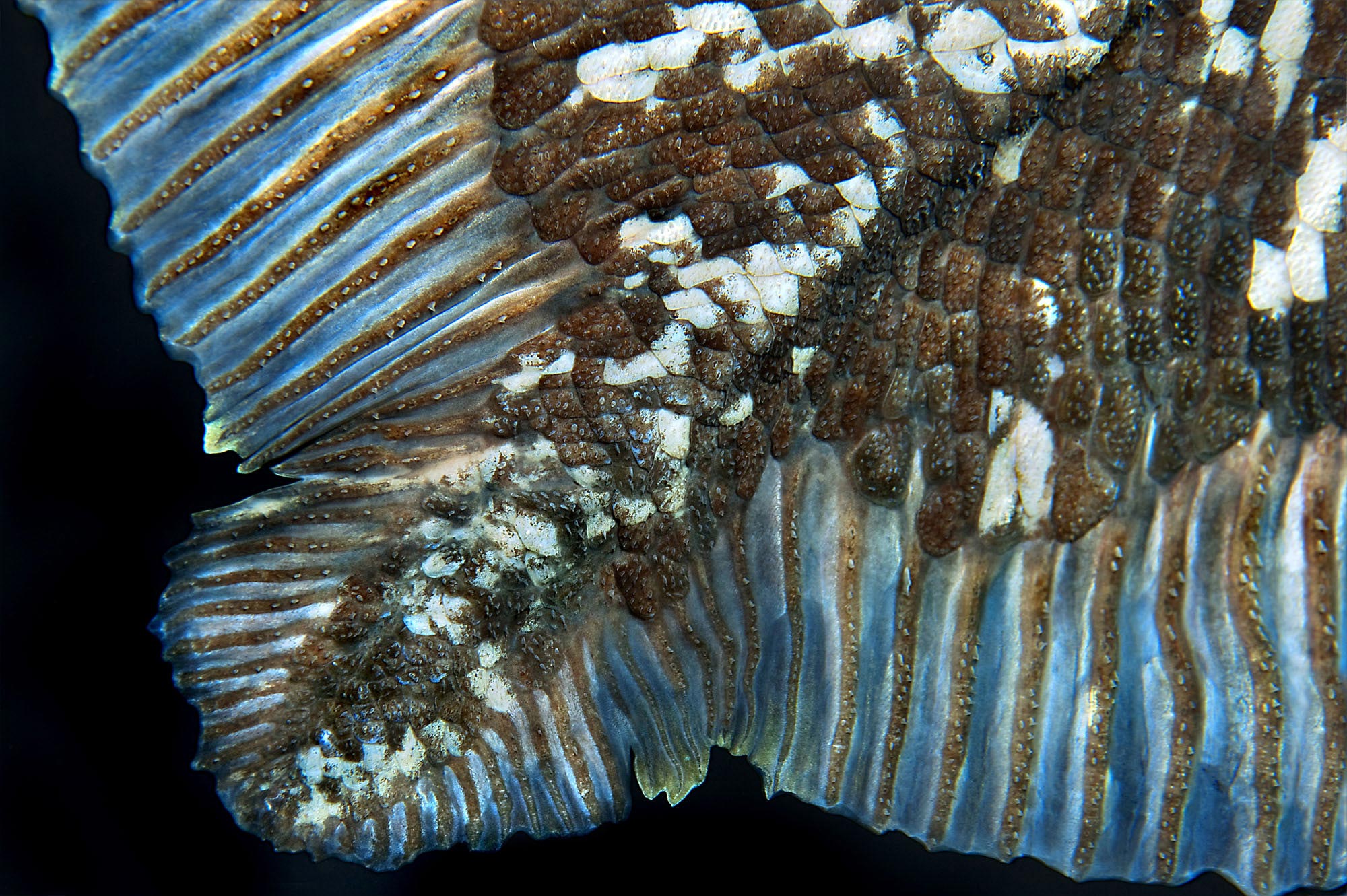
Coelacanths May Live Five Times Longer Than Researchers Expected
Once thought to be extinct, lobe-finned coelacanths are enormous fish that live deep in the ocean. Now, researchers reporting in the journal Current Biology on June 17 have evidence that, in addition to their impressive size, coelacanths also can live for an impressively long time — perhaps nearly a century.
The researchers found that their oldest specimen was 84 years old. They also report that coelacanths live life extremely slowly in other ways, reaching maturity around the age of 55 and gestating their offspring for five years.
“Our most important finding is that the coelacanth’s age was underestimated by a factor of five,” says Kélig Mahé of IFREMER Channel and North Sea Fisheries Research Unit in Boulogne-sur-mer, France. “Our new age estimation allowed us to re-appraise the coelacanth’s body growth, which happens to be one of the slowest among marine fish of similar size, as well as other life-history traits, showing that the coelacanth’s life history is actually one of the slowest of all fish.”
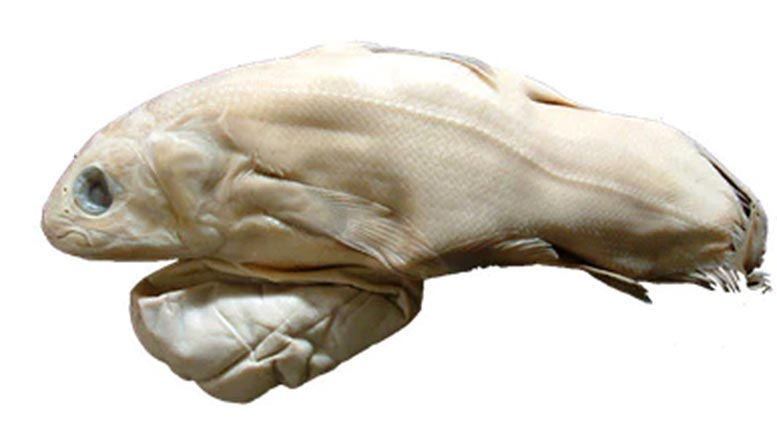
Earlier studies attempted to age coelacanths by directly observing growth rings on the scales of a small sample of 12 specimens. Those studies led to the notion that the fish didn’t live more than 20 years. If that were the case, it would make coelacanths among the fastest-growing fish given their large size. That seemed surprising considering that the coelacanth’s other known biological and ecological features, including slow metabolism and low fecundity, were more typical of fish with slow life histories and slow growth like most other deep-water species.
In the new study, Mahé, along with co-authors Bruno Ernande and Marc Herbin, took advantage of the fact that the French National Museum of Natural History (Muséum National d’Histoire Naturelle de Paris, MNHN) has one of the largest collections of coelacanths in the world, ranging from embryos in utero to individuals of almost two meters. They were able to examine 27 specimens in all. They also used new methods, including polarized light microscopy and scale interpretation technology mastered at IFREMER’s Sclerochronology Centre, Boulogne-sur-mer, France, to estimate individuals’ age and body growth more precisely than before.
Modern Microscopy Unlocks Aging Secrets
While earlier studies relied on more readily visible calcified structures called macro-circuli to age the coelacanths much as counting growth rings can age a tree, the new approaches allowed the researchers to pick up on much tinier and nearly imperceptible circuli on the scales. Their findings suggest that the coelacanths actually are about five times older than was previously thought.
“We demonstrated that these circuli were actually annual growth marks, whereas the previously observed macro-circuli were not,” Mahé says. “It meant that the maximum longevity of coelacanth was five times longer than previously thought, hence around a century.”
Their study of two embryos showed they were both about five years old. Using a growth model to back-calculate gestation length based on the size of offspring at birth, the researchers got the same answer. They now think that coelacanth offspring grow and develop for five years inside their mothers prior to birth.
One of the Slowest Marine Life Histories
“Coelacanth appears to have one of, if not the slowest life histories among marine fish, and close to those of deep-sea sharks and roughies,” Mahé says.
The researchers say that their findings have implications for the coelacanth’s conservation and future. They note that the African coelacanth is assessed as critically endangered in the Red List of Threatened Species of IUCN.
“Long-lived species characterized by slow life history and relatively low fecundity are known to be extremely vulnerable to perturbations of a natural or anthropic nature due to their very low replacement rate,” Mahé says. “Our results thus suggest that it may be even more threatened than expected due to its peculiar life history. Consequently, these new pieces of information on coelacanths’ biology and life history are essential to the conservation and management of this species.”
In future studies, they plan to perform microchemistry analyses on coelacanth scales to find out whether a coelacanth’s growth is related to temperature. The answer will provide some insight into the effects of global warming on this vulnerable species.
Reference: “New scale analyses reveal centenarian coelacanths Latimeria chalumnae” by Kélig Mahé, Bruno Ernande and Marc Herbin, 17 June 2021, Current Biology.
DOI: 10.1016/j.cub.2021.05.054
Never miss a breakthrough: Join the SciTechDaily newsletter.
Follow us on Google and Google News.
18 Comments
That’s great. So the next time I am asked about the size of the Coelacanths, I can say “enormous”.
The fact that we are it’s biggest danger, isn’t surprising. As my other commenter said… “enormous” compared to what??
That is what I was thinking. The creep goes on and on about how big the are , what an enormous size, etc., etc.
On the bandwagon. First thought exactly. And as I search for the info I’m sure to find the ad this elaborate article is secretly intended for.
Thank you James!
Wikipedia: they can grow to more than 2 m (6.6 ft) and weigh around 90 kg (200 lb).
Must be the size of a Blue Whale! Blue Whales are “Enormous”!
I think they can reach up to 6 ft. in length and up to a couple hundred lbs. based on something I read in a different publication surrounding this species, if memory serves me with any degree of accuracy
Another Bigfoot story pictures please!
All of the other commenters apparently have extremely low reading comprehension abilities. There is hardly anything in the article about the size of coelacanths. Back to reading class,students.
On National Geographic they say, in deep sea they can reach 6.5 feet / 2 meter
This species is characterized by a large body size that can reach up to 2 m in length and weigh up to 105 kg,5 with large length at maturity (around 150 cm6,7). These animals are ovoviviparous, produce a relatively small number of offspring, and have a large size at birth (around 35 cm).
Why don’t people read the article before posting? It says here they grow to upwards of 2 meters. Cmon now
Your article must be different from mine. No mention of size other than “enormous” here,
Huge size mentioned and yet no image for reference of scale…
I think we still have things to learn.primarily when to leave a species ALONE! we SHOULD be concentrating on cleaning up the oceans first (you know, the ones we’ve been polluting for the past 400 years). you short sighted people ALWAYS do this. Hey look at this rare thing!let’s mess with it til something goes wrong! we really need to get a handle on cleaning up our act and being more cautious and less about our studies. those who ignore history are doomed to repeat it! jeeeezzus!
In the article it says up to 2 meters
But are they any good to eat?