

Close Menu
    Facebook X (Twitter) Instagram
    SciTechDaily
    • Biology
    • Chemistry
    • Earth
    • Health
    • Physics
    • Science
    • Space
    • Technology
    Facebook X (Twitter) Pinterest YouTube RSS
    SciTechDaily
    Home»Technology»Sandia’s Robot Hand Can Replace Battery in Flashlight
    Technology

    Sandia’s Robot Hand Can Replace Battery in Flashlight

    By SciTechDailySeptember 10, 20121 Comment2 Mins Read
    Facebook Twitter Pinterest Telegram LinkedIn WhatsApp Email Reddit
    Share
    Facebook Twitter LinkedIn Pinterest Telegram Email Reddit
    sandia-hand-darpa-apple
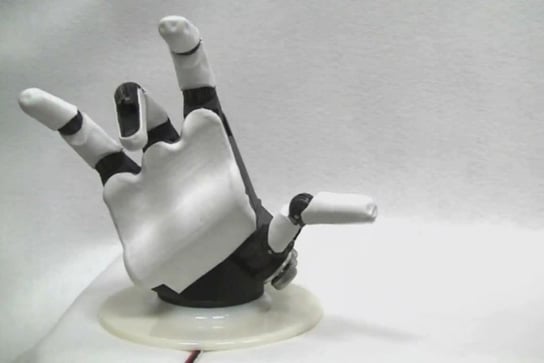
    Sandia scientists have developed a robotic hand that has enough engineered dexterity to replace a battery in a small flashlight.

    While the dream of fully autonomous cybernetic prosthetics might still be some time away, Sandia scientists have developed a robotic hand that has enough engineered dexterity to replace a battery in a small flashlight. It’s one of the intricacies of the human body and Sandia has approached the problem with a modular viewpoint.

    Sandia National Laboratories‘ modular, plastic hand, whose electronics system is largely made from parts found in common smartphones, is able to perform at a high level of finesse for something robotic. It’s expected to cost about $10,000, a fraction of the $250,000 price tag a modern, state-of-the-art robot hand costs today.
    robotic-hand-sandia

    The researchers saved on the cost by scouring the world for the least expensive, highest-performing parts. The other way they saved money was by building the entire system from commodity parts, found in cell phones and designing the structures in plastic, after having been ensured that they would provide adequate strength.

    Sandia Hand’s fingers are modular and affixed to the frame magnetically, allowing the researchers to design interchangeable appendages tipped with screwdrivers, flashlights, and other tools. The fingers also detach automatically when the hand hits a solid object too fast. The hand will even be able to retrieve a fallen finger.

    playing-cards-sandia-hand

    The Hand currently has only four fingers, including an opposable thumb. Future iterations of the Hand could have any number of fingers and arrangements, without adding too much cost or complexity. The Hand might someday be programmed to function autonomously, but for now, it has to be remote-controlled using a sensor-laden glove or control panel. The glove is currently tethered via USB, but the team is working on a wireless version. The goal is for the glove to cost about $1,000.

    DARPA is funding the project, and it might well become an addition to robots involved in disarming and disposing of IEDs.


    Sandia National Laboratories has developed a cost-effective robotic hand that can be used in disarming improvised explosive devices, or IEDs. The Sandia Hand addresses challenges that have prevented widespread adoption of other robotic hands, such as cost, durability, dexterity, and modularity.

    Never miss a breakthrough: Join the SciTechDaily newsletter.
    Follow us on Google and Google News.

    Popular Prothestics Robotics Sandia National Laboratory
    Share. Facebook Twitter Pinterest LinkedIn Email Reddit

    Related Articles

    Engineers Create 3D-Printed Smart Gel That Walks Underwater, Moves Objects

    New Inexpensive Robots Find Leaks from Inside Pipes

    MIT Develops a System That Can 3D Print the Basic Structure of an Entire Building

    Engineers Develop Micro-tentacles So Tiny Robots Can Handle Delicate Objects

    Cancer-Fighting DNA Nanorobots Could Target Specific Cells for Repair

    DARPA & Harvard’s Soft, Self-Camouflaging Robot

    Robonaut 2: A Robotic Space Station Crew Member

    Researchers Use Robot Fish to Lead Golden Shiner School

    Harvard Scientists Develop $5 Rubber Robot

    1 Comment

    1. Scott on May 30, 2013 5:35 pm

      Absolutely incredible… but scary!

      Can’t believe the precision of the Sandia hand. The ability to insert tiny AA size batteries into small mini flashlights and cut wires!

      Cybernetic technology really has come along way! All for the price of a mere $10,000!

      Thanks for the great post.
      Scott

      Reply
    Leave A Reply Cancel Reply

    • Facebook
    • Twitter
    • Pinterest
    • YouTube

    Don't Miss a Discovery

    Subscribe for the Latest in Science & Tech!

    Trending News

    What if Time Isn’t Fundamental? Physicists Just Tested the Idea in the Lab

    Scientists Say We’ve Been Wrong About the Aging Brain

    68 Quadrillion Miles: Scientists Map Earth’s Vast Hidden Fungal Network for the First Time

    Hidden Damage From Youth May Explode Into Disease Later in Life

    Climate Models May Be Wrong About How Trees Store Carbon

    Scientists Discover Brain-Protecting Peptide That Could Change Parkinson’s Treatment

    This Copper Drug Clears Alzheimer’s Brain Toxins and Boosts Memory

    Adults Over 65 Lost Massive Amounts of Weight With Ozempic

    Follow SciTechDaily
    • Facebook
    • Twitter
    • YouTube
    • Pinterest
    • Newsletter
    • RSS
    SciTech News
    • Biology News
    • Chemistry News
    • Earth News
    • Health News
    • Physics News
    • Science News
    • Space News
    • Technology News
    Recent Posts
    • After 50 Years, Astronomers Finally Found What the Milky Way’s Black Hole Was Hiding
    • Scientists Discover Immune Cells That Can Fight Both Measles and Nipah
    • The Most Powerful Drug of All Isn’t Found in a Pill Bottle
    • Scientists Capture Immune Cells Eating Live Cancer Cells for the First Time
    • Scientists Just Found Something Weird Inside Moss
    Copyright © 1998 - 2026 SciTechDaily. All Rights Reserved.
    • Science News
    • About
    • Contact
    • Editorial Board
    • Privacy Policy
    • Terms of Use

    Type above and press Enter to search. Press Esc to cancel.