
Close Menu
    Facebook X (Twitter) Instagram
    SciTechDaily
    • Biology
    • Chemistry
    • Earth
    • Health
    • Physics
    • Science
    • Space
    • Technology
    Facebook X (Twitter) Pinterest YouTube RSS
    SciTechDaily
    Home»Technology»Engineers Develop Micro-tentacles So Tiny Robots Can Handle Delicate Objects
    Technology

    Engineers Develop Micro-tentacles So Tiny Robots Can Handle Delicate Objects

    By Iowa State UniversityJune 22, 2015No Comments4 Mins Read
    Facebook Twitter Pinterest Telegram LinkedIn WhatsApp Email Reddit
    Share
    Facebook Twitter LinkedIn Pinterest Telegram Email Reddit
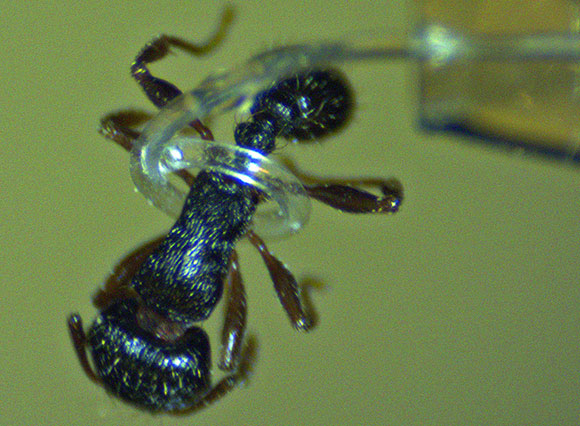
    Micro-tentacle Spirals Around an Ant
    A micro-tentacle developed by Iowa State engineers spirals around an ant. Credit: Jaeyoun (Jay) Kim/Iowa State University, Christopher Gannon

    Engineers at Iowa State University developed spiraling microrobotic tentacles that can gently grip delicate objects.

    The tiny tube circled an ant’s thorax, gently trapping the insect and demonstrating the utility of a microrobotic tentacle developed by Iowa State University engineers.

    “Most robots use two fingers and to pick things up they have to squeeze,” said Jaeyoun (Jay) Kim, an Iowa State University associate professor of electrical and computer engineering and an associate of the U.S. Department of Energy’s Ames Laboratory. “But these tentacles wrap around very gently.”

    And that makes them perfect hands and fingers for small robots designed to safely handle delicate objects.

    The spiraling microrobotic tentacles are described in a research paper recently published in the journal Scientific Reports. Kim is the lead author. Co-authors are In-Ho Cho, an Iowa State assistant professor of civil, construction, and environmental engineering; and Jungwook Paek, who recently earned his Iowa State doctorate in electrical and computer engineering and is moving to post-doctoral work at the University of Pennsylvania in Philadelphia.
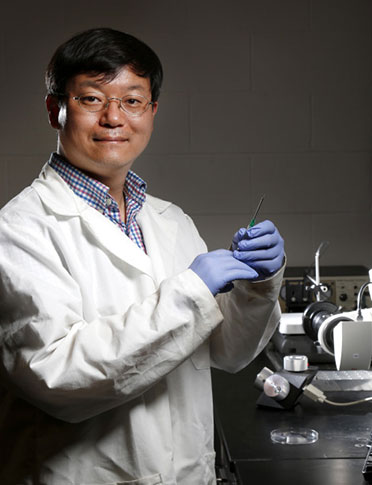
    Jaeyoun (Jay) Kim holds a syringe with a micro-tentacle attached. Behind Kim is the system of nozzles, micro-manipulators and microscopic cameras developed by his research group to shape soft, rubbery PDMS material.
    Jaeyoun (Jay) Kim holds a syringe with a micro-tentacle attached. Behind Kim is the system of nozzles, micro-manipulators and microscopic cameras developed by his research group to shape soft, rubbery PDMS material. Credit: Jaeyoun (Jay) Kim/Iowa State University, Christopher Gannon

    The paper describes how the engineers fabricated microtubes just 8 millimeters long and less than a hundredth of an inch wide. They’re made from PDMS, a transparent elastomer that can be a liquid or a soft, rubbery solid. Kim, whose research focus is micro-electro-mechanical systems, has worked with the material for about a decade and has patented a process for making thin wires from it.

    The paper also describes how the researchers sealed one end of the tube and pumped air in and out. The air pressure and the microtube’s asymmetrical wall thickness created a circular bend. They further describe how they added a small lump of PDMS to the base of the tube to amplify the bend and create a two-turn spiraling, coiling action.

    And that’s just what the engineers wanted:

    “Spiraling tentacles are widely utilized in nature for grabbing and squeezing objects,” the engineers wrote in the paper. “There have been continuous soft-robotic efforts to mimic them…, but the life-like, multi-turn spiraling motion has been reproduced only by centimeter-scale tentacles so far. At millimeter and sub-millimeter scales, they could bend only up to a single turn.”

    It took a lot of problem solving to create the extra turn in the microrobotic tentacles. “Yes, we scratched our heads a lot,” Kim said.

    The engineers had to develop new production techniques to create the microtubes. They had to figure out how to peel the microtubes off a production template. And they had to use computer modeling to find a way to create more coiling.

    Kim said the resulting microrobotic tentacle is “S-cubed – soft, safe and small.” He said that makes it ideal for medical applications because the microrobotic tentacles can’t damage tissues or even blood vessels.

    The current study was supported by Kim’s six-year, $400,000 Faculty Early Career Development Award from the National Science Foundation.

    Kim said the project is a nice combination of two new trends in robotics:

    “There’s microrobotics, where people want to make robots smaller and smaller. And there’s soft robotics, where people don’t want to make robots out of iron and steel. This project is an overlap of both of those fields. I want to pioneer new work in the field with both microscale and soft robotics.”


    Never miss a breakthrough: Join the SciTechDaily newsletter.
    Follow us on Google and Google News.

    Iowa State University Popular Robotics
    Share. Facebook Twitter Pinterest LinkedIn Email Reddit

    Related Articles

    Engineers Create 3D-Printed Smart Gel That Walks Underwater, Moves Objects

    New Inexpensive Robots Find Leaks from Inside Pipes

    MIT Develops a System That Can 3D Print the Basic Structure of an Entire Building

    Cancer-Fighting DNA Nanorobots Could Target Specific Cells for Repair

    Sandia’s Robot Hand Can Replace Battery in Flashlight

    DARPA & Harvard’s Soft, Self-Camouflaging Robot

    Robonaut 2: A Robotic Space Station Crew Member

    Researchers Use Robot Fish to Lead Golden Shiner School

    Harvard Scientists Develop $5 Rubber Robot

    Leave A Reply Cancel Reply

    • Facebook
    • Twitter
    • Pinterest
    • YouTube

    Don't Miss a Discovery

    Subscribe for the Latest in Science & Tech!

    Trending News

    Scientists Discover Game-Changing New Way To Treat High Cholesterol

    This Small Change to Your Exercise Routine Could Be the Secret to Living Longer

    Scientists Discover 430,000-Year-Old Wooden Tools, Rewriting Human History

    AI Could Detect Early Signs of Alzheimer’s in Under a Minute – Far Before Traditional Tests

    What if Dark Matter Has Two Forms? Bold New Hypothesis Could Explain a Cosmic Mystery

    This Metal Melts in Your Hand – and Scientists Just Discovered Something Strange

    Beef vs. Chicken: Surprising Results From New Prediabetes Study

    Alzheimer’s Breakthrough: Scientists Discover Key Protein May Prevent Toxic Protein Clumps in the Brain

    Follow SciTechDaily
    • Facebook
    • Twitter
    • YouTube
    • Pinterest
    • Newsletter
    • RSS
    SciTech News
    • Biology News
    • Chemistry News
    • Earth News
    • Health News
    • Physics News
    • Science News
    • Space News
    • Technology News
    Recent Posts
    • Milk Nanoparticles Could Revolutionize Treatment for Deadly Bile Duct Cancer
    • Largest-Ever Study Finds Medicinal Cannabis Ineffective for Anxiety, Depression, PTSD
    • Scientists Reveal Why a Common Drug Causes Birth Defects and Autism
    • A Medieval Japanese Diary Just Helped Scientists Detect a Dangerous Solar Event
    • Humans Returned to Britain 500 Years Earlier Than Scientists Thought
    Copyright © 1998 - 2026 SciTechDaily. All Rights Reserved.
    • Science News
    • About
    • Contact
    • Editorial Board
    • Privacy Policy
    • Terms of Use

    Type above and press Enter to search. Press Esc to cancel.