
Close Menu
    Facebook X (Twitter) Instagram
    SciTechDaily
    • Biology
    • Chemistry
    • Earth
    • Health
    • Physics
    • Science
    • Space
    • Technology
    Facebook X (Twitter) Pinterest YouTube RSS
    SciTechDaily
    Home»Space»Optical Observations of BepiColombo Spacecraft as a Proxy for a Potential Threatening Asteroid
    Space

    Optical Observations of BepiColombo Spacecraft as a Proxy for a Potential Threatening Asteroid

    By OzGravJuly 31, 2021No Comments3 Mins Read
    Facebook Twitter Pinterest Telegram LinkedIn WhatsApp Email Reddit
    Share
    Facebook Twitter LinkedIn Pinterest Telegram Email Reddit
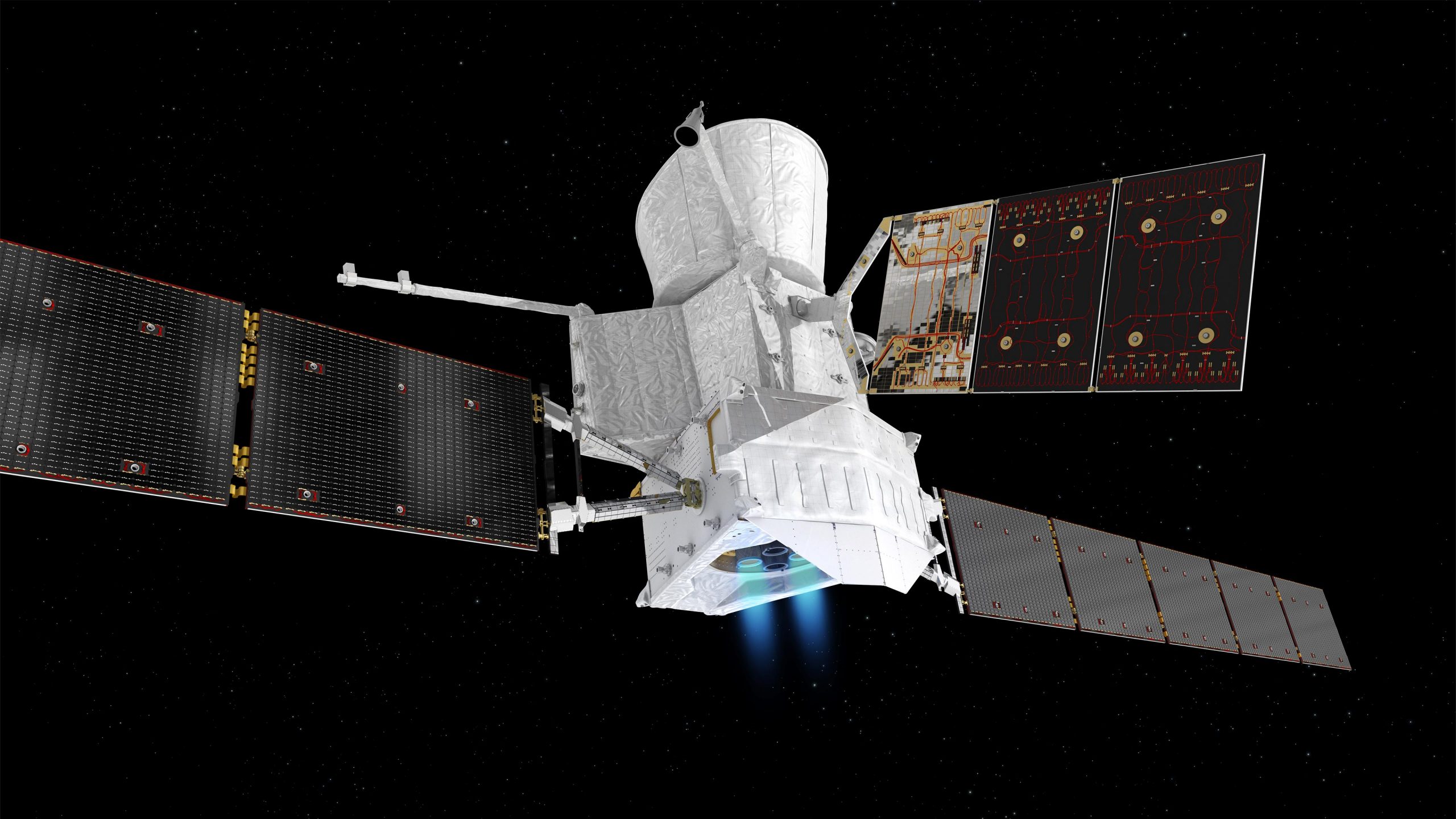
    Bepicolombo Cruise Configuration
    An artist’s impression of the ESA-JAXA BepiColombo spacecraft. Credit: ESA/ATG medialab

    BepiColombo’s Earth fly-by validated tracking methods for future asteroid impact predictions.

    BepiColombo is a joint mission between the European Space Agency (ESA) and the Japan Aerospace Exploration Agency (JAXA) designed to study the planet Mercury. Launched in late 2018, its complex trajectory involved a fly-by past Earth on April 10, 2020. We took advantage of the event to organize a coordinated observing campaign. The main goal was to compute and compare the observed fly-by orbit properties with the values available from the Mission Control. The method we designed could then be improved for future observation campaigns targeting natural objects that may collide with our planet.

    The incoming trajectory of the probe limited the ground-based observability to only a few hours, around the time when it was closest to Earth. The network of telescopes we used has been developed by ESA’s NEO Coordination Centre (NEOCC) with capabilities to quickly observe imminent impactors, thus presenting similar orbits. Our team successfully acquired the target with various instruments such as the 6ROADS Chilean telescope, the 1.0 m (3.3 ft) Zadko telescope in Australia, the ISON network of telescopes, and the 1.2 m (4 ft) Kryoneri telescope in Corinthia, Greece.

    The observations were difficult due to the object’s extremely fast angular motion in the sky. At one point, the telescopes saw the probe covering twice the size of the moon in the sky each minute. This challenged the tracking capabilities and timing accuracy of the telescopes. Each telescope was moving at the predicted instantaneous speed of the target while taking images, “tracking” the spacecraft. Field stars appeared as trails, while BepiColombo itself was a point source, but only if the observation started exactly at the right moment. Because the probe was moving so fast, any date errors of the telescope images translate into position errors of the probe. To reach a precise measurement of 0.1 meters (4 inches), the date of the images needed to have a precision of 100 milliseconds.

    The final results were condensed into two measurable quantities that could be directly compared with the Mission Control ones, the perigee distance, and the time of the probe’s closest approach to Earth. Both numbers were perfectly matched, proving our method a success: it calculated a more accurate prediction of BepiColombo’s orbit; it also provided valuable insights for future observations of objects colliding with Earth:

    • A purely optical observing campaign can provide trajectory information during a fly-by at sub-kilometer and sub-second levels of precision.
    • A similar campaign would lead to a sub-kilometer and sub-second precision for the time and location of the atmospheric entry of any colliding object.
    • Timing accuracy below 100 milliseconds is crucial for the closest observations.
    • It’s possible to organize astrometric campaigns with coverage from nearly every continent.

    Written by OzGrav researcher Dr. Bruce Gendre, University of Western Australia.

    Never miss a breakthrough: Join the SciTechDaily newsletter.
    Follow us on Google and Google News.

    Asteroid BepiColombo OzGrav
    Share. Facebook Twitter Pinterest LinkedIn Email Reddit

    Related Articles

    Billionaires and Futurists Plan Space Missions to Mine Asteroids for Metals

    Dawn Images Shine New Light on Vesta

    New WISE Atlas of Entire Infrared Sky Contains Over 18,000 Images

    Magnetic Anomalies on Moon

    Amino Acids Found in Meteorites that Experienced High Temperatures

    Bus-Sized Asteroid Barely Misses Earth

    Scientists Believe Water Ice May Exist on the Giant Asteroid Vesta

    NASA Probe Takes Close-Up Photos of Giant Vesta Asteroid

    3D Video Offers A Tour Over Asteroid Vesta

    Leave A Reply Cancel Reply

    • Facebook
    • Twitter
    • Pinterest
    • YouTube

    Don't Miss a Discovery

    Subscribe for the Latest in Science & Tech!

    Trending News

    Scientists Finally Uncover How a “Forever Chemical” Causes Birth Defects

    Scientists Uncover the Earliest Brain Changes That May Predict Alzheimer’s Decades Before Symptoms

    Surprising New Study Challenges a Century-Old Theory of Habit Formation

    Scientists Turn Seawater Into Drinking Water Without Toxic Brine

    Vitamin D Drug Shows Surprising Promise Against One of the Deadliest Cancers

    NASA’s X-59 Sonic Boom Killer Is Ready for Its Biggest Test Yet

    The Best Exercise Combination for Longevity, According to a 30-Year Study

    Popular Weight-Loss Drug Found To Slow Biological Aging in Landmark Human Trial

    Follow SciTechDaily
    • Facebook
    • Twitter
    • YouTube
    • Pinterest
    • Newsletter
    • RSS
    SciTech News
    • Biology News
    • Chemistry News
    • Earth News
    • Health News
    • Physics News
    • Science News
    • Space News
    • Technology News
    Recent Posts
    • Tiny Genetic Change Turns Female Mice Into Males, Scientists Discover
    • Scientists Discover Strange New Spider Species That Disguises Itself as a Fungus
    • This Simple Drink Could Help Calm the Inflammation Behind Many Diseases
    • Doctors May Be Overlooking the Real Cause of Persistent Arthritis Pain
    • According to Scientists, This Simple Dietary Change Is Linked to Lower Depression Scores
    Copyright © 1998 - 2026 SciTechDaily. All Rights Reserved.
    • Science News
    • About
    • Contact
    • Editorial Board
    • Privacy Policy
    • Terms of Use

    Type above and press Enter to search. Press Esc to cancel.