
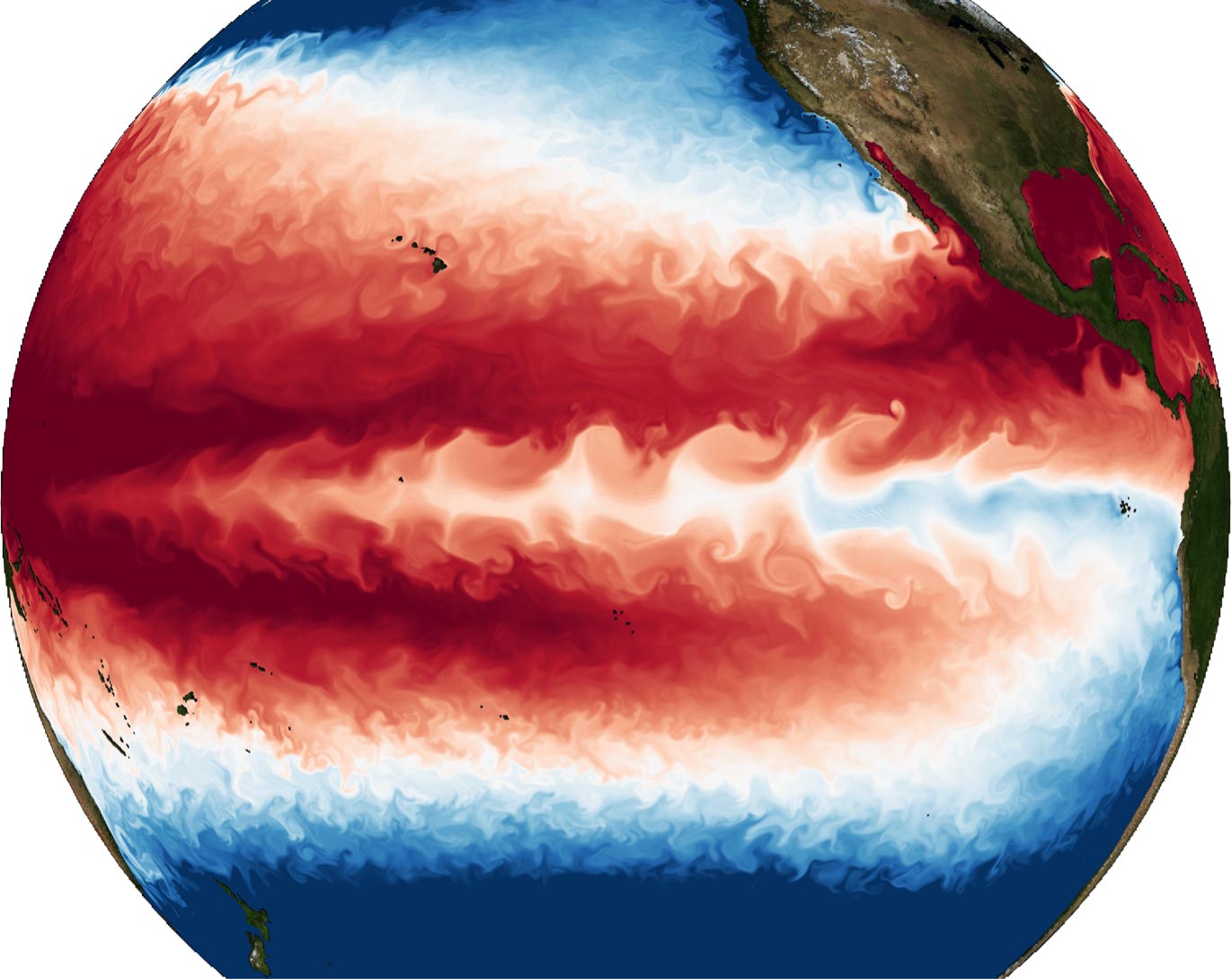
Highest resolution global warming simulation conducted to date reveals possible end of El Niño/ La Niña temperature cycle.
The cycling between warm El Niño and cold La Niña conditions in the eastern Pacific (commonly referred to as the El Niño-Southern Oscillation, ENSO) has persisted without major interruptions for at least the last 11,000 years. This may change in the future according to a new study published in the journal Nature Climate Change by a team of scientists from the IBS Center for Climate Physics (ICCP) at Pusan National University in South Korea, the Max Planck Institute of Meteorology, Hamburg, Germany, and the University of Hawaiʻi at Mānoa, USA.
The team conducted a series of global climate model simulations with an unprecedented spatial resolution of 10 km (6 miles) in the ocean and 25 km (16 miles) in the atmosphere. Boosted by the power of one of South Korea’s fastest supercomputers (Aleph), the new ultra-high-resolution climate model simulations can now realistically simulate tropical cyclones in the atmosphere and tropical instability waves in the equatorial Pacific Ocean, which both play fundamental roles in the generation and termination of El Niño and La Niña events. “Our supercomputer ran non-stop for over one year to complete a series of century-long simulations covering present-day climate and two different global warming levels. The model generated 2 quadrillion bytes of data; enough to fill up about 2,000 hard disks,” says Dr. Sun-Seon Lee who conducted the experiments.
Simulating ENSO with Record-Breaking Precision
Analyzing this enormous dataset, the team focused on a long-standing problem: how will ENSO change in response to increasing greenhouse gas concentrations. “Two generations of climate scientists have looked at this issue using climate models of varying complexity. Some models simulated weaker; others predicted larger eastern Pacific temperature swings in a future warmer climate. The jury was still out.” says Prof. Axel Timmermann, co-corresponding author and Director of the ICCP. He adds “What is common to these models is that their simulated temperatures in the equatorial Pacific, west of Galapagos, were always too cold compared to the observations. This prevented them from properly representing the delicate balance between positive and negative feedback processes that are important in the ENSO cycle.”
By capturing small-scale climatic processes at the highest computationally possible resolution, the ICCP team was able to alleviate these ocean temperature biases, leading to substantial improvements in the representations of ENSO and its response to Global Warming. “The result from our computer simulations is clear: Increasing CO2 concentrations will weaken the intensity of the ENSO temperature cycle,” says Dr. Christian Wengel, first author of the study and former postdoctoral researcher at the ICCP, now at the Max Planck Institute of Meteorology in Hamburg in Germany.
Unraveling the Mechanics of ENSO’s Collapse
By tracing the movement of heat in the coupled atmosphere/ocean system the scientists identified the main culprit of the collapse of the ENSO system: Future El Niño events will lose heat to the atmosphere more quickly due to the evaporation of water vapor, which has the tendency to cool the ocean. In addition, the reduced future temperature difference between the eastern and western tropical Pacific will also inhibit the development of temperature extremes during the ENSO cycle. However, these two factors are partly offset by a projected future weakening of tropical instability waves. Normally these oceanic waves, which can encompass up to 30% of the earth’s entire circumference, develop during La Niña conditions. They replace colder equatorial waters with warmer off-equatorial water, thereby accelerating the demise of a La Niña event. The new computer simulations, which resolve the detailed structure of these waves, demonstrate that the associated negative feedback for ENSO will weaken in the future.
“There is a tug-of-war between positive and negative feedbacks in the ENSO system, which tips over to the negative side in a warmer climate. This means future El Niño and La Niña events cannot develop their full amplitude anymore” comments ICCP alumni Prof. Malte Stuecker, co-author of the study and now assistant professor at the Department of Oceanography and the International Pacific Research Center at the University of Hawaiʻi at Mānoa.
Even though the year-to-year fluctuations in eastern equatorial Pacific temperatures are likely to weaken with human-induced warming according to this new study, the corresponding changes in El Niño and La Niña-related rainfall extremes will continue to increase due to an intensified hydrological cycle in a warmer climate, as shown in recent studies by scientists from the ICCP and their international collaborators.
“Our research documents that unabated warming is likely to silence the world’s most powerful natural climate swing which has been operating for thousands of years. We don’t yet know the ecological consequences of this potential no-analog situation“ says Axel Timmermann, “but we are eager to find out.”
Reference: “Future high-resolution El Niño/Southern Oscillation dynamics” by Christian Wengel, Sun-Seon Lee, Malte F. Stuecker, Axel Timmermann, Jung-Eun Chu and Fabian Schloesser, 26 August 2021, Nature Climate Change.
DOI: 10.1038/s41558-021-01132-4
Never miss a breakthrough: Join the SciTechDaily newsletter.
Follow us on Google and Google News.
3 Comments
“Global Warming Simulation Reveals Possible End of El Niño/ La Niña …”
Almost anything is possible. The more important question is, “What is the probability?” The issue of probability is often ignored in climatology!
“The result from our computer simulations is clear: Increasing CO2 concentrations will weaken the intensity of the ENSO temperature cycle, …”
That is not quite accurate! CO2, in and of itself, does not affect the ENSO temperature cycle. The unstated assumption, which often causes problems, is that CO2 will contribute to a level of warming that the models predict will weaken the ENSO. If that assumption is wrong, then the prediction is meaningless!
The article claims that the ENSO cycle has persisted for at least the last 11,000 years. However, the Holocene Climatic Optimum, which occurred from about 5,000 to 9,000 years ago, was even warmer than today, or what the predictions are for the near future. Yet, the authors don’t acknowledge that the ENSO cycle apparently continued then. Why should it not do so in the near future then?
It is commonly accepted that the older Global Circulation Models ran warm, and the most recent models are running even warmer, compared to observations. In the last 40 years, there has been no significant progress in narrowing the estimate of the amount of warming expected for a doubling of CO2 in the atmosphere. Various authors have suggested ranges from about +/- 0.5 K (Kelvin degrees) to 5.5 K, with the average around 3 K. Until that range can be reduced, exercises such as this article have very little credibility. The authors imply that the ENSO uncertainty has been resolved because of increased modeled warmth in the west-equatorial Pacific. What if their model is wrong?
This is interesting. However, it would be a mistake to assume that this is the last word on the topic.
The data on the ENSO index go back to 1870. CO2 was at pre-industrial levels. There is no correlation between monthly Mauna Loa CO2 and the monthly NINo 3.4 index, at least since 1982. It is commonly forgotten that the ENSO is made of three parts, not just two. Between El-Nino and La-Nina is the neutral condition, sometimes referred to as El-Nada. All three together over time show no relationship with CO2. Computer simulation cannot duplicate that and predict a slowing down because of elevated CO2. The global mean temperature anomaly since 1880 has risen less than one degree C from 14.0°C to 14.83°C in 2016.
A new study ( https://scitechdaily.com/discover-the-fascinating-22000-year-cycle-that-dramatically-shapes-seasons-in-the-equatorial-pacific/ ), suggests that the assumptions used for this study are not valid. This study didn’t incorporate the 22,000-year cycle of the Earth’s eccentricity. Indeed, the new study suggests that the science wasn’t settled in 2021, and probably still isn’t settled in 2022 even.