
Close Menu
    Facebook X (Twitter) Instagram
    SciTechDaily
    • Biology
    • Chemistry
    • Earth
    • Health
    • Physics
    • Science
    • Space
    • Technology
    Facebook X (Twitter) Pinterest YouTube RSS
    SciTechDaily
    Home»Space»Images of the Necklace Nebula
    Space

    Images of the Necklace Nebula

    By SciTechDailyOctober 8, 2012No Comments2 Mins Read
    Facebook Twitter Pinterest Telegram LinkedIn WhatsApp Email Reddit
    Share
    Facebook Twitter LinkedIn Pinterest Telegram Email Reddit
    necklace-nebula
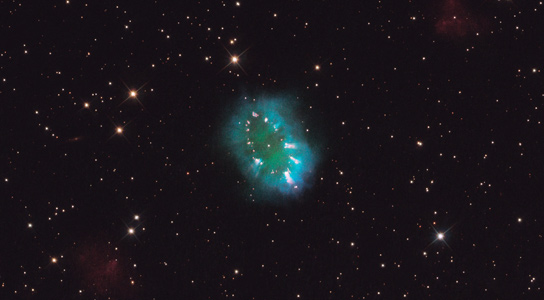
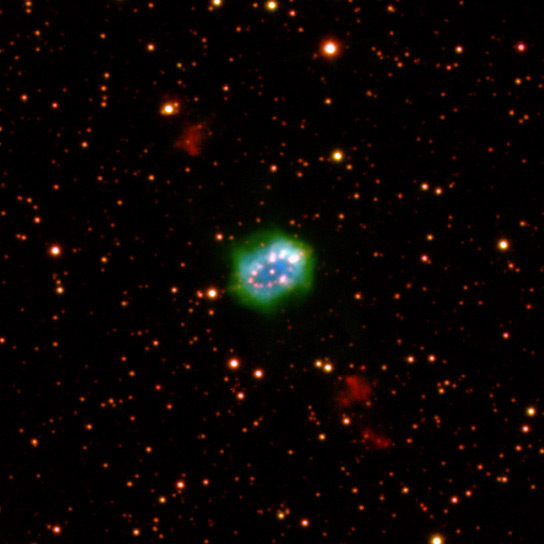
    The Necklace Nebula (PN G054.2-03.4) is a planetary nebula found in the northern constellation Sagitta, approximately 15,000 light-years distant.

    The Necklace Nebula (PN G054.2-03.4) is a planetary nebula situated in the northern constellation Sagitta, and is located about 15,000 light-years away. It was first discovered by the Isaac Newton Telescope Photometric H-alpha Survey (IPHAS) in 2005. The mission is ground-based and focused on the North Galactic Plane.

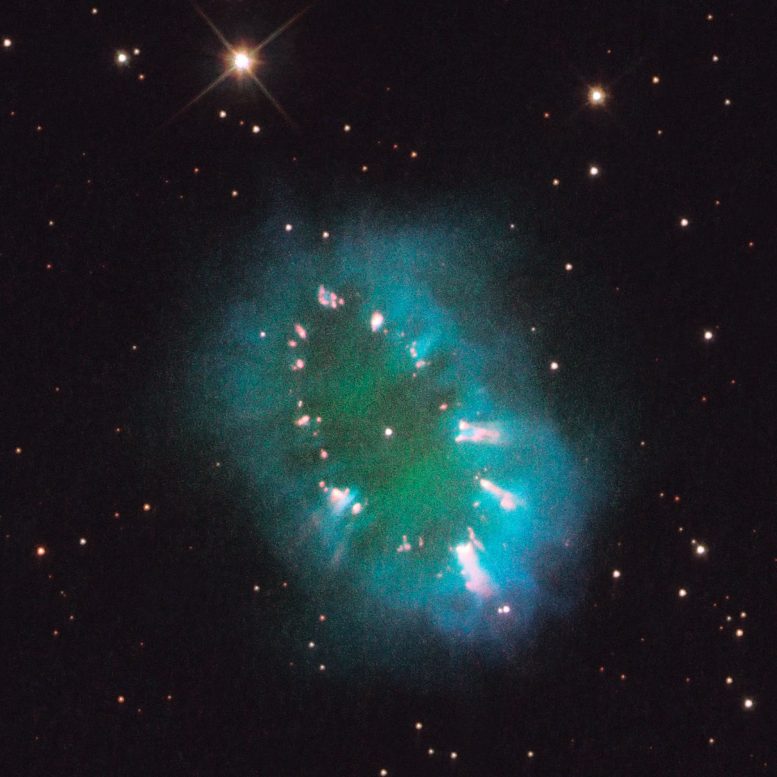
    These composite images were taken by the NASA Hubble Space Telescope. The object surrounds the glowing remains of a Sol-like star and consists of a bright ring measuring 2.04 light-years across, dotted with dense, bright knots of gas that look like pearls or diamonds in a necklace. The knots grow brightly due to the absorption of UV light from the central stars.
    the Necklace Nebula

    Binary stars orbiting very closely together produced the nebula 10,000 years ago. One of the aging stars ballooned and enveloped its companion star. This caused the larger star to spin so quickly that its gaseous envelope extended into space. Due to the centrifugal force, most of the gas escaped along the star’s equator, producing the dense ring seen in the composite images.
    necklace-nebula-context

    The bright knots are embedded and are the densest gas clumps in the ring. The stars were whirling around each other in 1.2 days. The image was captured by Hubble’s Wide Field Camera 3. It showcases the glow of hydrogen, in blue, oxygen in green, and nitrogen in red.

    Never miss a breakthrough: Join the SciTechDaily newsletter.
    Follow us on Google and Google News.

    Astronomy Hubble Space Telescope Nebula
    Share. Facebook Twitter Pinterest LinkedIn Email Reddit

    Related Articles

    Tour Stunning Hubble Images of Incredible Nebulae in This New NASA Video

    The Most Comprehensive Picture of Eta Carinae to Date

    ESA Image of the Week: Butterfly Emerges From Stellar Demise of NGC 6302

    Astronomers Discover Water-Building Molecule in Planetary Nebulas

    Hubble Image of the Day: The Sharpest View of the Orion Nebula

    Astronomers Find Bizarre Alignment of Planetary Nebulae in the Milky Way

    Hubble Views Planetary Nebula IC 289

    A Closer Look at Planetary Nebula NGC 2392

    Hubble’s Close-Up View of the Tarantula Nebula

    Leave A Reply Cancel Reply

    • Facebook
    • Twitter
    • Pinterest
    • YouTube

    Don't Miss a Discovery

    Subscribe for the Latest in Science & Tech!

    Trending News

    Scientists May Have Discovered How To Heal Damaged Kidneys

    Interstellar Visitor 3I/ATLAS Is Bursting With an Unexpected Chemical

    Scientists Just Found All 5 Genetic “Letters” of DNA and RNA on an Asteroid

    The 4,000-Year-Old City That Defied History’s Rules on Wealth and Power

    The World’s Biggest Population Fear Has Flipped – and It Could Change Everything

    This “Fake” Pill Improved Memory and Physical Performance in Just 3 Weeks

    Scientists Say Frequent Ejaculation May Improve Sperm Quality and Fertility

    Scientists Have Found “The Heaven Sword” After Years of Looking

    Follow SciTechDaily
    • Facebook
    • Twitter
    • YouTube
    • Pinterest
    • Newsletter
    • RSS
    SciTech News
    • Biology News
    • Chemistry News
    • Earth News
    • Health News
    • Physics News
    • Science News
    • Space News
    • Technology News
    Recent Posts
    • Scientists Challenge a Fundamental Assumption About Consciousness
    • Scientists Say the “Backrooms” Have Become a New Kind of Tourist Destination
    • A Giant Scorpion the Size of a Coffee Table Is Forcing Scientists To Rethink Evolution
    • Science Debunks a Common Belief About Pets and Stress
    • The Surprising Reason Sugary Gum Helped Lower Blood Pressure
    Copyright © 1998 - 2026 SciTechDaily. All Rights Reserved.
    • Science News
    • About
    • Contact
    • Editorial Board
    • Privacy Policy
    • Terms of Use

    Type above and press Enter to search. Press Esc to cancel.