
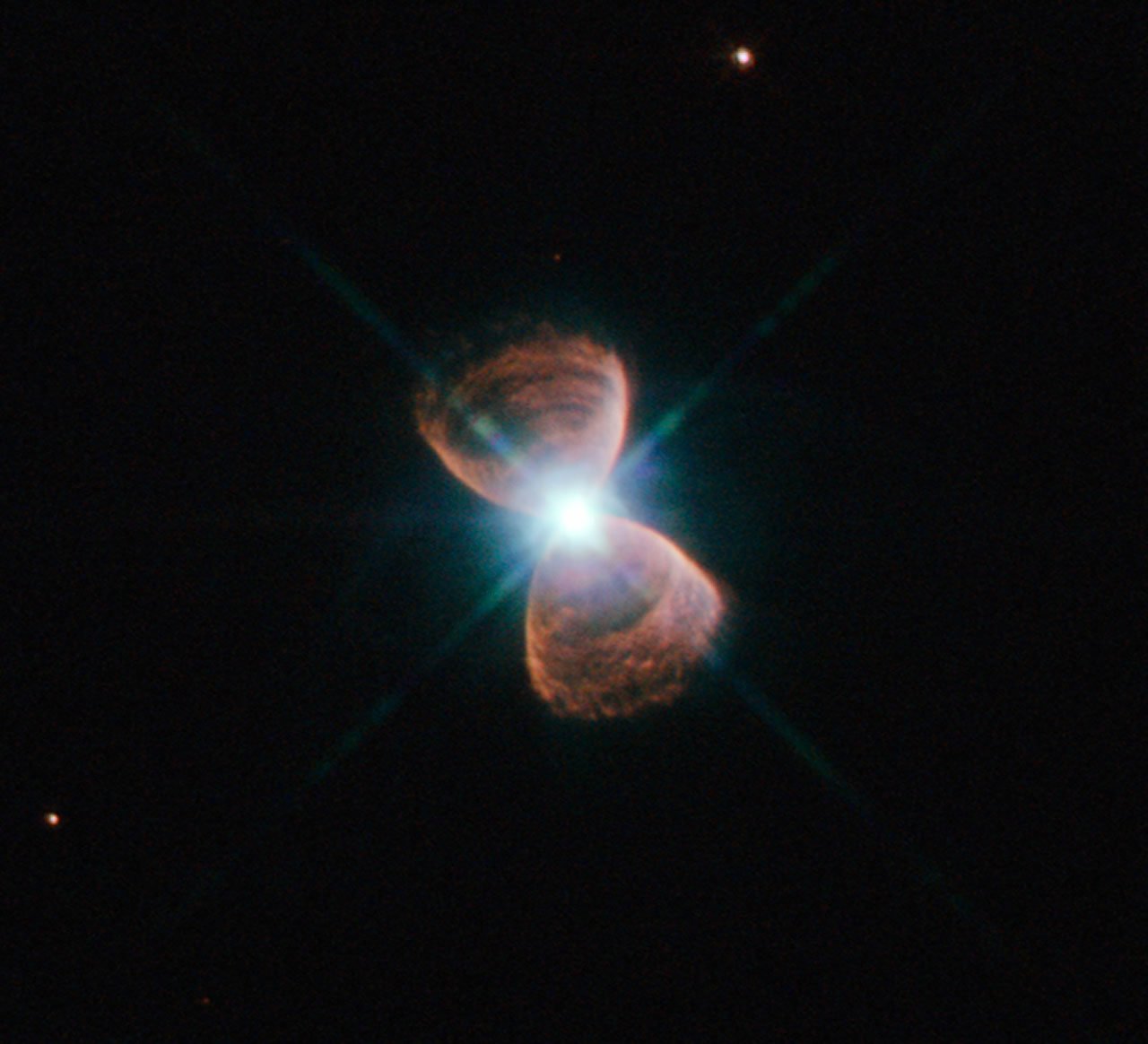
Using Hubble observations, a new study from the University of Manchester has found that bipolar planetary nebulae located towards the central bulge of our Milky Way appear to be strangely aligned in the sky.
Astronomers have used the NASA/ESA Hubble Space Telescope and ESO’s New Technology Telescope to explore more than 100 planetary nebulae in the central bulge of our galaxy. They have found that butterfly-shaped members of this cosmic family tend to be mysteriously aligned — a surprising result given their different histories and varied properties.
The final stages of life for a star like our Sun result in the star puffing its outer layers out into the surrounding space, forming objects known as planetary nebulae in a wide range of beautiful and striking shapes. One type of such nebulae, known as bipolar planetary nebulae, create ghostly hourglass or butterfly shapes around their parent stars.
All these nebulae formed in different places and have different characteristics. Neither the individual nebulae, nor the stars that formed them, interact with other planetary nebulae. However, a new study by astronomers from the University of Manchester, UK, now shows surprising similarities between some of these nebulae: many of them line up in the sky in the same way [1].
“This really is a surprising find and, if it holds true, a very important one,” explains Bryan Rees of the University of Manchester, one of the paper’s two authors. “Many of these ghostly butterflies appear to have their long axes aligned along the plane of our galaxy. By using images from both Hubble and the NTT we could get a really good view of these objects, so we could study them in great detail.”
The astronomers looked at 130 planetary nebulae in the Milky Way’s central bulge. They identified three different types, and peered closely at their characteristics and appearance [2].

Row 1 (from upper left): NGC 6302, NGC 6881, NGC 5189
Row 2 (from lower left) : M2-9, Hen 3-1475, Hubble 5
“While two of these populations were completely randomly aligned in the sky, as expected, we found that the third — the bipolar nebulae — showed a surprising preference for a particular alignment,” says the paper’s second author Albert Zijlstra, also of the University of Manchester. “While any alignment at all is a surprise, to have it in the crowded central region of the galaxy is even more unexpected.”
Planetary nebulae are thought to be sculpted by the rotation of the star system from which they form. This is dependent on the properties of this system — for example, whether it is a binary [3], or has a number of planets orbiting it, both of which may greatly influence the form of the blown bubble. The shapes of bipolar nebulae are some of the most extreme, and are thought to be caused by jets blowing mass outwards from the star system perpendicular to its orbit.
“The alignment we’re seeing for these bipolar nebulae indicates something bizarre about star systems within the central bulge,” explains Rees. “For them to line up in the way we see, the star systems that formed these nebulae would have to be rotating perpendicular to the interstellar clouds from which they formed, which is very strange.”
While the properties of their progenitor stars do shape these nebulae, this new finding hints at another more mysterious factor. Along with these complex stellar characteristics are those of our Milky Way; the whole central bulge rotates around the galactic center. This bulge may have a greater influence than previously thought over our entire galaxy — via its magnetic fields. The astronomers suggest that the orderly behavior of the planetary nebulae could have been caused by the presence of strong magnetic fields as the bulge formed.
As such nebulae closer to home do not line up in the same orderly way, these fields would have to have been many times stronger than they are in our present-day neighborhood [4].
“We can learn a lot from studying these objects,” concludes Zijlstra. “If they really behave in this unexpected way, it has consequences for not just the past of individual stars, but for the past of our whole galaxy.”
Notes
- The “long axis” of a bipolar planetary nebula slices though the wings of the butterfly, whilst the “short axis” slices through the body.
- The shapes of the planetary nebula images were classified into three types, following conventions: elliptical, either with or without an aligned internal structure, and bipolar.
- A binary system consists of two stars rotating around their common center of gravity.
- Very little is known about the origin and characteristics of the magnetic fields that were present in our galaxy when it was young, so it is unclear how they have changed over time.
Publication: Accepted for publication in MNRAS
PDF Copy of the Study: Alignment of the Angular Momentum Vectors of Planetary Nebulae in the Galactic Bulge
Images:
ESA/Hubble & NASA
NGC 6302: NASA, ESA and the Hubble SM4 ERO Team
NGC 6881: ESA/Hubble & NASA
NGC 5189: NASA, ESA and the Hubble Heritage Team (STScI/AURA)
M2-9: Bruce Balick (University of Washington), Vincent Icke (Leiden University, The Netherlands), Garrelt Mellema (Stockholm University), and NASA/ESA
Hen 3-1475: ESA/Hubble & NASA
Hubble 5: Bruce Balick (University of Washington), Vincent Icke (Leiden University, The Netherlands), Garrelt Mellema (Stockholm University), and NASA/ESA
Never miss a breakthrough: Join the SciTechDaily newsletter.
Follow us on Google and Google News.