
Close Menu
    Facebook X (Twitter) Instagram
    SciTechDaily
    • Biology
    • Chemistry
    • Earth
    • Health
    • Physics
    • Science
    • Space
    • Technology
    Facebook X (Twitter) Pinterest YouTube RSS
    SciTechDaily
    Home»Space»Distant Exoplanets Form Planetary Syzygy Celestial Alignment
    Space

    Distant Exoplanets Form Planetary Syzygy Celestial Alignment

    By SciTechDailyOctober 11, 2012No Comments2 Mins Read
    Facebook Twitter Pinterest Telegram LinkedIn WhatsApp Email Reddit
    Share
    Facebook Twitter LinkedIn Pinterest Telegram Email Reddit
    exoplanetary-system
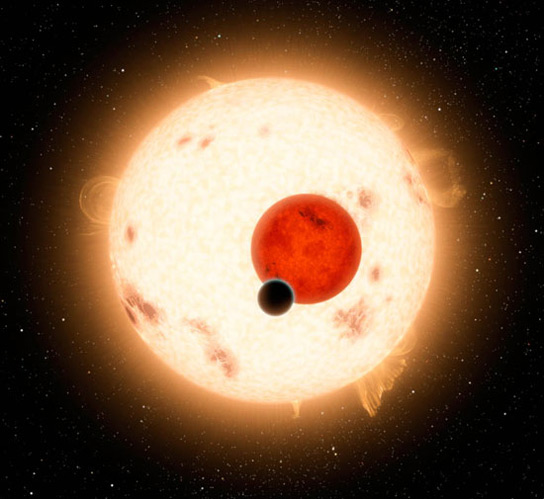
    Artist’s illustration of two planets transiting in front of the star at the same time.

    Astronomers have discovered that two exoplanets are overlapping in the skies as they cross their star. The phenomenon is new enough that it doesn’t have a name, but it’s related to a syzygy, which is when a straight line configuration of three celestial bodies is formed in a gravitational system.

    Astronomers used data from the Kepler Space Telescope to probe KOI-94, a star seemingly orbited by four planets. A planet transiting in front of the star causes the light to momentarily dim, which is how Kepler finds exoplanets. Two planets transiting at the same time dim the light even more, but if they overlap there is a momentary increase in brightness as the planets cover less of the star.
    planetary-syzygy
    Credit: Image via NMSU

    The scientists published their findings in a preprint available on arXiv. Teruyuki Hirano, of the University of Tokyo, Japan, et al. saw this pattern in one planet candidate, KOI-94.03. The innermost candidate, KOI-94.01 passed between the two. This could also be explained by a single planet passing in front of the dark starspot.

    This uncertainty hasn’t stopped astronomers from speculating what to call the event. Hirano favors planet-planet-eclipse, but double transit has also been mentioned as has overlapping double transit. Exosyzygy or planetary syzygy are also strong candidates.

    Finding more than two planets lining up is believed to be extremely unlikely.

    Reference: “Planet-Planet Eclipse and the Rossiter-McLaughlin Effect of a Multiple Transiting System: Joint Analysis of the Subaru Spectroscopy and the Kepler Photometry” by Teruyuki Hirano, Norio Narita, Bun’ei Sato, Yasuhiro H. Takahashi, Kento Masuda, Yoichi Takeda, Wako Aoki, Motohide Tamura and Yasushi Suto, 23 October 2012, The Astrophysical Journal Letters.
    DOI: 10.1088/2041-8205/759/2/L36

    Never miss a breakthrough: Join the SciTechDaily newsletter.
    Follow us on Google and Google News.

    Astronomy Exoplanet Kepler Space Telescope Planetary Science
    Share. Facebook Twitter Pinterest LinkedIn Email Reddit

    Related Articles

    Kepler Data Reveal the Discovery of 833 New Candidate Planets

    Astronomers Create First Cloud Map of a Planet Beyond Our Solar System

    Scientists Discover an Earth-Sized Exoplanet That Orbits Its Star Every 8.5 Hours

    NASA’s Kepler Mission Delivers New Data

    Two New Extrasolar Planets KOI-200b and KOI-889b Detected

    Water Planets in the Habitable Zone: A Closer Look at Kepler 62e and 62f

    Kepler Mission Discovers Two New Planetary Systems With ‘Habitable Zone’ Planets

    Kepler Finds Over 2,300 Candidate Exoplanets

    Volunteer Scientists Aid in Discovery of Four-Star Planet PH1

    Leave A Reply Cancel Reply

    • Facebook
    • Twitter
    • Pinterest
    • YouTube

    Don't Miss a Discovery

    Subscribe for the Latest in Science & Tech!

    Trending News

    Black Hole Shredded a Massive Star in the Most Powerful Stellar Explosion Ever Seen

    Building the Brain Requires Millions of Dangerous DNA Breaks

    Endless Supply of Cancer-Fighting Immune Cells Unlocked by USC Scientists

    XRISM Reveals Galaxy-Shaping Winds Erupting From a Supermassive Black Hole

    New Molecule Restores the Brain’s Natural Defenses Against Alzheimer’s

    Could Creatine Boost More Than Muscles? It May Also Help Depression

    Scientists Discover a Natural Molecule That Could Help Prevent Vision Loss

    Scientists Thought Royal Jelly Made Queen Bees. They Were Wrong

    Follow SciTechDaily
    • Facebook
    • Twitter
    • YouTube
    • Pinterest
    • Newsletter
    • RSS
    SciTech News
    • Biology News
    • Chemistry News
    • Earth News
    • Health News
    • Physics News
    • Science News
    • Space News
    • Technology News
    Recent Posts
    • Microscope Breakthrough Could Reveal Proteins Once Thought Too Small To See
    • Beyond Heisenberg: Scientists Discover a New “Space-Time Limit” in Quantum Physics
    • New Technique Exposes Hidden Multiple Sclerosis Damage in Routine MRI Scans
    • Intermittent Fasting Benefits May Last Long After the Diet Ends
    • Scientists Develop a Food Ingredient That May Prevent Obesity
    Copyright © 1998 - 2026 SciTechDaily. All Rights Reserved.
    • Science News
    • About
    • Contact
    • Editorial Board
    • Privacy Policy
    • Terms of Use

    Type above and press Enter to search. Press Esc to cancel.