
Close Menu
    Facebook X (Twitter) Instagram
    SciTechDaily
    • Biology
    • Chemistry
    • Earth
    • Health
    • Physics
    • Science
    • Space
    • Technology
    Facebook X (Twitter) Pinterest YouTube RSS
    SciTechDaily
    Home»Space»Volunteer Scientists Aid in Discovery of Four-Star Planet PH1
    Space

    Volunteer Scientists Aid in Discovery of Four-Star Planet PH1

    By Michele Johnson, Ames Research Center; NASAOctober 16, 2012No Comments3 Mins Read
    Facebook Twitter Pinterest Telegram LinkedIn WhatsApp Email Reddit
    Share
    Facebook Twitter LinkedIn Pinterest Telegram Email Reddit
    PH1
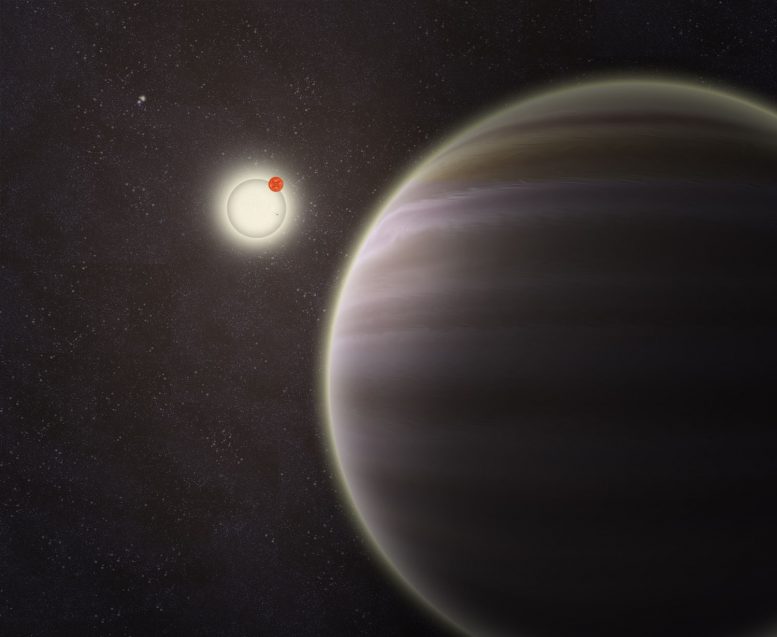
    An artist’s illustration of PH1, a planet discovered by volunteers from the Planet Hunters citizen science project. PH1, shown in the foreground, is the first reported case of a planet orbiting a double-star that, in turn, is orbited by a second distant pair of stars. The phenomenon is called a circumbinary planet in a four-star system. A bit larger than Neptune and thought to be a gas giant, PH1 orbits its host stars every 137 days. Beyond the planet’s orbit approximately 900 times the distance between the sun and Earth, a second pair of stars orbits the planetary system. Credit: Haven Giguere/Yale

    A team of international astronomers, aided by volunteer scientists using the Planethunters.org website, discovered a circumbinary planet in a four-star system, called PH1.

    The discovery of planets continues to expand beyond the domain of professional astronomers. A joint effort of amateur astronomers and scientists has led to the first reported case of a planet orbiting a double-star that, in turn, is orbited by a second distant pair of stars.

    Aided by volunteer citizen scientists using the Planethunters.org website, a Yale-led international team of astronomers identified and confirmed discovery of the phenomenon, called a circumbinary planet in a four-star system. Only six planets are known to orbit two stars but none of these are orbited by a distant binary.

    Coined PH1, the planet was identified by the citizen scientists participating in Planets Hunters, a Yale-led program that enlists the public to review astronomical data from NASA’s Kepler spacecraft for signs of planets transits distant stars.

    “I celebrate this discovery as a milestone for the Planet Hunters team: discovering their first exoplanet lurking in the Kepler data. I celebrate this discovery for the wow-factor of a planet in a four-star system,” said Natalie Batalha, Kepler scientist at NASA Ames Research Center, Moffett Field, California. “Most importantly, I celebrate this discovery as the fruit of exemplary human cooperation—cooperation between scientists and citizens who give of themselves for the love of stars, knowledge, and exploration.”

    A bit larger than Neptune and thought to be a gas giant, PH1 orbits its host stars every 137 days. Beyond the planet’s orbit approximately 900 times the distance between the sun and Earth, a second pair of stars orbits the planetary system.

    The research paper submitted to the Astrophysical Journal is scheduled to be presented today at the annual meeting of the Division of Planetary Sciences of the American Astronomical Society in Reno.

    Reference: “Planet Hunters: A Transiting Circumbinary Planet in a Quadruple Star System” by Megan E. Schwamb, Jerome A. Orosz, Joshua A. Carter, William F. Welsh, Debra A. Fischer, Guillermo Torres, Andrew W. Howard, Justin R. Crepp, William C. Keel, Chris J. Lintott, Nathan A. Kaib, Dirk Terrell, Robert Gagliano, Kian J. Jek, Michael Parrish, Arfon M. Smith, Stuart Lynn, Robert J. Simpson, Matthew J. Giguere and Kevin Schawinski, 23 April 2013, Astrophysical Journal.
    DOI: 10.1088/0004-637X/768/2/127

    Never miss a breakthrough: Join the SciTechDaily newsletter.
    Follow us on Google and Google News.

    Astronomy Exoplanet Kepler Space Telescope NASA Planetary Science Stars
    Share. Facebook Twitter Pinterest LinkedIn Email Reddit

    Related Articles

    Kepler Space Telescope Reveals 1,284 New Planets

    Kepler Discovers Bigger, Older Cousin to Earth

    Kepler Discovers Earth-Size Planet Orbiting a Star in the ‘Habitable Zone’

    NASA’s Kepler Mission Announces 715 New Worlds

    Five New Rocky Planets Discovered in Kepler Data

    Kepler Data Reveal the Discovery of 833 New Candidate Planets

    NASA’s Kepler Mission Delivers New Data

    Kepler Mission Discovers Two New Planetary Systems With ‘Habitable Zone’ Planets

    NASA’s Kepler Mission Discovers 11 New Extrasolar Systems with 26 Exoplanets

    Leave A Reply Cancel Reply

    • Facebook
    • Twitter
    • Pinterest
    • YouTube

    Don't Miss a Discovery

    Subscribe for the Latest in Science & Tech!

    Trending News

    Breakthrough Bowel Cancer Trial Leaves Patients Cancer-Free for Nearly 3 Years

    Natural Compound Shows Powerful Potential Against Rheumatoid Arthritis

    100,000-Year-Old Neanderthal Fossils in Poland Reveal Unexpected Genetic Connections

    Simple “Gut Reset” May Prevent Weight Gain After Ozempic or Wegovy

    2.8 Days to Disaster: Scientists Warn Low Earth Orbit Could Suddenly Collapse

    Common Food Compound Shows Surprising Power Against Superbugs

    5 Simple Ways To Remember More and Forget Less

    The Atomic Gap That Could Cost the Semiconductor Industry Billions

    Follow SciTechDaily
    • Facebook
    • Twitter
    • YouTube
    • Pinterest
    • Newsletter
    • RSS
    SciTech News
    • Biology News
    • Chemistry News
    • Earth News
    • Health News
    • Physics News
    • Science News
    • Space News
    • Technology News
    Recent Posts
    • After 37 Years, the World’s Longest-Running Soil Warming Experiment Uncovers a Startling Climate Secret
    • NASA Satellite Captures First-Ever High-Res View of Massive Pacific Tsunami
    • ADHD Isn’t Just a Deficit: Study Reveals Powerful Hidden Strengths
    • Scientists Uncover “Astonishing” Hidden Property of Light
    • Scientists Discover Stem Cells That Could Regrow Teeth and Bone
    Copyright © 1998 - 2026 SciTechDaily. All Rights Reserved.
    • Science News
    • About
    • Contact
    • Editorial Board
    • Privacy Policy
    • Terms of Use

    Type above and press Enter to search. Press Esc to cancel.