
NASA’s DART mission will test asteroid deflection by striking Dimorphos. Goddard scientists are running complex simulations and verifying trajectories while Webb and ALMA will track dust and gas from the impact.
Although the chance of an asteroid impacting Earth is small, even a relatively small asteroid of about 500 feet (about 150 meters) across carries enough energy to cause widespread damage around the impact site. NASA leads efforts in the U.S. and worldwide both to detect and track potentially hazardous asteroids and to study technologies to mitigate or avoid impacts on Earth. If an asteroid were discovered and determined to be on a collision course with Earth, one response could be to launch a “kinetic impactor” – a high-velocity spacecraft that would deflect the asteroid by ramming into it, altering the asteroid’s orbit slightly so that it misses Earth. NASA’s Double Asteroid Redirection Test (DART) will be the first mission to demonstrate asteroid deflection using a kinetic impactor.
DART will test kinetic impactor technology by targeting a double asteroid that is not on a path to collide with Earth and therefore poses no actual threat to the planet. The system is composed of two asteroids: the larger asteroid Didymos (diameter: 780 meters, 0.48 miles), and the smaller moonlet asteroid, Dimorphos (diameter: 160 meters, 525 feet), which orbits the larger asteroid. DART, which launched Wednesday, November 24 at 1:21 a.m. EST on a SpaceX Falcon 9 rocket from Space Launch Complex 4 East at Vandenberg Space Force Base in California, will slam into Dimorphos nearly head-on, shortening the time it takes the small asteroid moonlet to orbit Didymos by several minutes. The mission is led by the Johns Hopkins Applied Physics Laboratory (APL) in Laurel, Maryland for NASA’s Planetary Defense Coordination Office and has support from several NASA centers.
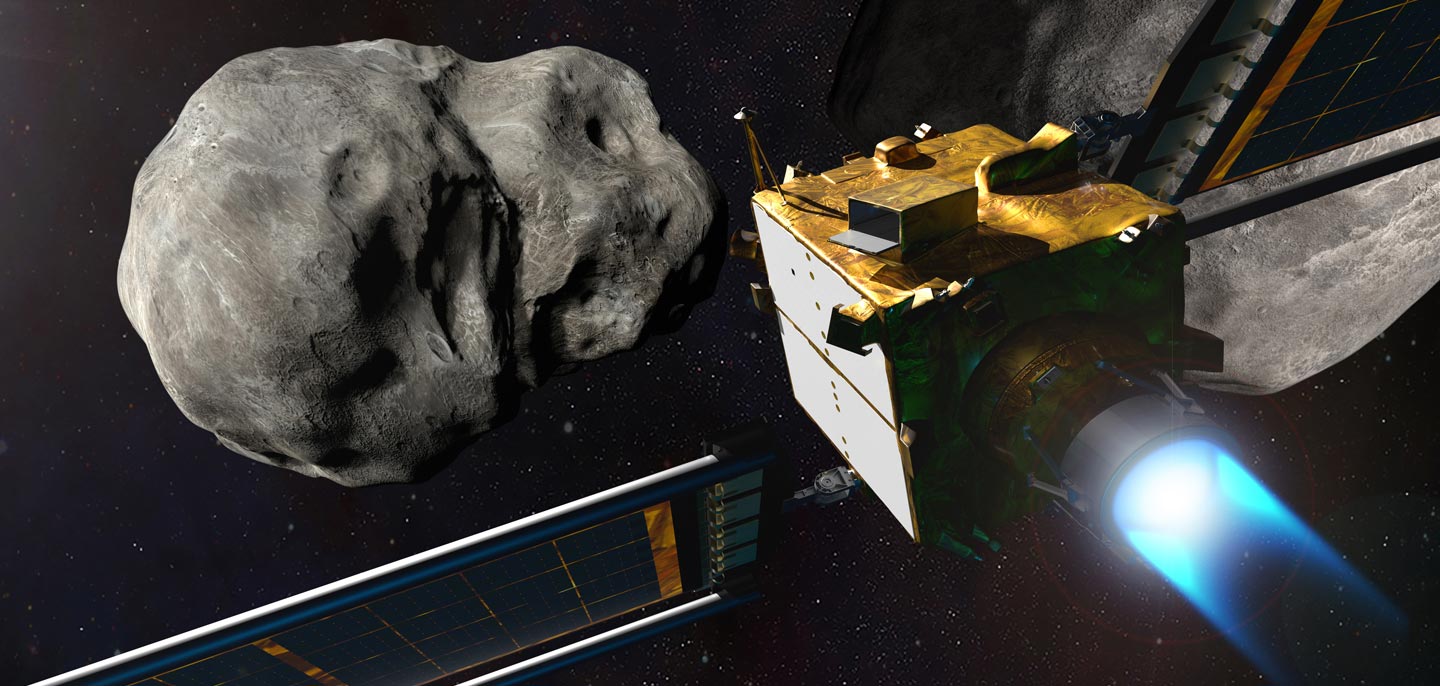
Scientists and engineers at NASA’s Goddard Space Flight Center in Greenbelt, Maryland, are checking the flight path of the mission and running computer simulations that predict how the impact might change Dimorphos’ orbit. The team will also make telescopic observations to determine the amount and composition of dust and volatiles (easily vaporized material) released during the impact.
“We are an independent check on the mission’s trajectory calculations,” said Brent Barbee, dynamics verification and validation lead and DART flight dynamics support lead at Goddard. Goddard used its in-house-developed Evolutionary Mission Trajectory Generator (EMTG) to provide independent verification and validation of the DART mission trajectories at various stages of the mission’s development and evaluate the ability of the mission to adapt to missed thrust and other contingencies.
“We also used the EMTG to support independent trajectory optimization studies for DART. These studies assessed the best flight paths for the spacecraft given its goals, capabilities, and limitations,” said Bruno Sarli of Goddard and Heliospace Corporation, Berkeley, California, a member of the DART trajectory optimization team.
Goddard scientists are also helping to calculate how the impact will change the orbit of Dimorphos, using a specialized binary (double) asteroid dynamics simulation code developed by the mission’s investigation team to model the orbital and rotational motion of the Didymos system. The Goddard group curated a version of the tool for the DART mission, adding features and functionality. “Our simulation results shed light on how DART’s impact will change the dynamics of the system in ways that are detectable via remote observations,” said Barbee.
Simulations Validate Mission Success Under Varying Conditions
“Prior to launch, these simulations helped verify that the DART impact would meet mission requirements even in impact circumstances that are not ideal,” adds Joshua Lyzhoft of Goddard, who performs dynamics simulation development, modeling, and analysis for DART. “We will also be updating the simulations during the mission using observations to help ascertain how much DART’s impact changed the momentum of Dimorphos, which is an important goal of the mission.”
The double asteroid dynamics algorithms and code are very complex and computationally intensive, according to the team. “One of the important features Goddard added to the code is the ability to execute it using parallel distributed computing so that the simulations complete in reasonable amounts of time,” said Barbee. “When the system is observed post-impact that will be the first time such impact effects are observed and the first time such observations will be compared to and used to calibrate dynamics simulations for a double asteroid.”
The spacecraft will intercept Didymos’ moonlet in late September 2022, when the Didymos system is within about 6.8 million miles (11 million kilometers) of Earth, enabling observations by ground-based telescopes and planetary radar to measure the change in momentum imparted to the moonlet.
Goddard scientists will be performing additional observations to add to the mission’s scientific return. “We’ll determine the amount of dust released during impact, as well as the amount and nature of any potential volatiles, through high-resolution radio-telescope observations with the Atacama Large Millimeter Array (ALMA) as well as other radio (millimeter/submillimeter) facilities,” said Stefanie Milam of Goddard, who is part of the DART supporting observations working group and co-investigator on the ALMA program. “Additionally, there will be observations with the James Webb Space Telescope of Didymos during and after impact to also monitor dust released during the event.” Milam also supports the Webb Guaranteed Time Observations team (PI: Thomas/NAU).
Probing Asteroid Composition
“The dust and volatile observations from Webb (near-infrared wavelengths) and ALMA (submillimeter wavelengths) will help us to understand the composition of the asteroid as well as the speed, direction, and nature of the material ejected by the impact,” said Nathan Roth of Goddard, also a member of the DART supporting observations working group and principal investigator of the ALMA program. “Based on the brightness of the asteroid at each wavelength, we’ll be able to understand the size distribution of dust particles in the ejecta. With high-resolution imaging from Webb, we’ll be able to understand jets or other structures in the ejecta. With molecular spectroscopy (analysis of light released by molecules) from ALMA, we’ll be able to measure the content of any trace ices present beneath the surface of Dimorphos as well as any gas-phase molecules produced by the impact.”
More about the mission and partners:
The binary asteroid simulation dynamics code was developed jointly by DART’s Dynamics Working Group, which is led by Prof. Derek Richardson of the University of Maryland, College Park. The core code was originally developed by Alex B. Davis and Daniel J. Scheeres at the University of Colorado, Boulder, who are also members of the Dynamics Working Group. DART’s Observations Working Group is chaired by Prof. Cristina Thomas of Northern Arizona University.
Johns Hopkins APL manages the DART mission for NASA’s Planetary Defense Coordination Office as a project of the agency’s Planetary Missions Program Office. NASA provides support for the mission from several centers, including the Jet Propulsion Laboratory in Southern California, Goddard Space Flight Center in Greenbelt, Maryland, Johnson Space Center in Houston, Glenn Research Center in Cleveland, and Langley Research Center in Hampton, Virginia. The launch is managed by NASA’s Launch Services Program, based at the agency’s Kennedy Space Center in Florida. SpaceX is the launch services provider for the DART mission.
Never miss a breakthrough: Join the SciTechDaily newsletter.
Follow us on Google and Google News.
1 Comment
wait until they make parabolic reflectors for spacecraft in the future cartoon sci-fi fans of the 80s and 90s.