
Never-Before-Seen Spacecraft Collision Yields Unexpected Surprises
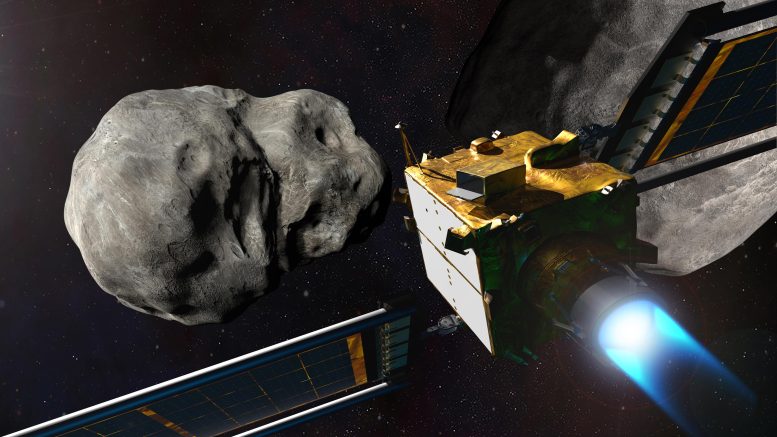
In 2022 NASA embarked on a bold experiment to see if they could change an asteroid’s velocity by smacking it with a ballistic probe – kind of like hitting it with a hammer. This experiment was to test a potential technique to someday deflect an asteroid on a collision course to Earth. Perhaps, for the first time in the history of the universe, an intelligent planetary species sought ways to avoid its own potential extinction by threats from outer space (something the dinosaurs, who were wiped out 65 million years ago by a rogue asteroid, never evolved to accomplish). Called DART (Double Asteroid Redirection Test), the target was a binary asteroid Didymos/Dimorphos. On September 26, 2022, Dimorphos was hit with the DART spacecraft, which was half the weight of a small car.
Hubble had a ringside seat to the demolition derby. It fired off a series of snapshots over several days capturing the outflow of tons of dusty debris from the 13,000 miles-per-hour impact. Astronomers didn’t know what to expect. They were surprised, delighted, and somewhat mystified by the results. The dust blew off the asteroid into a cone shape, got twisted up along the asteroid’s orbit about its companion, and was then blown into a comet-like tail. Knowing how to steer a rogue asteroid away from a catastrophic collision with Earth might save humanity someday.
This movie captures the breakup of the asteroid Dimorphos when it was deliberately hit by NASA’s 1,200-pound Double Asteroid Redirection Test (DART) mission spacecraft on September 26, 2022. The Hubble Space Telescope had a ringside view of the space demolition derby. The Hubble movie starts at 1.3 hours before impact. The first post-impact snapshot is 2 hours after the event. Debris flies away from the asteroid in straight lines, moving faster than four miles per hour (fast enough to escape the asteroid’s gravitation pull, so it does not fall back onto the asteroid). The ejecta forms a largely hollow cone with long, stringy filaments. At about 17 hours after the impact the debris pattern entered a second stage. The dynamic interaction within the binary system started to distort the cone shape of the ejecta pattern. The most prominent structures are rotating, pinwheel-shaped features. The pinwheel is tied to the gravitational pull of the companion asteroid, Didymos. Hubble next captures the debris being swept back into a comet-like tail by the pressure of sunlight on the tiny dust particles. This stretches out into a debris train where the lightest particles travel the fastest and farthest from the asteroid. The mystery is compounded later when Hubble records the tail splitting in two for a few days. Credit: NASA, ESA, STScI, and Jian-Yang Li (PSI); Video: Joseph DePasquale (STScI)
Hubble Space Telescope Captures Movie of DART Asteroid Impact Debris
Like a sports photographer at an auto-racing event, NASA’s Hubble Space Telescope captured a series of photos of asteroid Dimorphos when it was deliberately hit by a 1,200-pound NASA spacecraft called DART on September 26, 2022.
The primary objective of DART, which stands for Double Asteroid Redirection Test, was to test our ability to alter the asteroid’s trajectory as it orbits its larger companion asteroid, Didymos. Though neither Didymos nor Dimorphos poses any threat to Earth, data from the mission will help inform researchers how to potentially divert an asteroid’s path away from Earth, if ever necessary. The DART experiment also provided fresh insights into planetary collisions that may have been common in the early solar system.
Unveiling the Aftermath: Dust and Debris Ejection
Hubble’s time-lapse movie of the aftermath of DART’s collision reveals surprising and remarkable, hour-by-hour changes as dust and chunks of debris were flung into space. Smashing head on into the asteroid at 13,000 miles per hour, the DART impactor blasted over 1,000 tons of dust and rock off of the asteroid.
The Hubble movie offers invaluable new clues into how the debris was dispersed into a complex pattern in the days following the impact. This was over a volume of space much larger than could be recorded by the LICIACube cubesat, which flew past the binary asteroid minutes after DART’s impact.
“The DART impact happened in a binary asteroid system. We’ve never witnessed an object collide with an asteroid in a binary asteroid system before in real time, and it’s really surprising. I think it’s fantastic. Too much stuff is going on here. It’s going to take some time to figure out,” said Jian-Yang Li of the Planetary Science Institute in Tucson, Arizona. The study, led by Li along with 63 other DART team members, was published on March 1 in the journal Nature.
The movie shows three overlapping stages of the impact aftermath: the formation of an ejecta cone, the spiral swirl of debris caught up along the asteroid’s orbit about its companion asteroid, and the tail swept behind the asteroid by the pressure of sunlight (resembling a windsock caught in a breeze).
The Hubble movie starts at 1.3 hours before impact. In this view both Didymos and Dimorphos are within the central bright spot; even Hubble can’t resolve the two asteroids separately. The thin, straight spikes projecting away from the center (and seen in later images) are artifacts of Hubble’s optics. The first post-impact snapshot is 2 hours after the event. Debris flies away from the asteroid, moving with a range of speeds faster than four miles per hour (fast enough to escape the asteroid’s gravitational pull, so it does not fall back onto the asteroid). The ejecta forms a largely hollow cone with long, stringy filaments.
Surprising Discoveries: Pinwheel Patterns and Tail Splits
At about 17 hours after the impact the debris pattern entered a second stage. The dynamic interaction within the binary system starts to distort the cone shape of the ejecta pattern. The most prominent structures are rotating, pinwheel-shaped features. The pinwheel is tied to the gravitational pull of the companion asteroid, Didymos. “This is really unique for this particular incident,” said Li. “When I first saw these images, I couldn’t believe these features. I thought maybe the image was smeared or something.”
Hubble next captures the debris being swept back into a comet-like tail by the pressure of sunlight on the tiny dust particles. This stretches out into a debris train where the lightest particles travel the fastest and farthest from the asteroid. The mystery is compounded later when Hubble records the tail splitting in two for a few days.
A multitude of other telescopes on Earth and in space, including NASA’s James Webb Space Telescope and Lucy spacecraft, also observed the DART impact and its outcomes.
This Hubble movie is part of a suite of new studies published in the journal Nature about the DART mission. See NASA’s DART Data Validates Asteroid Kinetic Impact Method to learn more.
“Ejecta from the DART-produced active asteroid Dimorphos” by Jian-Yang Li, Masatoshi Hirabayashi, Tony L. Farnham, Jessica M. Sunshine, Matthew M. Knight, Gonzalo Tancredi, Fernando Moreno, Brian Murphy, Cyrielle Opitom, Steve Chesley, Daniel J. Scheeres, Cristina A. Thomas, Eugene G. Fahnestock, Andrew F. Cheng, Linda Dressel, Carolyn M. Ernst, Fabio Ferrari, Alan Fitzsimmons, Simone Ieva, Stavro L. Ivanovski, Teddy Kareta, Ludmilla Kolokolova, Tim Lister, Sabina D. Raducan, Andrew S. Rivkin, Alessandro Rossi, Stefania Soldini, Angela M. Stickle, Alison Vick, Jean-Baptiste Vincent, Harold A. Weaver, Stefano Bagnulo, Michele T. Bannister, Saverio Cambioni, Adriano Campo Bagatin, Nancy L. Chabot, Gabriele Cremonese, R. Terik Daly, Elisabetta Dotto, David A. Glenar, Mikael Granvik, Pedro H. Hasselmann, Isabel Herreros, Seth Jacobson, Martin Jutzi, Tomas Kohout, Fiorangela La Forgia, Monica Lazzarin, Zhong-Yi Lin, Ramin Lolachi, Alice Lucchetti, Rahil Makadia, Elena Mazzotta Epifani, Patrick Michel, Alessandra Migliorini, Nicholas A. Moskovitz, Jens Ormö, Maurizio Pajola, Paul Sánchez, Stephen R. Schwartz, Colin Snodgrass, Jordan Steckloff, Timothy J. Stubbs and Josep M. Trigo-Rodríguez, 1 March 2023, Nature.
DOI: 10.1038/s41586-023-05811-4
The Hubble Space Telescope is a project of international cooperation between NASA and ESA. NASA’s Goddard Space Flight Center in Greenbelt, Maryland, manages the telescope. The Space Telescope Science Institute (STScI) in Baltimore, Maryland, conducts Hubble and Webb science operations. STScI is operated for NASA by the Association of Universities for Research in Astronomy, in Washington, D.C.
Never miss a breakthrough: Join the SciTechDaily newsletter.
Follow us on Google and Google News.
5 Comments
The pic of the asteroid revolved 45% looks like an orangutan skull. You blew up an endangered and adorable species!
I could produce the video of the explosion in my bedroom in 10 minutes, for 45 cents. How much did the kids at NASSSore pay? When elected, I shall close them down and put them in Dr. Fauci’s cell. And outsource their activities to Pakistan or Mongolia.
Clearly chux you do not have a degree in anything pertaining to this subject matter. Keeping this the oh kids n 45 cents 10 minutes . I assure the nasa rewrite spelling errors on your fumble 🧠 🤯. Unwarranted undesirable and totally incorrect. No I will not overlook this insult.
The pic of the asteroid revolved 45% looks like an orangutan skull. You blew up an endangered and adorable species!
I could produce the video of the explosion in my bedroom in 10 minutes, for 45 cents. How much did the kids at NASSSore pay? When elected, I shall close them down and put them in Dr. Fauci’s cell. And outsource their activities to Pakistan or Mongolia.
Asteroid extinction event occurred before , so the technology is here 😀. Survival of the human race. Research, continuing learning, brings peace of mind. Happy 😊 plants.
I have to wonder how far they’ve estimated the new wobble introduced to the asteroid pair. Will it have any impact on the trajectory? If so, what would that be?
It seems like it might be a better idea to nudge an incoming asteroid into a better path instead of just clobbering it and hoping for the best.