
Unexpected Aftermath of First-of-Its-Kind Test Intrigues Astronomers
NASA carried out the Double Asteroid Redirection Test (DART), a first-of-its-kind experiment, on September 26, 2022. The pioneering experiment was designed to intentionally crash a spacecraft into a small asteroid in the world’s first-ever in-space test for planetary defense. According to NASA, the mission was successful in altering the orbit of Dimorphos, the asteroid moonlet of Didymos. However, there is still much to learn about the system.
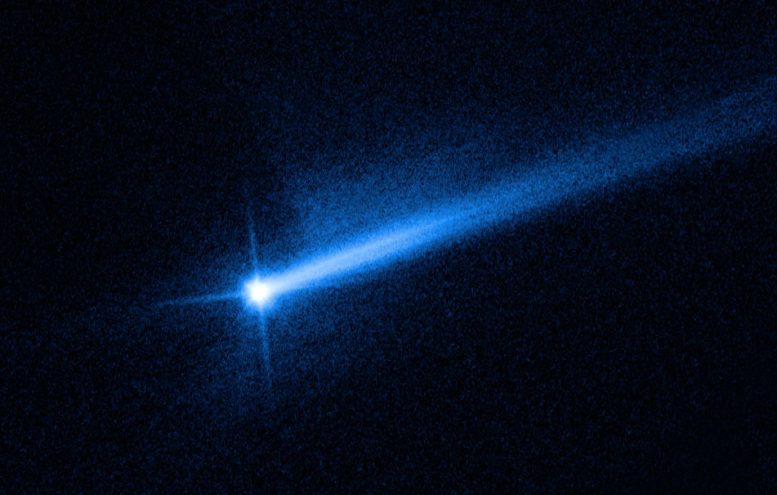
Follow-up observations from NASA’s Hubble Space Telescope are already revealing the clearest image of a stunning surprise — a newly developed second tail of ejecta.
NASA’s Hubble Space Telescope Spots Twin Tails in New Image After DART Impact
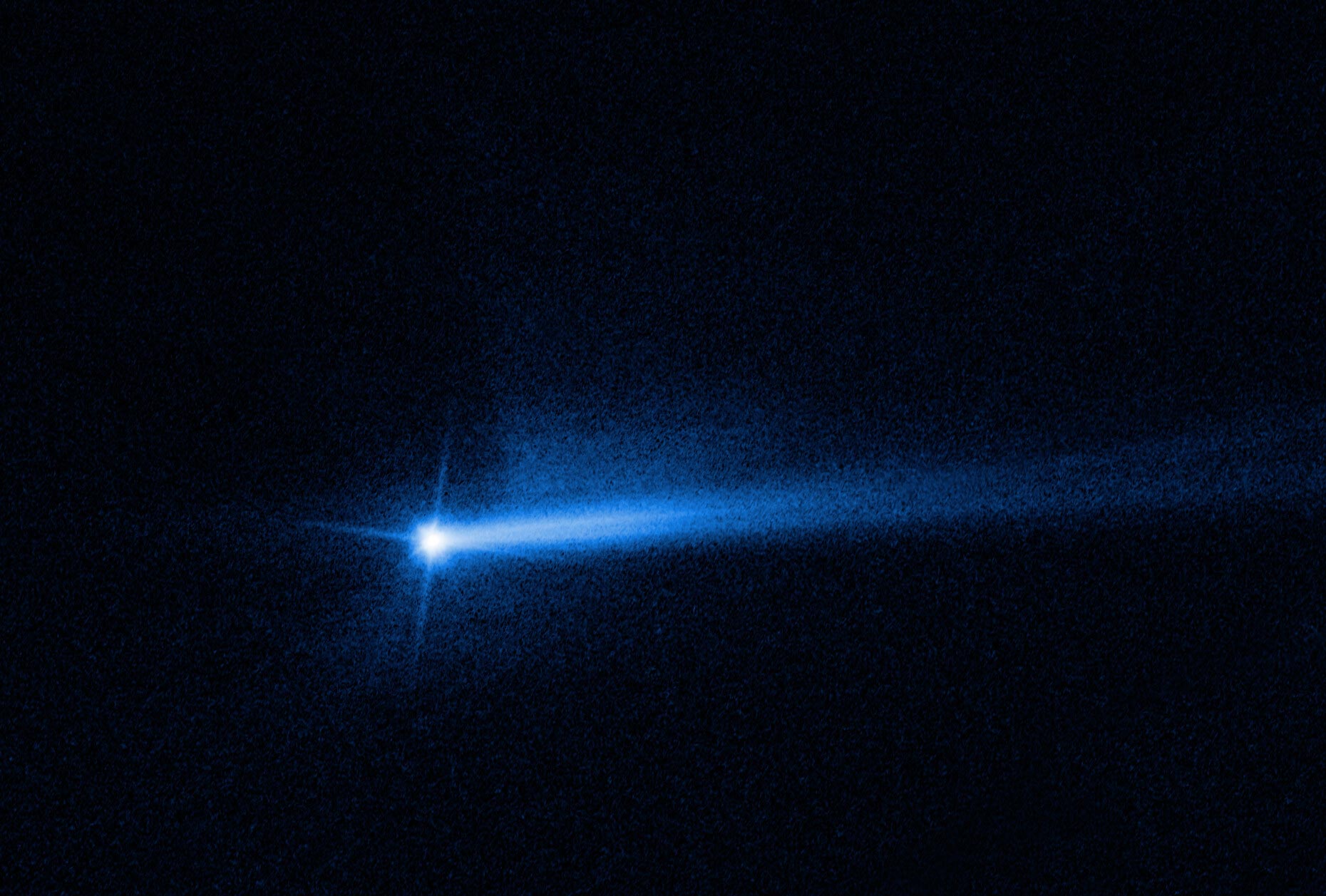
New images from NASA’s Hubble Space Telescope clearly reveal two tails of dust ejected from the Didymos-Dimorphos asteroid system. These images are part of Hubble’s work in documenting the lingering aftermath of NASA’s Double Asteroid Redirection Test (DART) impact.
On September 26, the DART spacecraft intentionally impacted Dimorphos, a small moonlet of Didymos in a planetary defense test. The goal was to change Dimorphos’ orbit by crashing into it. Current data show that DART was successful and shortened Dimorphos’ original 11-hour and 55-minute orbit around Didymos by about 32 minutes.
Over the last several weeks, repeated observations from Hubble have provided scientists with a more complete picture of how the system’s debris cloud has evolved over time. The observations show that the ejected material, or “ejecta,” has expanded and faded in brightness as time went on after impact, largely as expected. Although the twin tail is an unexpected development, similar behavior is often seen in comets and active asteroids. The latest Hubble observations provide the best-quality image of the double-tail to date.
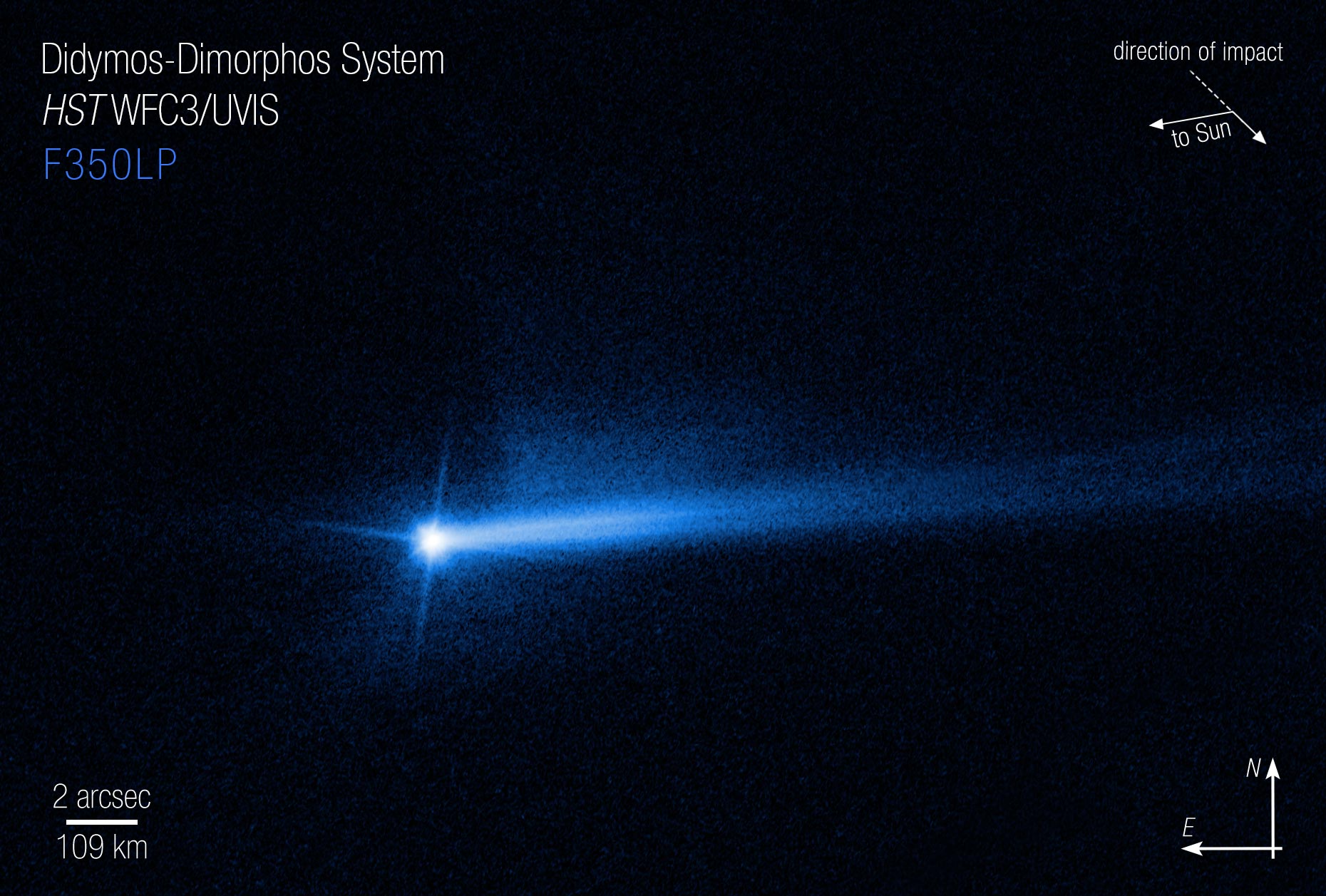
At the top right of the image, there are arrows indicating the direction of impact by the DART spacecraft. The direction of impact arrow points in the 10 o’clock direction. The ‘to Sun’ arrow points in the 8 o’clock direction.
Following impact, Hubble made 18 observations of the system. Imagery indicates the second tail formed between October 2 and October 8.
At the bottom right are compass arrows that indicate the orientation of the image on the sky. The north arrow points directly straight up. The east arrow points to the left in the 9 o’clock direction. In the top left corner of each image are the filters used to create the image. For Hubble, F350LP is blue.
Credit: Science: NASA, ESA, STScI, Jian-Yang Li (PSI), Image Processing: Joseph DePasquale
Hubble made 18 observations of the system following the DART impact. Imagery indicates the second tail formed between October 2 and October 8.
In this image, DART impacted the Didymos-Dimorphos system from the 10 o’clock direction.
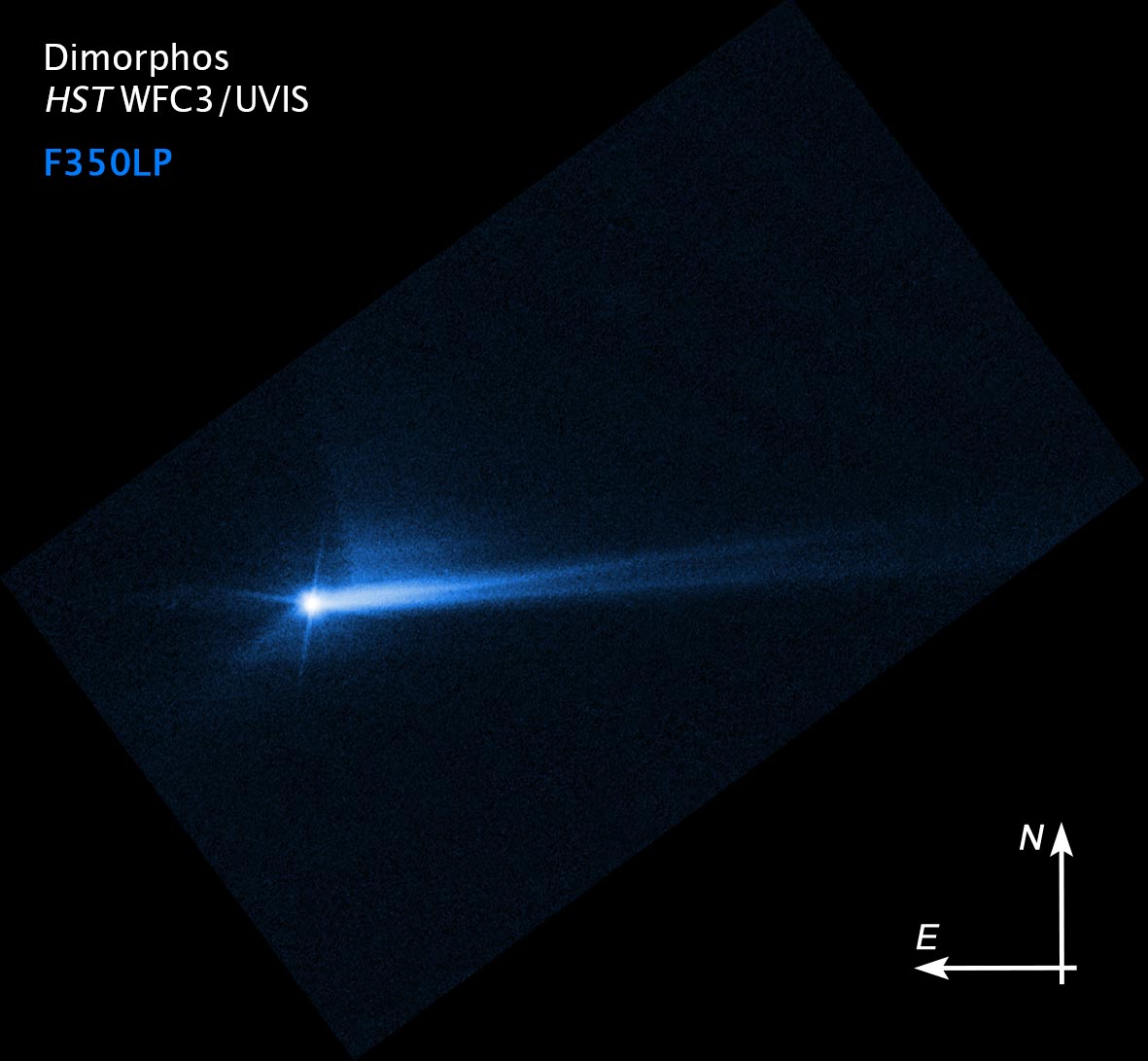
The relationship between the comet-like tail and other ejecta features seen at various times in images from Hubble and other telescopes is still unclear, and is something the Investigation Team is currently working to understand. The northern tail is newly developed. In the coming months, scientists will be taking a closer look at the data from Hubble to determine how the second tail developed. There are a number of possible scenarios the team will investigate.
The Hubble data were collected as part of Cycle 29 General Observers Program 16674.
The Hubble Space Telescope is a project of international cooperation between NASA and ESA. NASA’s Goddard Space Flight Center in Greenbelt, Maryland, manages the telescope. The Space Telescope Science Institute (STScI) in Baltimore, Maryland, conducts Hubble and Webb science operations. STScI is operated for NASA by the Association of Universities for Research in Astronomy, in Washington, D.C.
Never miss a breakthrough: Join the SciTechDaily newsletter.
Follow us on Google and Google News.
15 Comments
So with out the general vote of the people on Earth, NASA impacts a spacecraft on an asteroid. They state it was a safe experiment and I can somewhat believe them but what if something happens that eventually negatively effects earth. What then? Free shrugs? When I see them reveal that something unexpected has now occurred, I have less confidence in their assessment.
Maybe there is a fine balance in how objects have been going about in space for millions of years. That balance allowed a small window, in Earths long history, to be able to host humans. If this leads to some chain reaction that takes years/decades to come to a point where it affects earth, there will be no liability nor consequences for those that allowed this to happen nor those that actually carried it out.
“…general vote of the people on Earth…”
It’s difficult to believe this is a serious comment.
Based on the content of your comment, it is quite obvious that your knowledge of astrophysics and celestial mechanics is so, SO much more intricate and extnsive than anyone who actually worked on and understands what took place in this mission. Could you offer any additional and equally valuable insights into other fields such as nuclear fusion or brain surgery?
I’d agree the sense of foreboding washed over me after reading about the experiment playing cosmic pinball is in my opinion a mistake
Regards Colin brown
Boys, your foreboding and trepidation pales to that of the billions concerned with possible asteroids headed to Earth. Perhaps the reason they selected an asteroid circling and asteroid was that the collision plume would not escape the larger bodies gravitational pull. If some of the pieces were to make it to Earth they are small enough that they would disintegrate in the our atmosphere. Listening to a recent talk by US Space Force’s General Jay Raymond, the space junk circling our planets is a greater issue.
Greenhouse gasses and climate change are due to industries and MONEY and greed. They’re trying to see if shooting one away from the planet would save the planet. Damn, Chicken Little, the sky is not falling. Yet.
I don’t understand why some people are so fearful of things they don’t understand. If everyone felt like this we would still be living in caves. Have faith in the people smarter than you. Every modern advance you benefit from comes from capable people who work very hard to move us forward.
Yes Green House gases by smarter People .many things are being done for greed
I have also been left with a sense of foreboding with this experiment and I have a very keen sense of intuition so don’t discredit their fears….although honestly my sense of dread seems to happen every night when I look up at the moon which seems to keep getting bigger and bigger in the sky and has been enlarging ever since that rocket debris crashed into the dark side of the moon. I fear that it knocked the moon out of its natural orbit position and is now slowly falling towards Earth and I fear that NASA already knows this and is secretly preparing to try to fix it before life as we know it ends.
It’s quite coincidental timeline wise with these tests and the back of the moon being impacted by an out of control manmade object that had a deadly speed upon impact.
Well, if we can crash on it… why not grapple it and use it to explore space…
Just an idea. Thanks
The tail of Dimorphos is interesting but rather addition phenomenon. The main thing is the reality of changing its orbit. It is possible that the main role in the observed features of asteroid mutual shading during the first weeks after the impact was played not by a change in the orbit of Dimorphos as loosely-bound rubble pile.
This role could be played by the evolution of an asymmetric and optically dense near-surface “meteoroid cocoon” consisting of recoiled debris as part of the material ejected into the hemisphere.
Based on the impact geometry (see, for example, diagram in: https://www.kidsnews.com.au/space/first-incredible-pictures-reveal-impact-from-nasa-asteroid-crash/news-story/cb057c5d5c5a2f9aaacb864643d7adbc most of this “cocoon” should have been concentrated on the side of the main component, where, in addition, its attraction maximally contributed to the rebound of large fragments. Such an asymmetry could shift the center of the summarised “albedo spot” (determined owing to asteroid eclipses) towards a shorter orbit relative to the real mass center of the Dimorphos as the parent body towards its shorter orbit.
Therefore, yet it cannot be ruled out that after the “cocoon” dissipation, transformation and/or fallback onto the surface of Dimorphos, its orbit will be partially or almost completely “restored”.
The abrupt appearance of such a “cocoon”, observed as the “swelling” of Dimorphos against the background of a smooth ejection of finer material, was recorded on a video animation compressed into 13 seconds, obtained on the basis of 50-minute observations with a 1-meter telescope of the ATLAS system (see around 50 th second of the video):
https://www.youtube.com/watch?v=bfqVqOl9S9w
“I don’t understand why some people are so fearful of things they don’t understand.“
That exactly how fear generates.
Well, judging by these comments, we should all just cower in the corner and HOPE that no asteroid is headed our way instead of being proactive about it WHEN one I’d headed our way. It’s happened before, it’ll happen again. KUDOS to NASA for at least attempting to give human life a fighting chance. Glad some here don’t work for NASA.
No need for pessimism. The fact that the impact method is unsuitable for real deflection (as well as a nuclear explosion, gravitational tractor, laser fantasies, etc.) does not mean that effective methods have not been proposed.
Today the optimum way (most powerful push thrusting, scalability up to global-threat sizes and any type of hazardous bodies as well as low cost and environmental friendliness) is use of high-focused solar energy by an innovative type of concentrating collector – see: Vasylyev V. P., Deflection of Hazardous Near-Earth Objects by High Concentrated Sunlight and Adequate Design of Optical Collector, Earth, Moon, and Planets, Vol 110, Issue 1-2, pages 67–79 (2013), https://link.springer.com/article/10.1007%2Fs11038-012-9410-2
as well as relevant section of the Wikipedia (“Asteroid impact avoidance – Use of focused solar energy”).
Nothing like shameless self-promotion in the 3rd person.