
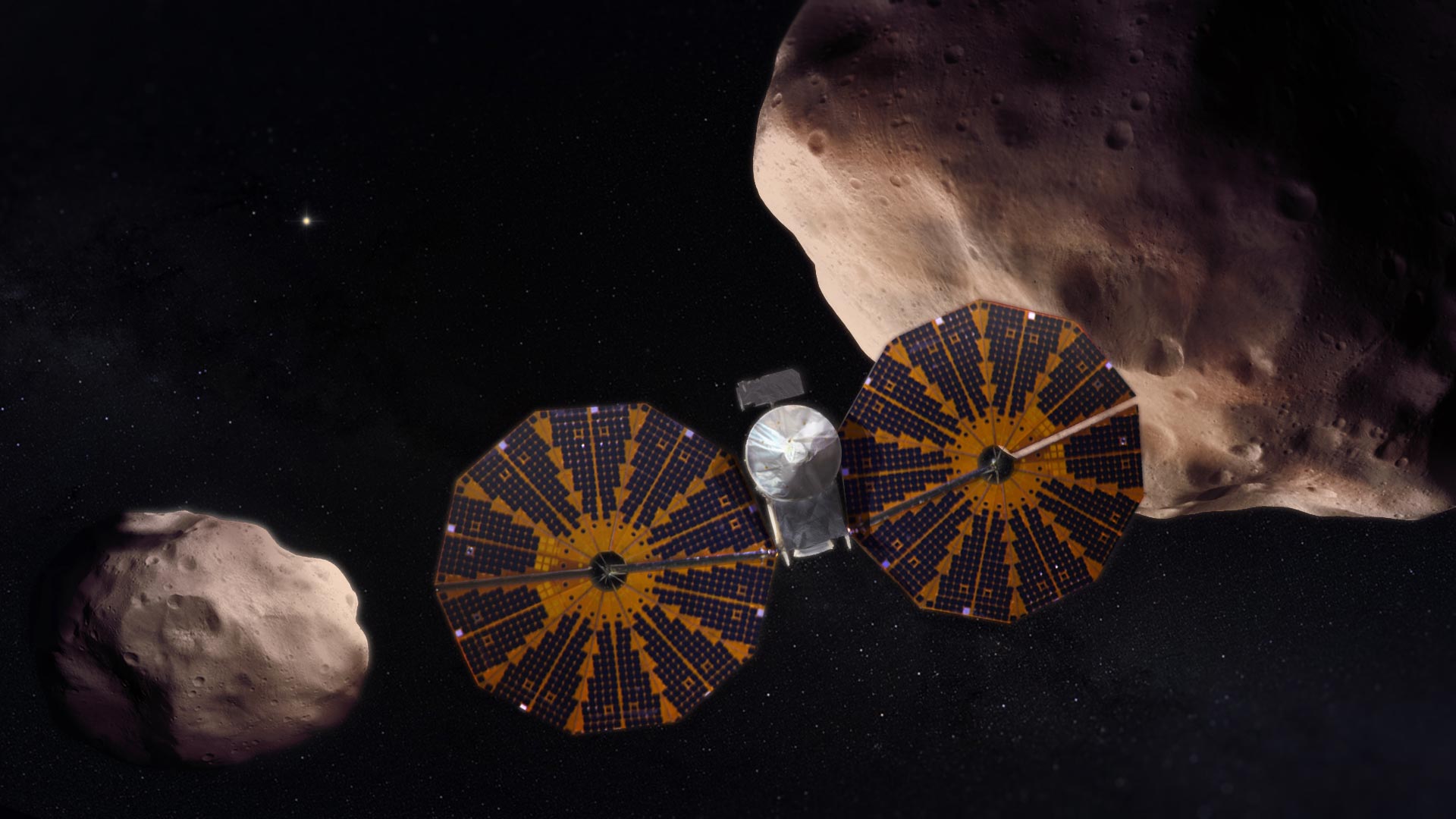
NASA’s Lucy mission discovered a satellite around Polymele, increasing its asteroid targets to nine.
Even before its launch in October 2021, NASA’s Lucy mission was already on course to break records by visiting more asteroids than any previous mission. Now, the mission can add one more asteroid to the list, after a surprise result from a long-running observation campaign.
Lucy’s science team discovered on March 27 that the smallest of the mission’s Trojan asteroid targets, Polymele, has a satellite of its own. On that day, Polymele was expected to pass in front of a star. This would allow the team to observe the star blink out as the asteroid briefly blocked, or occulted, it. The Lucy team planned to measure the location, size, and shape of Polymele with unprecedented precision while it was outlined by the star behind it. To do so, they spread 26 teams of professional and amateur astronomers across the path where the occultation would be visible.
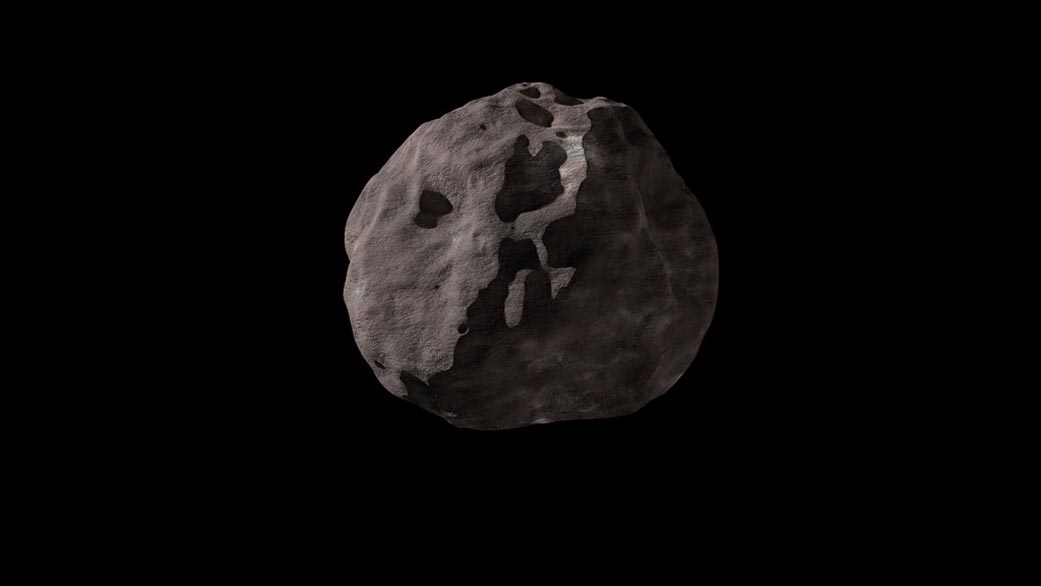
These occultation campaigns have been enormously successful in the past, providing valuable information to the mission on its asteroid targets, but this day would hold a special bonus.
We were thrilled that 14 teams reported observing the star blink out as it passed behind the asteroid. However, as we analyzed the data, we saw that two of the observations were not like the others,” said Marc Buie, Lucy occultation science lead at the Southwest Research Institute, which is headquartered in San Antonio. “Those two observers detected an object around 200 km (about 124 miles) away from Polymele. It had to be a satellite.”
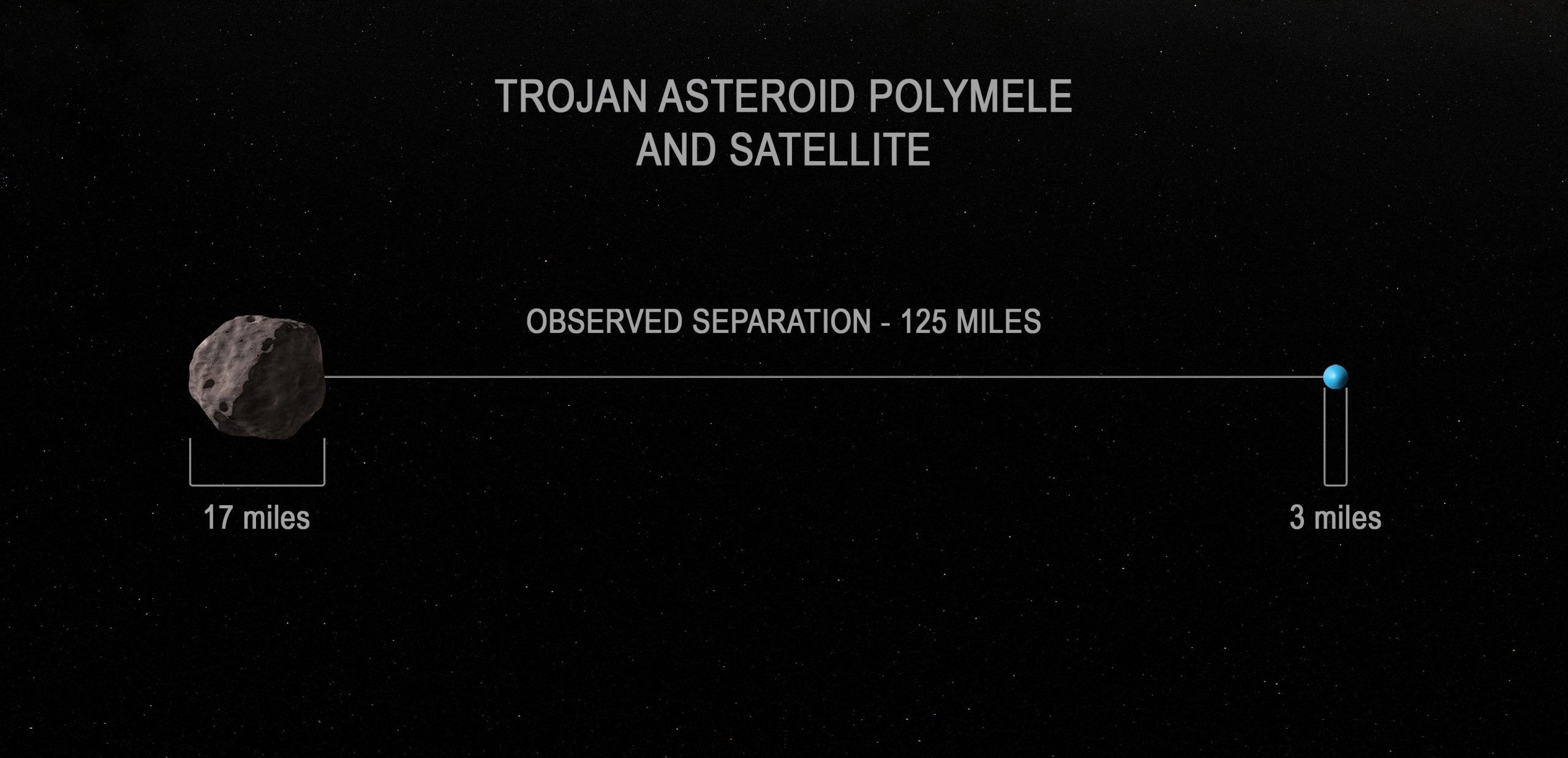
Using the occultation data, the scientists determined that this satellite is roughly 3 miles (5 km) in diameter, orbiting Polymele, which is itself around 17 miles (27 km) along its widest axis. The observed distance between the two bodies was approximately 125 miles (200 km).
Following planetary naming conventions, the satellite will not be issued an official name until the team can determine its orbit. As the satellite is too close to Polymele to be clearly seen by Earth-based or Earth-orbiting telescopes – without the help of a fortuitously positioned star – that determination will have to wait until Lucy approaches the asteroid in 2027, unless the team gets lucky with future occultation attempts before then.
At the time of the observation, Polymele was 480 million miles (770 million km) from Earth. Those distances are roughly equivalent to finding a quarter on a sidewalk in Los Angeles – while trying to spot it from a skyscraper thousands of miles away in Manhattan.

Asteroids hold vital clues to deciphering the history of the solar system – perhaps even the origins of life. Solving these mysteries is a high priority for NASA. The Lucy team originally planned to visit one main belt asteroid and six Trojan asteroids, a previously unexplored population of asteroids that lead and follow Jupiter in its orbit around the Sun. In January of 2021, the team used the Hubble Space Telescope to discover that one of the Trojan asteroids, Eurybates, has a small satellite. Now with this new satellite, Lucy is on track to visit nine asteroids on this remarkable 12-year voyage.
“Lucy’s tagline started out: 12 years, seven asteroids, one spacecraft,” said Lucy program scientist Tom Statler at NASA Headquarters in Washington. “We keep having to change the tagline for this mission, but that’s a good problem to have.”
On January 9, 2020, the Lucy Mission officially announced that it would be visiting not seven, but eight asteroids. As it turns out, Eurybates, one of the asteroids along Lucy’s path, has a small satellite. Shortly after the Lucy team discovered the satellite, both it and Eurybates moved behind the Sun, preventing the team from observing it further. However, the asteroids emerged from behind the Sun in July 2020, and since then, the Lucy team has been able to observe the satellite with Hubble on multiple occasions, allowing the team to precisely define the satellite’s orbit and allowing the little satellite to finally get an official name – Queta.
Lucy’s principal investigator is based out of the Boulder, Colorado, branch of Southwest Research Institute, headquartered in San Antonio, Texas. NASA’s Goddard Space Flight Center in Greenbelt, Maryland, provides overall mission management, systems engineering, and safety and mission assurance. Lockheed Martin Space in Littleton, Colorado, built the spacecraft. Lucy is the 13th mission in NASA’s Discovery Program. NASA’s Marshall Space Flight Center in Huntsville, Alabama, manages the Discovery Program for the agency’s Science Mission Directorate in Washington.
Never miss a breakthrough: Join the SciTechDaily newsletter.
Follow us on Google and Google News.