
Lucy’s New Asteroid Encounter
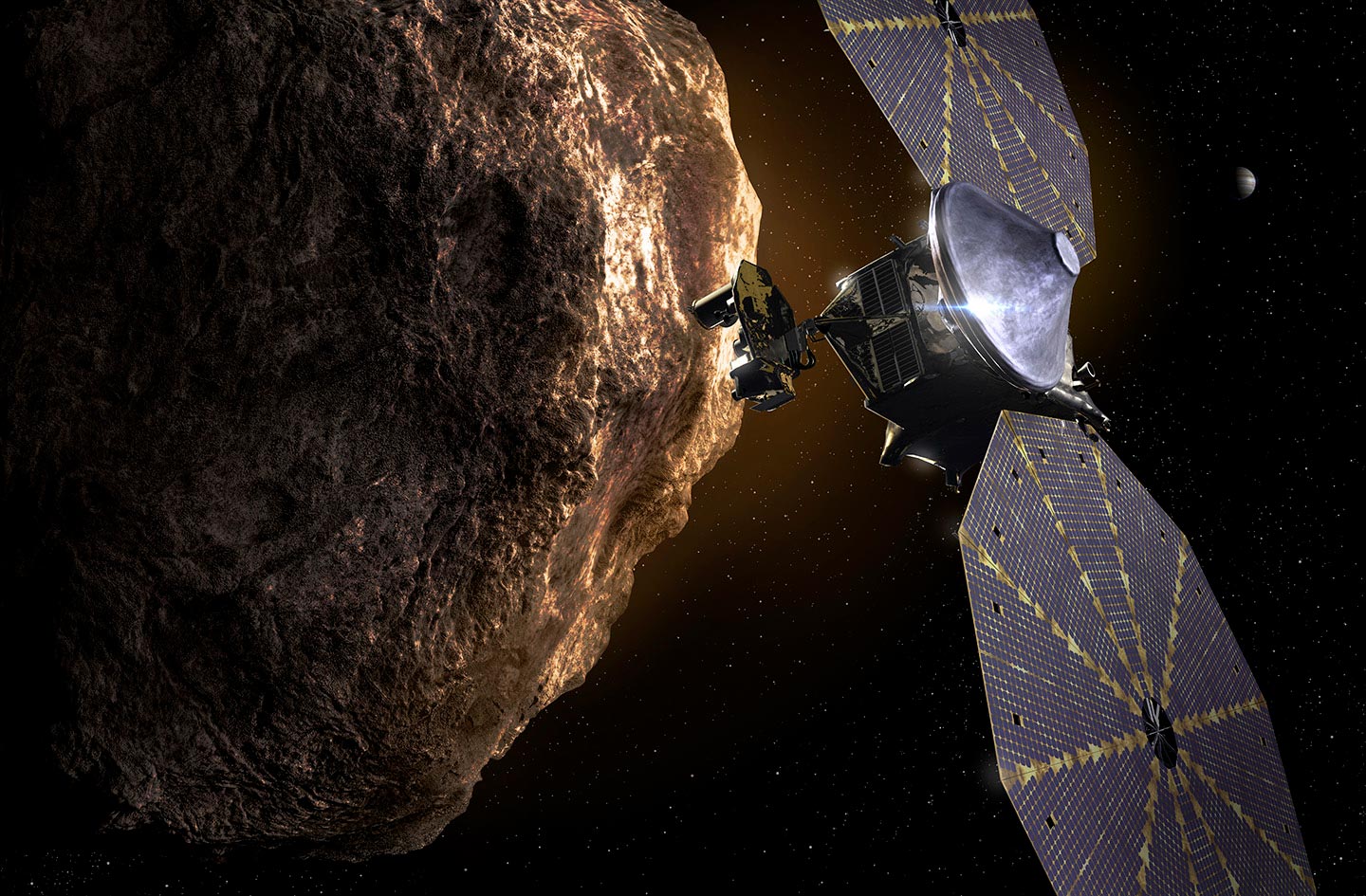
NASA’s Lucy spacecraft will add another asteroid encounter to its 4-billion-mile journey. On November 1, 2023, Lucy will get a close-up view of a small main-belt asteroid to conduct an engineering test of the spacecraft’s innovative asteroid-tracking navigation system.
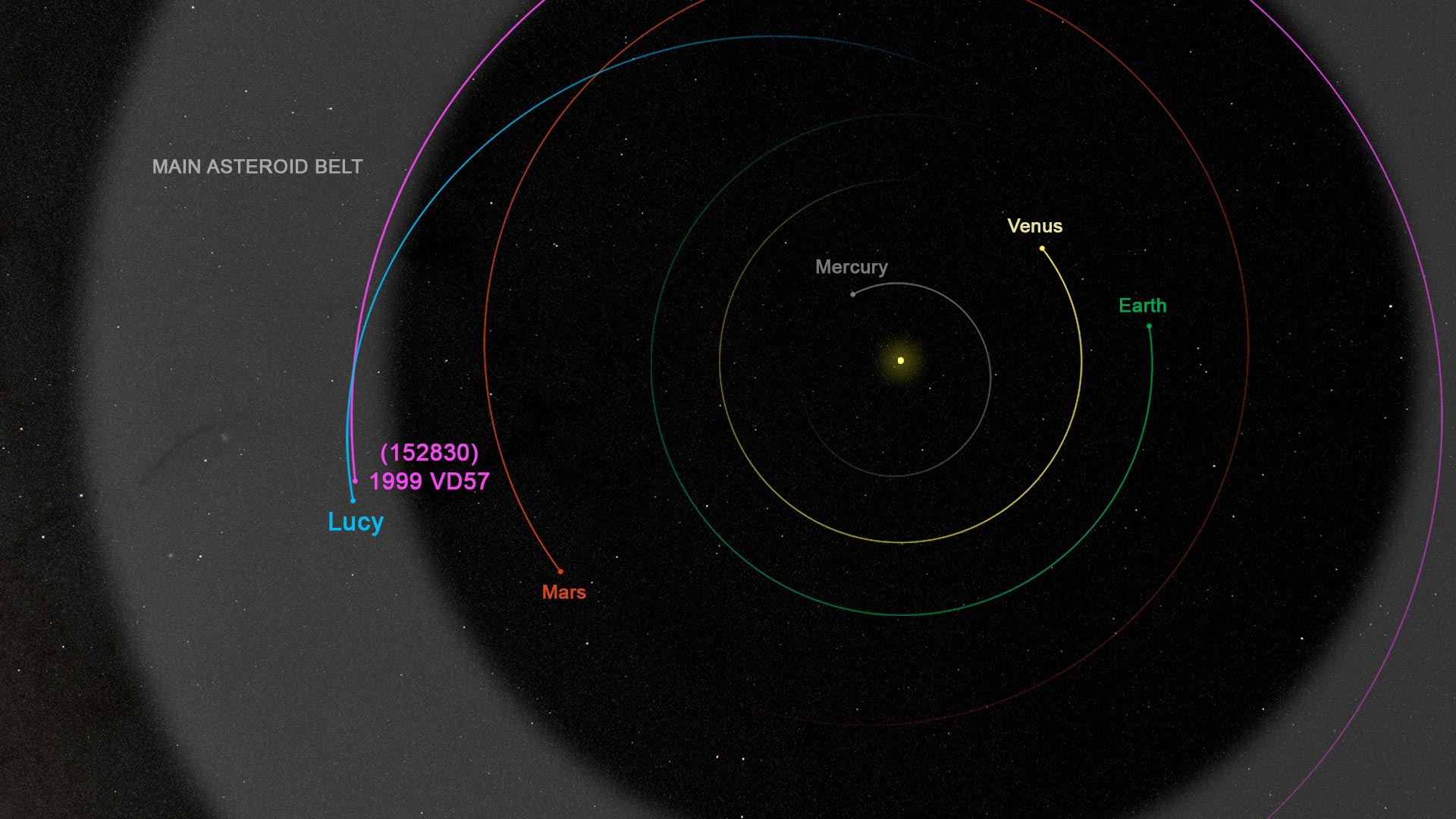
The Lucy mission is already breaking records by planning to visit nine asteroids during its 12-year tour of the Jupiter Trojan asteroids, which orbit the Sun at the same distance as Jupiter. Originally, Lucy was not scheduled to get a close-up view of any asteroids until 2025, when it will fly by the main belt asteroid (52246) Donaldjohanson. However, the Lucy team identified a small, as-yet unnamed asteroid in the inner main belt, designated (152830) 1999 VD57, as a potential new and useful target for the Lucy spacecraft.
“There are millions of asteroids in the main asteroid belt,” said Raphael Marschall, Lucy collaborator at the Nice Observatory in France, who identified asteroid 1999 VD57 as an object of special interest for Lucy. “I selected 500,000 asteroids with well-defined orbits to see if Lucy might be traveling close enough to get a good look at any of them, even from a distance. This asteroid really stood out. Lucy’s trajectory as originally designed will take it within 40,000 miles of the asteroid, at least three times closer than the next closest asteroid.”
Terminal Tracking System
The Lucy team realized that, by adding a small maneuver, the spacecraft would be able to get an even closer look at this asteroid. So, on January 24, the team officially added it to Lucy’s tour as an engineering test of the spacecraft’s pioneering terminal tracking system. This new system solves a long-standing problem for flyby missions: during a spacecraft’s approach to an asteroid, it is quite difficult to determine exactly how far the spacecraft is from the asteroid, and exactly which way to point the cameras.
“In the past, most flyby missions have accounted for this uncertainty by taking a lot of images of the region where the asteroid might be, meaning low efficiency and lots of images of blank space,” said Hal Levison, Lucy principal investigator from the Southwest Research Institute Boulder, Colorado office. “Lucy will be the first flyby mission to employ this innovative and complex system to automatically track the asteroid during the encounter. This novel system will allow the team to take many more images of the target.”
It turns out that 1999 VD57 provides an excellent opportunity to validate this never-before-flown procedure. The geometry of this encounter—particularly the angle that the spacecraft approaches the asteroid relative to the Sun—is very similar to the mission’s planned Trojan asteroid encounters. This allows the team to carry out a dress rehearsal under similar conditions well in advance of the spacecraft’s main scientific targets.
The Smallest Main Belt Asteroid Visited
This asteroid was not identified as a target earlier because it is extremely small. In fact, 1999 VD57, estimated to be a mere 0.4 miles (700 m) in size, will be the smallest main belt asteroid ever visited by a spacecraft. It is much more similar in size to the near-Earth asteroids visited by recent NASA missions OSIRIS-REx and DART than to previously visited main belt asteroids.
The Lucy team will carry out a series of maneuvers starting in early May 2023 to place the spacecraft on a trajectory that will pass approximately 280 miles (450 km) from this small asteroid.
Lucy’s principal investigator is based out of the Boulder, Colorado branch of Southwest Research Institute, headquartered in San Antonio, Texas. NASA’s Goddard Space Flight Center in Greenbelt, Maryland, provides overall mission management, systems engineering, and safety and mission assurance. Lockheed Martin Space in Littleton, Colorado, built the spacecraft. Lucy is the 13th mission in NASA’s Discovery Program. NASA’s Marshall Space Flight Center in Huntsville, Alabama, manages the Discovery Program for the Science Mission Directorate at NASA Headquarters in Washington.
Never miss a breakthrough: Join the SciTechDaily newsletter.
Follow us on Google and Google News.
1 Comment
No comments yet. Later on