
Close Menu
    Facebook X (Twitter) Instagram
    SciTechDaily
    • Biology
    • Chemistry
    • Earth
    • Health
    • Physics
    • Science
    • Space
    • Technology
    Facebook X (Twitter) Pinterest YouTube RSS
    SciTechDaily
    Home»Science»We Asked a NASA Scientist: What Are the Trojan Asteroids? [Video]
    Science

    We Asked a NASA Scientist: What Are the Trojan Asteroids? [Video]

    By NASANovember 2, 2021No Comments3 Mins Read
    Facebook Twitter Pinterest Telegram LinkedIn WhatsApp Email Reddit
    Share
    Facebook Twitter LinkedIn Pinterest Telegram Email Reddit
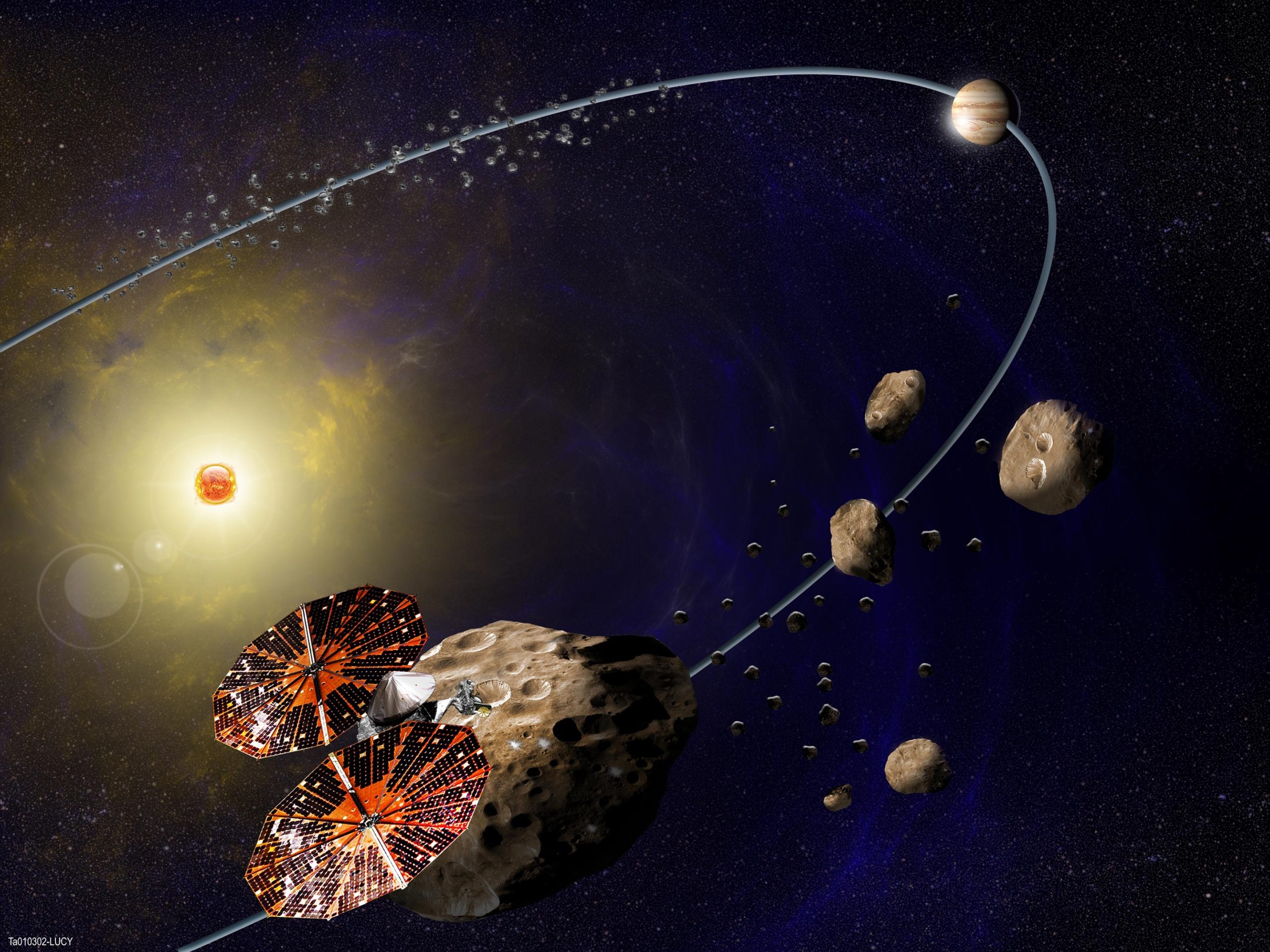
    NASA’s Lucy Mission First Reconnaissance of Trojan Asteroids
    NASA’s Lucy mission, which launched on October 16, 2021, for the first reconnaissance of the Trojans, a population of primitive asteroids orbiting in tandem with Jupiter. In this artist’s concept (not to scale), the Lucy spacecraft is flying by Eurybates, one of the six diverse and scientifically important Trojans to be studied.
    Credit: Southwest Research Institute

    What are the Trojan asteroids? These mysterious space rocks have been gravitationally trapped in Jupiter’s orbit around the Sun for billions of years and hold clues to the formation of our solar system. NASA’s Lucy mission will be the first spacecraft to study these ancient relics up close. Lucy scientist Audrey Martin at Northern Arizona University has the details.

    What are the Trojan asteroids? Let’s begin by going back over four billion years when the newly formed solar system consisted of trillions of tiny little rocky and icy objects. Many of these objects came together to form the planets. The majority of the others were scattered into the distant reaches of our solar system and beyond, but not all of them.

    Some of these leftover space rocks are pristine asteroids that now orbit with Jupiter in two huge swarms leading and trailing the planet. They’re known as the Trojan asteroids. They’re really mysterious and we think that they come from the outer solar system. They’re also special in terms of understanding the evolution of the solar system because they’ve remained gravitationally stable for over billions of years. Astronomers have only been able to study these distant and enigmatic small bodies from Earth, but all of that is about to change.

    NASA’s Lucy mission recently launched on a 12-year journey to visit these primitive asteroids. This will be the first time that we are able to see these objects up close!

    So, what are the Trojan asteroids? They’re asteroids that orbit with Jupiter around the Sun that ultimately hold the clues to the formation of our solar system.

    We Asked a NASA Expert Video Series

    • Why is Venus Called Earth’s Evil Twin?
    • Is NASA Really Crashing a Spacecraft Into an Asteroid?
    • Is NASA Aware of Any Earth-Threatening Asteroids?
    • When Was the Last Time an Asteroid Hit Earth?
    • How Did Perseverance Mars Rover Pick Its Landing Spot?
    • What if an Asteroid Was Going To Hit Earth?
    • Did Mars Ever Look Like Earth?
    • What Are Lagrange Points?
    • What Are the Trojan Asteroids?
    • Is There Oxygen on Mars?
    • Does NASA Know About All the Asteroids?
    • Do Aliens Exist?
    • Is There Weather on Mars?
    • Will an Asteroid Ever Hit Earth?
    • Is Mars Habitable?
    • Could Microbes Survive a Trip to Mars?

    Never miss a breakthrough: Join the SciTechDaily newsletter.
    Follow us on Google and Google News.

    Asteroid NASA
    Share. Facebook Twitter Pinterest LinkedIn Email Reddit

    Related Articles

    NASA to Study Ryugu Asteroid Sample Collected by Japan’s Hayabusa2 in New Astromaterials Research Lab

    Spitzer Reveals That Asteroid Don Quixote is a Comet

    NEOWISE Data Reveals Potentially Hazardous Asteroids

    Dawn Mission Reveals the Inner Secrets of Vesta

    Dawn Images Shine New Light on Vesta

    Bus-Sized Asteroid Barely Misses Earth

    Scientists Believe Water Ice May Exist on the Giant Asteroid Vesta

    Airborne NASA Radar to Study Kilauea Volcano in Hawaii

    NASA Probe Takes Close-Up Photos of Giant Vesta Asteroid

    Leave A Reply Cancel Reply

    • Facebook
    • Twitter
    • Pinterest
    • YouTube

    Don't Miss a Discovery

    Subscribe for the Latest in Science & Tech!

    Trending News

    Largest-Ever Study Finds Medicinal Cannabis Ineffective for Anxiety, Depression, PTSD

    250-Million-Year-Old Egg Solves One of Evolution’s Biggest Mysteries

    Living With Roommates Might Be Changing Your Gut Microbiome Without You Knowing

    Century-Old Cleaning Chemical Linked to 500% Increased Risk of Parkinson’s Disease

    What if Your Memories Never Happened? Physicists Take a New Look at the Boltzmann Brain Paradox

    One of the Universe’s Largest Stars May Be Getting Ready To Explode

    Scientists Discover Enzyme That Could Supercharge Ozempic-Like Weight Loss Drugs

    Popular Sweetener Linked to DNA Damage – “It’s Something You Should Not Be Eating”

    Follow SciTechDaily
    • Facebook
    • Twitter
    • YouTube
    • Pinterest
    • Newsletter
    • RSS
    SciTech News
    • Biology News
    • Chemistry News
    • Earth News
    • Health News
    • Physics News
    • Science News
    • Space News
    • Technology News
    Recent Posts
    • A Cosmic Crash Turned This Nearby Galaxy Into Chaos
    • This Alien Solar System Doesn’t Follow the Rules – and Scientists Are Intrigued
    • What Did Prehistoric Europeans Eat? Scientists Uncover Surprising Answers
    • Scientists Say This Overlooked Organ Could Hold the Key to Longer Life
    • Want Less Stress? Landmark Study Points to a Simple Habit
    Copyright © 1998 - 2026 SciTechDaily. All Rights Reserved.
    • Science News
    • About
    • Contact
    • Editorial Board
    • Privacy Policy
    • Terms of Use

    Type above and press Enter to search. Press Esc to cancel.