
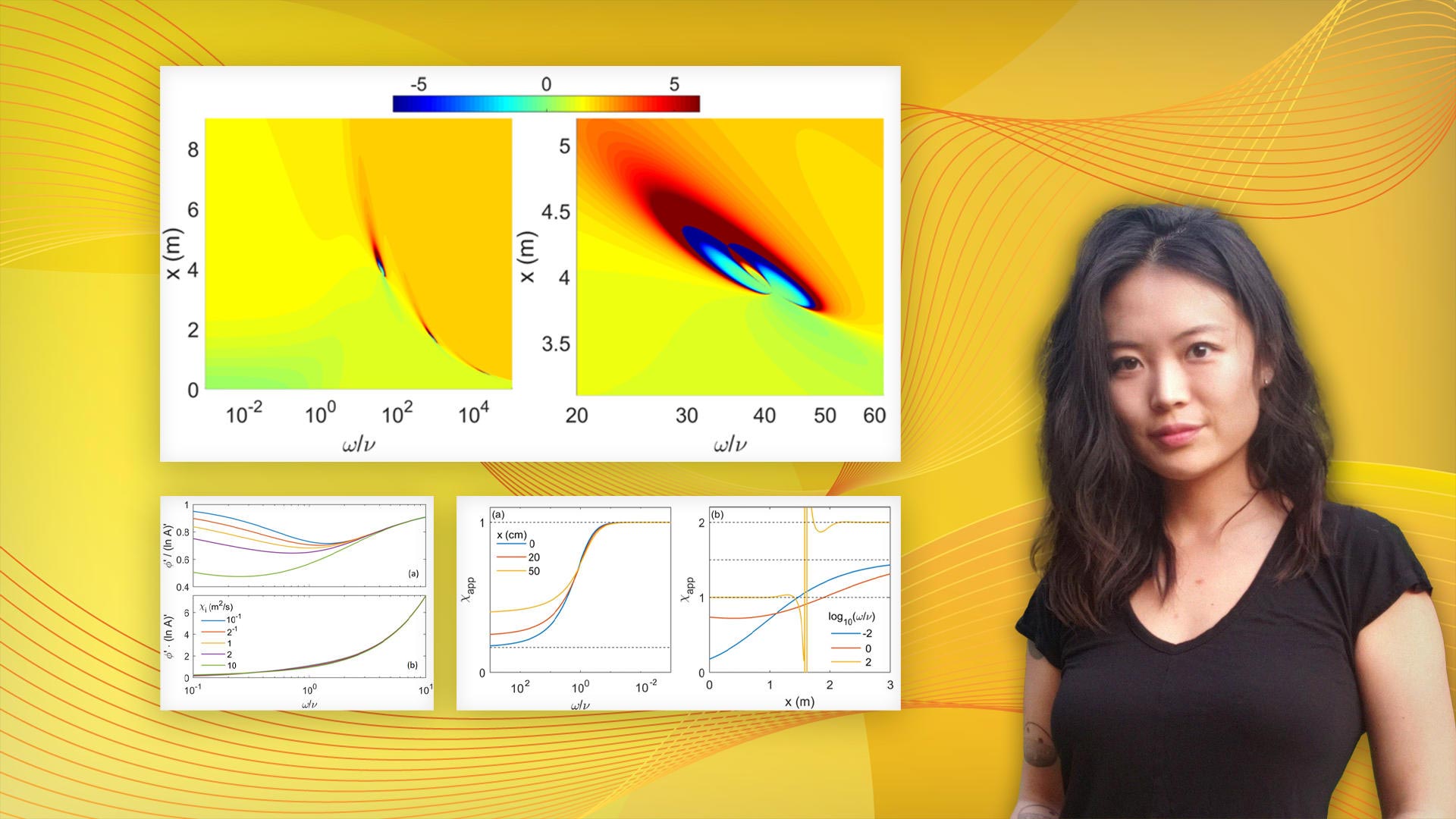
A new PPPL model shows electrons and ions interact strongly in plasma heat transport, boosting accuracy and helping fusion research move closer to practical energy.
A high-tech fusion facility is like a thermos — both keep their contents as hot as possible. Fusion facilities confine electrically charged gas known as plasma at temperatures 10 times hotter than the sun, and keeping it hot is crucial to stoking the fusion reactions that scientists seek to harness to create a clean, plentiful source of energy for producing electricity.
Now, researchers at the U.S. Department of Energy’s (DOE) Princeton Plasma Physics Laboratory (PPPL) have made simple changes to equations that model the movement of heat in plasma. The changes improve insights that could help engineers avoid the conditions that could lead to heat loss in future fusion facilities.
Fusion, the power that drives the sun and stars, combines light elements in the form of plasma — the hot, charged state of matter composed of free electrons and atomic nuclei — that generates massive amounts of energy. Scientists are seeking to replicate fusion on Earth for a virtually inexhaustible supply of power to generate electricity.
“The whole magnetic confinement fusion approach basically boils down to holding a plasma together with magnetic fields and then getting it as hot as possible by keeping heat confined,” said Suying Jin, a graduate student in the Princeton Program for Plasma Physics and lead author of a paper reporting the results in Physical Review E. “To accomplish this goal, we have to fundamentally understand how heat moves through the system.”
Rethinking Plasma Heat Transport Models
Scientists had been using an analysis technique that assumed that the heat flowing among electrons was substantially unaffected by the heat flowing among the much larger ions, Jin said. But she and colleagues found that the two pathways for heat actually interact in ways that can profoundly affect how measurements are interpreted. By allowing for that interaction, scientists can measure the temperatures of electrons and ions more accurately. They also can infer information about one pathway from information about the other.
“What’s exciting about this is that it doesn’t require different equipment,” Jin said. “You can do the same experiments and then use this new model to extract much more information from the same data.”
Jin became interested in heat flow during earlier research into magnetic islands, plasma blobs formed from swirling magnetic fields. Modeling these blobs depends on accurate measurements of heat flow. “Then we noticed gaps in how other people had measured heat flow in the past,” Jin said. “They had calculated the movement of heat assuming that it moved only through one channel. They didn’t account for interactions between these two channels that affect how the heat moves through the plasma system. That omission led both to incorrect interpretations of the data for one species and missed opportunities to get further insights into the heat flow through both species.”
Fresh Insights into Electron–Ion Coupling
Jin’s new model provides fresh insights that weren’t available before. “It’s generally easier to measure electron heat transport than it is to measure ion heat transport,” said PPPL physicist Allan Reiman, a paper co-author. “These findings can give us an important piece of the puzzle in an easier way than expected.”
“It is remarkable that even minimal coupling between electrons and ions can profoundly change how heat propagates in plasma,” said Nat Fisch, Professor of Astrophysical Sciences at Princeton University and a co-author of the paper. “This sensitivity can now be exploited to inform our measurements.”
The new model will be used in future research. “We are looking at proposing another experiment in the near future, and this model will give us some extra knobs to turn to understand the results,” Reiman said. “With Jin’s model, our inferences will be more accurate. We now know how to extract the additional information we need.”
Reference: “Coupled heat pulse propagation in two-fluid plasmas” by S. Jin, A. H. Reiman and N. J. Fisch, 4 May 2021, Physical Review E.
DOI: 10.1103/PhysRevE.103.053201
Never miss a breakthrough: Join the SciTechDaily newsletter.
Follow us on Google and Google News.
1 Comment
… it is kind of hard to concentrate on the words… am not an A grade student…