
The Shape of Heavy Nuclei Changes As the Energy Level Varies
The universe is governed by four fundamental forces that dictate the interactions between particles and shape the world we know. These forces include the electromagnetic force, gravity, weak nuclear force, and strong nuclear force. These fundamental forces act on everything from the tiniest atoms to the largest galaxies in the universe.
A recent study from the Argonne National Laboratory and the University of North Carolina at Chapel Hill has brought researchers closer to understanding the strong nuclear force, one of the most enigmatic of the fundamental forces.
Their work builds on foundational theories of atomic structures that originated with Argonne physicist and Nobel Prize winner Maria Goeppert Mayer in the early 1960s. She helped develop a mathematical model for the structure of nuclei. Her model explained why certain numbers of protons and neutrons in the nucleus of an atom cause it to be extremely stable — a phenomenon that had baffled scientists for some time.
Investigating the Ni-64 Nucleus
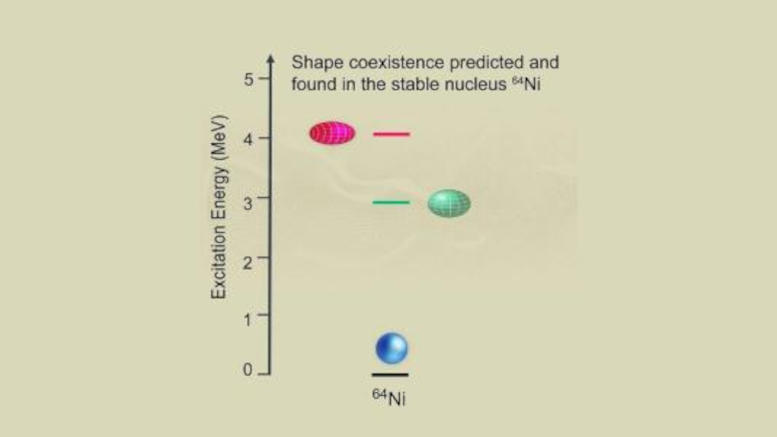
The research team previously conducted similar experiments to study the strong nuclear force by examining how the structure of a nucleus can change when it is produced in an excited state through a nuclear reaction. These and other experiments done elsewhere led them to investigate nickel-64, which has 64 neutrons and protons. This nucleus is the heaviest stable nickel nucleus, with 28 protons and 36 neutrons. This nickel isotope has properties that allow its structure to change when it is excited to higher energy states.
For their experiment, the team used the Argonne Tandem Linac Accelerator System, a DOE Office of Science user facility, to accelerate a sample of Ni-64 nuclei toward a target of lead. The lead atoms were able to excite the Ni-64 nuclei through the electromagnetic forces resulting from the repulsion between the protons in lead and the protons in nickel.
The process looks similar to putting a bag of popcorn in the microwave. As the kernels warm up, they begin to pop into all different shapes and sizes. The popcorn that comes out of the microwave is different than what went in and crucially, the kernels changed their shape due to the energy exerted upon them.
After the Ni-64 nuclei were excited, an instrument called GRETINA detected the gamma rays released when the nuclei decayed back to their ground state. Another detector named CHICO2 determined the direction of the particles involved in the interaction. The data obtained by the detectors allowed the team to determine what shape — or shapes — the Ni-64 took as it was excited.
Unusual Shape-Shifting Behavior in Heavy Nuclei
From the analysis of the data, it was concluded that the Ni-64 nuclei excited by interactions with lead also changed their shape. But instead of popping into familiar fluffy shapes, the nickel’s spherical atomic nucleus changed into one of two shapes depending on the amount of energy exerted on it: oblate, like a doorknob, or prolate, like a football. This finding is unusual for heavy nuclei like Ni-64, which consist of many protons and neutrons.
“A model is a picture of reality and it’s only a valid model if it can explain what was known before, and it has some predictive power,” said Robert Janssens, a professor at UNC-Chapel Hill and co-author of the paper. “We are studying the nature and behavior of nuclei to continuously improve our current models of the strong nuclear force.”
Ultimately, the researchers hope their findings in Ni-64 and surrounding nuclei can lay the foundations for future practical discoveries in the nuclear science field, such as nuclear energy, astrophysics, and medicine. “More than 50% of the medical procedures in hospitals today involve nuclear isotopes,” Janssens said. “And most of these isotopes have been discovered while doing fundamental research like we are doing.”
Reference: “Multistep Coulomb excitation of 64Ni: Shape coexistence and nature of low-spin excitations” by D. Little, A. D. Ayangeakaa, R. V. F. Janssens, S. Zhu, Y. Tsunoda, T. Otsuka, B. A. Brown, M. P. Carpenter, A. Gade, D. Rhodes, C. R. Hoffman, F. G. Kondev, T. Lauritsen, D. Seweryniak, J. Wu, J. Henderson, C. Y. Wu, P. Chowdhury, P. C. Bender, A. M. Forney and W. B. Walters, 14 October 2022, Physical Review C.
DOI: 10.1103/PhysRevC.106.044313
The study was funded by the DOE Office of Nuclear Physics and the National Science Foundation.
Never miss a breakthrough: Join the SciTechDaily newsletter.
Follow us on Google and Google News.
2 Comments
The interactions and balances of topological vortex fields cover all short-distance and long-distance contributions, and are the basis of the formation and evolution of cosmic matter.
Two or more topological vortices interact together, in which the vortex cores or planes are deviated, or the vortex cores and planes all are deviated.
(1) Absolute Space-time
The cores of the vortices are coincided, where the vortex planes of them are deviated from each other. This vortex field is defined as Absolute Space-time (AST). The typical geometric model is pherical or oblate.
(2) Quantum Space-time
The planes of the vortices are superimposed in the same easy-planes, where the vortex cores of them deviate. This vortex field is defined as Quantum Space-time (QST). The typical geometric model is Möbius strip.
(3) Relative Space-time
The cores and the planes of the vortices all are deviated from each other. This vortex field is defined as Relative Space-time (RST). The typical geometric model is cylinder.
According to the topological vortex field theory, the topological vortex forms a natural gravitational field through its spin. From the cosmic space accretion disk to the quantum spin, nothing is different. Therefore, the end of science is mathematics, not theology and unbridled delusion.