
Close Menu
    Facebook X (Twitter) Instagram
    SciTechDaily
    • Biology
    • Chemistry
    • Earth
    • Health
    • Physics
    • Science
    • Space
    • Technology
    Facebook X (Twitter) Pinterest YouTube RSS
    SciTechDaily
    Home»Space»Mysterious Dusty Object Discovered by Astronomers Using NASA’s TESS Planet Hunter
    Space

    Mysterious Dusty Object Discovered by Astronomers Using NASA’s TESS Planet Hunter

    By Harvard-Smithsonian Center for AstrophysicsJanuary 3, 2022No Comments4 Mins Read
    Facebook Twitter Pinterest Telegram LinkedIn WhatsApp Email Reddit
    Share
    Facebook Twitter LinkedIn Pinterest Telegram Email Reddit
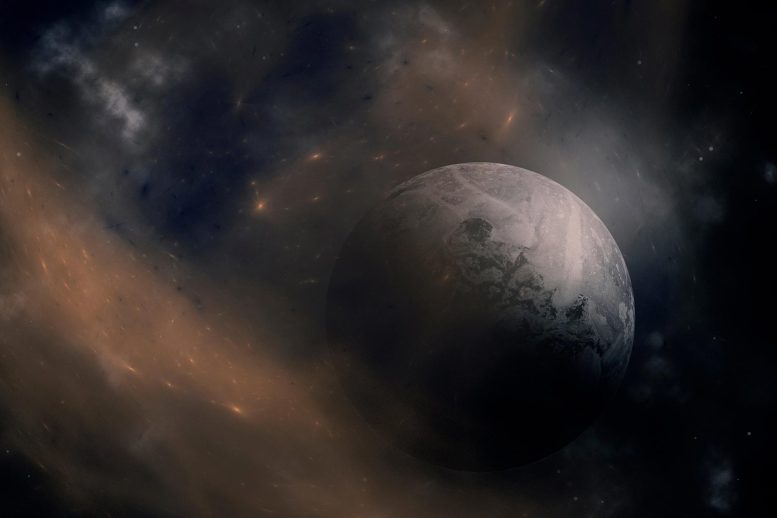
    Dark Exoplanet
    TESS’s achievements include the discovery of the binary star system TIC 400799224, which shows periodic dimming from dust clouds despite its potential instability. This phenomenon has persisted over six years, sustaining interest in its long-term observation and analysis.

    TESS, operational since 2018, has cataloged over a billion celestial objects and notably discovered TIC 400799224, a binary star system with erratic dimming caused by an orbiting body’s dust emissions. Remarkably, the system’s periodicity has remained stable over time, despite the transient nature of the dust clouds, making it a focal point for ongoing astronomical study.

    The Transiting Exoplanet Survey Satellite, TESS, was launched in 2018 with the goal of discovering small planets around the Sun’s nearest neighbor stars. TESS has so far discovered 172 confirmed exoplanets and compiled a list of 4,703 candidate exoplanets. Its sensitive camera takes images that span a huge field of view, more than twice the area of the constellation of Orion, and TESS has also assembled a TESS Input Catalog (TIC) with over 1 billion objects. Follow-up studies of TIC objects have found they result from stellar pulsations, shocks from supernovae, disintegrating planets, gravitational self-lensed binary stars, eclipsing triple star systems, disk occultations, and more.

    CfA astronomer Karen Collins was a member of a large team that discovered the mysterious variable object TIC 400799224. They searched the Catalog using machine-learning-based computational tools developed from the observed behaviors of hundreds of thousands of known variable objects; the method has previously found disintegrating planets and bodies that are emitting dust, for example. The unusual source TIC 400799224 was spotted serendipitously because of its rapid drop in brightness, by nearly 25% in just a few four hours, followed by several sharp brightness variations that could each be interpreted as an eclipse.
    TIC 400799224
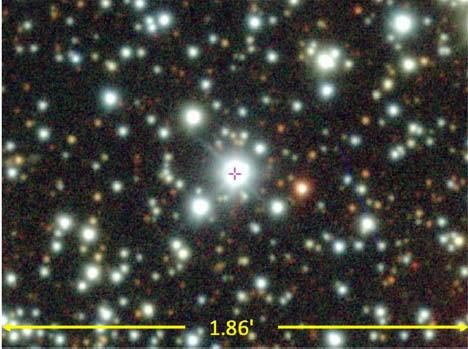
    An optical/near-infrared image of the sky around the TESS Input Catalog (TIC) object TIC 400799224 (the crosshair marks the location of the object, and the width of the field of view is given in arcminutes). Astronomers have concluded that the mysterious periodic variations in the light from this object are caused by an orbiting body that periodically emits clouds of dust that occult the star. Credit: Powell et al., 2021

    Evidence Suggests a Dust-Emitting Binary System

    The astronomers studied TIC 400799224 with a variety of facilities including some that have been mapping the sky for longer than TESS has been operating. They found that the object is probably a binary star system, and that one of the stars pulsates with a 19.77 day period, probably from an orbiting body that periodically emits clouds of dust that occult the star. But while the periodicity is strict, the dust occultations of the star are erratic in their shapes, depths, and durations, and are detectable (at least from the ground) only about one-third of the time or less.

    Given the amount of dust released, the nature of the orbital body itself is unclear; if it were created by like the asteroid Ceres in our solar system disintegrating, it would only last for eight thousand years before disappearing. Amazingly, though, the periodicity has stayed rigid over the six years that this object has been seen and the object producing the dust seems to have remained intact.

    The team plans to continue monitoring the object and to incorporate historical observations of the sky to try to determine its variations over many decades.

    Reference: “Mysterious Dust-emitting Object Orbiting TIC 400799224” by Brian P. Powell, Veselin B. Kostov, Saul A. Rappaport, Andrei Tokovinin, Avi Shporer, Karen A. Collins, Hank Corbett, Tamás Borkovits, Bruce L. Gary, Eugene Chiang, Joseph E. Rodriguez, Nicholas M. Law, Thomas Barclay, Robert Gagliano, Andrew Vanderburg, Greg Olmschenk, Ethan Kruse, Joshua E. Schlieder, Alan Vasquez Soto, Erin Goeke, Thomas L. Jacobs, Martti H. Kristiansen, Daryll M. LaCourse, Mark Omohundro, Hans M. Schwengeler, Ivan A. Terentev and Allan R. Schmitt, 8 December 2021, The Astronomical Journal.
    DOI: 10.3847/1538-3881/ac2c81

    Never miss a breakthrough: Join the SciTechDaily newsletter.
    Follow us on Google and Google News.

    Astronomy Astrophysics Harvard-Smithsonian Center for Astrophysics NASA Popular TESS
    Share. Facebook Twitter Pinterest LinkedIn Email Reddit

    Related Articles

    In the “Hot Neptune Desert,” a Rare Planet Offers Clues to Cosmic Mysteries

    NASA’s Planet Hunter’s Rare Glimpse at Two Black Holes in a Faraway Galaxy

    Cosmic Choreography: Unraveling the 6-Planet Resonance Mystery

    Perplexing Stellar Pulsations: Regular Rhythms Discovered in Mysterious Pulsating Stars

    Tiny Red Dwarf Star Has a Magnetic Field Several Hundred Times Stronger Than Our Sun

    Newfound Venus-Like Planet GJ 1132b May Have an Atmosphere

    Fermi Data Reveal New Clues to Dark Matter

    Magnetic Winds From a Young Star in the Orion Nebula

    Pr0201b and Pr0211b Orbiting Sun-Like Stars in the Beehive Cluster

    Leave A Reply Cancel Reply

    • Facebook
    • Twitter
    • Pinterest
    • YouTube

    Don't Miss a Discovery

    Subscribe for the Latest in Science & Tech!

    Trending News

    New “Nanozyme Hypothesis” Could Rewrite the Story of Life’s Origins

    Anatomy Isn’t Finished: The Human Body Still Holds Secrets

    “Pretty Close to Home”: The Hidden Earthquake Threat Beneath Seattle

    The Surprising Reason You Might Want To Sleep Without a Pillow

    Scientists Say This Natural Hormone Reverses Obesity by Targeting the Brain

    35-Million-Year-Old Mystery: Strange Arachnid Discovered Preserved in Amber

    Is AI Really Just a Tool? It Could Be Altering How You See Reality

    JWST Reveals a “Forbidden” Planet With a Baffling Composition

    Follow SciTechDaily
    • Facebook
    • Twitter
    • YouTube
    • Pinterest
    • Newsletter
    • RSS
    SciTech News
    • Biology News
    • Chemistry News
    • Earth News
    • Health News
    • Physics News
    • Science News
    • Space News
    • Technology News
    Recent Posts
    • Scientists Finally Crack the 100-Million-Year Evolutionary Mystery of Squid and Cuttlefish
    • This Algae Could One Day Pull Microplastics out of Your Drinking Water
    • Scientists Can Now Read Your Body Clock From a Single Hair
    • Beyond “Safe Levels”: Study Challenges What We Know About Pesticides and Cancer
    • Researchers Have Found a Dietary Compound That Increases Longevity
    Copyright © 1998 - 2026 SciTechDaily. All Rights Reserved.
    • Science News
    • About
    • Contact
    • Editorial Board
    • Privacy Policy
    • Terms of Use

    Type above and press Enter to search. Press Esc to cancel.