
Close Menu
    Facebook X (Twitter) Instagram
    SciTechDaily
    • Biology
    • Chemistry
    • Earth
    • Health
    • Physics
    • Science
    • Space
    • Technology
    Facebook X (Twitter) Pinterest YouTube RSS
    SciTechDaily
    Home»Space»Astronomy & Astrophysics 101: What Is “Redshift?”
    Space

    Astronomy & Astrophysics 101: What Is “Redshift?”

    By European Space Agency (ESA)February 20, 20224 Comments4 Mins Read
    Facebook Twitter Pinterest Telegram LinkedIn WhatsApp Email Reddit
    Share
    Facebook Twitter LinkedIn Pinterest Telegram Email Reddit
    What is Cosmological Redshift Crop
    (Click image to see full infographic.) The universe is expanding, and that expansion stretches light traveling through space in a phenomenon known as cosmological redshift. The greater the redshift, the greater the distance the light has traveled. As a result, telescopes with infrared detectors are needed to see light from the first, most distant galaxies. Credit: NASA, ESA, AND L. Hustak (STSci)

    What Is “Redshift?”

    ‘Redshift’ is a key concept for astronomers. The term can be understood literally — the wavelength of the light is stretched, so the light is seen as ‘shifted’ towards the red part of the spectrum.

    Something similar happens to sound waves when a source of sound moves relative to an observer. This effect is called the ‘Doppler effect’ after Christian Andreas Doppler, an Austrian mathematician who discovered that the frequency of sound waves changes if the source of sound and the observer are moving relative to each other.

    If the two are approaching, then the frequency heard by the observer is higher; if they move away from each other, the frequency heard is lower.

    There are many everyday examples of the Doppler effect — the changing pitch of police and ambulance sirens, or train whistles and racing car engines as they pass by. In every case, there is an audible change in pitch as the source approaches and then passes an observer.
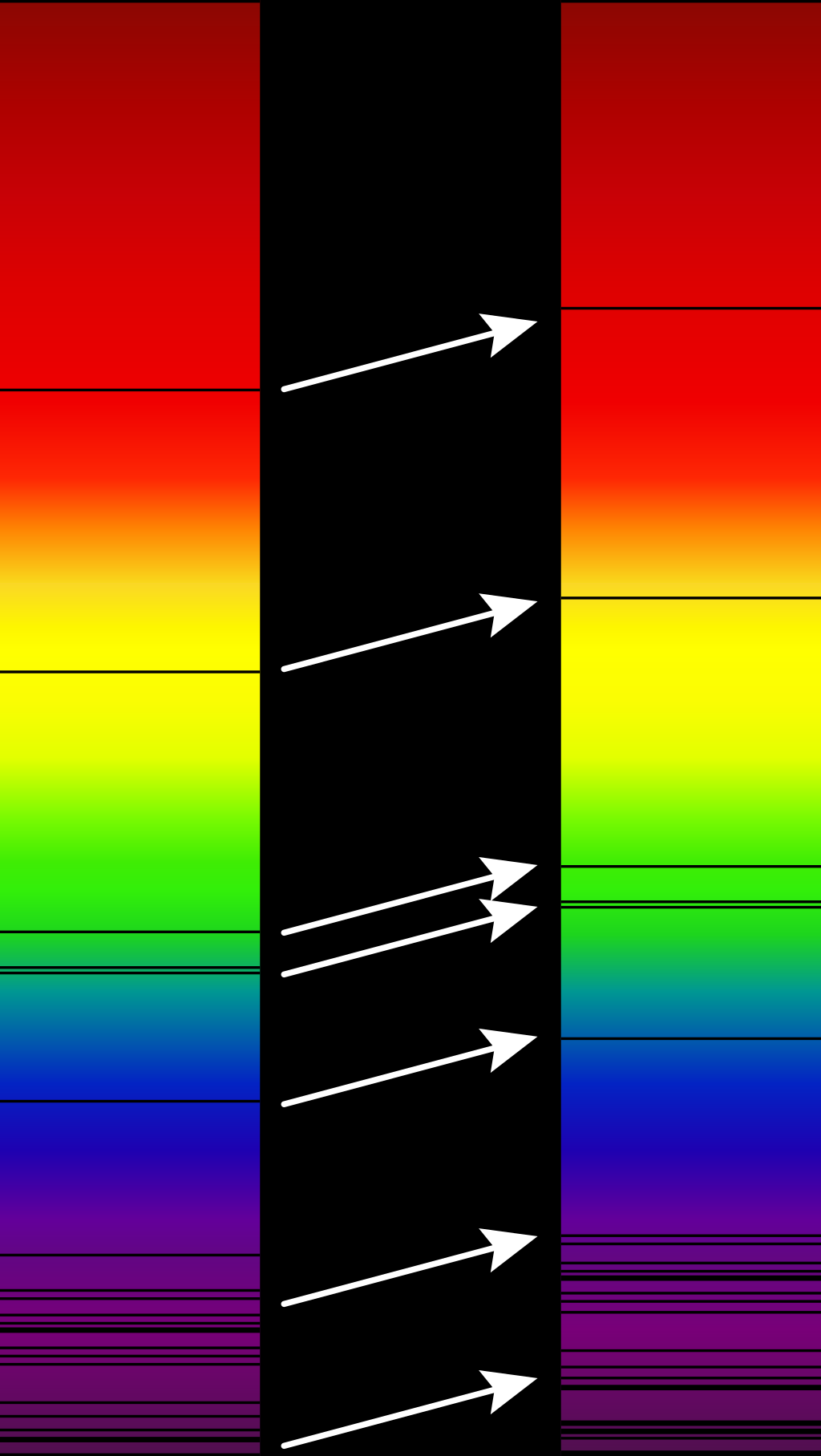
    Redshift
    Absorption lines in the visible spectrum of a supercluster of distant galaxies (right), as compared to absorption lines in the visible spectrum of the Sun (left). Arrows indicate redshift. Wavelength increases up towards the red and beyond (frequency decreases). Credit: Georg Wiora (Dr. Schorsch) CC BY-SA 3.0

    Everyone has heard the increased pitch of an approaching police siren and the sharp decrease in pitch as the siren passes by and recedes. The effect arises because the sound waves arrive at the listener’s ear closer together as the source approaches, and further apart as it recedes.

    Light behaves like a wave, so light from a luminous object undergoes a Doppler-like shift if the source is moving relative to us. Ever since 1929, when Edwin Hubble discovered that the Universe is expanding, we have known that most other galaxies are moving away from us. Light from these galaxies is shifted to longer (and this means redder) wavelengths — in other words, it is ‘red-shifted’.

    Since light travels at such a great speed relative to everyday phenomena (a million times faster than sound) we do not experience this redshift in our daily lives.

    The redshift of a distant galaxy or quasar is easily measured by comparing its spectrum with a reference laboratory spectrum. Atomic emission and absorption lines occur at well-known wavelengths. By measuring the location of these lines in astronomical spectra, astronomers can determine the redshift of the receding sources.

    However, to be accurate, the redshifts observed in distant objects are not exactly due to the Doppler phenomenon, but are rather a result of the expansion of the Universe.

    Doppler shifts arise from the relative motion of source and observer through space, whereas astronomical redshifts are ‘expansion redshifts’ due to the expansion of space itself.

    Two objects can actually be stationary in space and still experience a redshift if the intervening space itself is expanding.

    A convenient analogy for the expansion of the Universe is a loaf of unbaked raisin bread. The raisins are at rest relative to one another in the dough before it is placed in the oven. As the bread rises, it also expands, making the space between the raisins increase.

    If the raisins could see, they would observe that all the other raisins were moving away from them although they themselves were stationary within the loaf. Only the dough — their ‘Universe’ — is expanding.

    Never miss a breakthrough: Join the SciTechDaily newsletter.
    Follow us on Google and Google News.

    Astronomy Astrophysics European Space Agency Redshift
    Share. Facebook Twitter Pinterest LinkedIn Email Reddit

    Related Articles

    Feared Apophis Impact Ruled Out – Asteroid Will Pass Close Enough to Earth to See With Naked Eye

    Tantalizing Evidence: Is the Nearest Star Cluster to the Sun Being Destroyed?

    Tantrums of a Baby Star: Herbig-Haro Objects

    Unexpected Discovery: Hubble Space Telescope Uncovers Concentration of Small Black Holes

    Unique Planetary System With Rhythmic Orbital Resonance Revealed by Exoplanet Watcher Cheops

    Cosmic Neon Lights: Strange New Type of Star Revealed in X-ray Light

    “Unprecedented” – Unusual Planetary Nebula Fades Mere Decades After It Arrived

    Hubble Captures Unprecedented Fading of Stingray Nebula – “This Is Very, Very Dramatic, and Very Weird”

    To the Milky Way’s Anticenter and Beyond: Gaia’s New Detailed Data From More Than 1.8 Billion Stars

    4 Comments

    1. xABBAAA on February 23, 2022 1:08 am

      … but is Andromeda red shifting too?

      Reply
    2. mullach abu on February 25, 2022 10:50 am

      Ever since 1929, when Edwin Hubble discovered that the Universe is expanding, we have known that most other galaxies are moving away from us. Light from these galaxies is shifted to longer (and this means redder) wavelengths — in other words, it is ‘red-shifted’.
      so edwin explain in precise concise and plain language
      the milky way has had nine galactic mergers
      and any galaxy above the milky way size must have had more than nine
      so how do the raisins
      collide in the dough

      Reply
    3. mullach abu on February 25, 2022 10:52 am

      just checking to see the printed question

      Reply
    4. Laura Jayne on March 3, 2025 9:45 pm

      Mars Is The New – Planet & Redshift

      Reply
    Leave A Reply Cancel Reply

    • Facebook
    • Twitter
    • Pinterest
    • YouTube

    Don't Miss a Discovery

    Subscribe for the Latest in Science & Tech!

    Trending News

    Scientists Warn: America’s Most Popular Cooking Oil May Be Harming Your Intestines

    Scientists Say a 59,000-Year-Old Neanderthal Tooth Shows Evidence of Surgery

    Scientists Finally Think They Know Why T. rex Had Tiny Arms

    This Alien Planet Has Rock Clouds That Vaporize Before Sunset

    The Simple Habit That Could Lower Your Cancer Risk

    146,000-Year-Old Discovery Rewrites the Story of Human Creativity

    The Type of Alcohol You Drink Could Affect How Long You Live

    This Common Vitamin May Help Stop Prediabetes From Turning Into Diabetes

    Follow SciTechDaily
    • Facebook
    • Twitter
    • YouTube
    • Pinterest
    • Newsletter
    • RSS
    SciTech News
    • Biology News
    • Chemistry News
    • Earth News
    • Health News
    • Physics News
    • Science News
    • Space News
    • Technology News
    Recent Posts
    • Scientists Discover 43-Foot Sea Reptile Twice the Size of a Great White Shark
    • Scientists Discover New Way To Freeze and Revive Living Brain Tissue
    • Bees and Birds Are Drinking Alcohol From Flowers
    • Scientists Discover How Obesity May Trigger Alzheimer’s Disease
    • Scientists Confirm Alcohol Causes Widespread Health Damage
    Copyright © 1998 - 2026 SciTechDaily. All Rights Reserved.
    • Science News
    • About
    • Contact
    • Editorial Board
    • Privacy Policy
    • Terms of Use

    Type above and press Enter to search. Press Esc to cancel.