
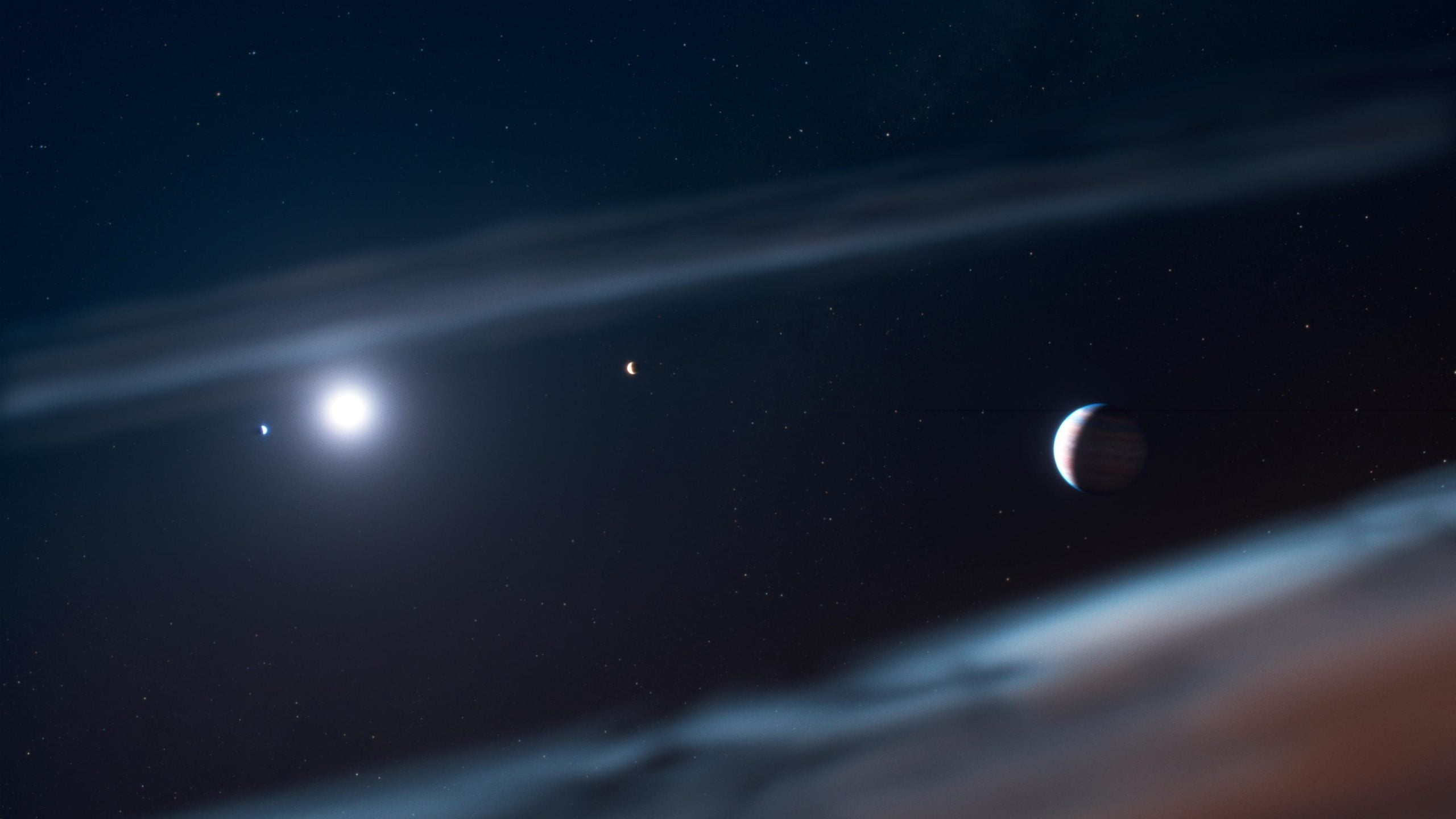
Webb found a hidden giant planet by detecting its atmospheric chemistry through a bright debris disk.
For years, a third giant planet remained concealed within the bright dust surrounding Beta Pictoris, one of the most closely observed planetary systems in the Milky Way. NASA’s James Webb Space Telescope has now exposed the hidden world by detecting molecules in its atmosphere.
The young star was already known to host Beta Pictoris b, one of the earliest exoplanets captured through direct imaging, and Beta Pictoris c. The addition of Beta Pictoris d makes Beta Pictoris only the second known system with at least three imaged planets. Unlike its two companions, the new planet was initially recognized through its atmospheric chemical signature rather than as a distinct point of light, demonstrating a potentially valuable way to find other difficult-to-see worlds.
“This discovery adds another piece to an already fascinating planetary system,” said Aidan Gibbs, lead author of a new study published in the Astrophysical Journal Letters and a postdoctoral researcher at the University of California, San Diego. “Beta Pictoris has long served as a laboratory for understanding how planetary systems form and evolve, and now we have another planet helping us tell that story.”
A third giant reshapes the system
Beta Pictoris lies 63 light-years from Earth and is approximately 23 million years old. Its relative youth and proximity allow astronomers to examine how newly formed planets interact with the remaining disk of dust and debris from the system’s formation.
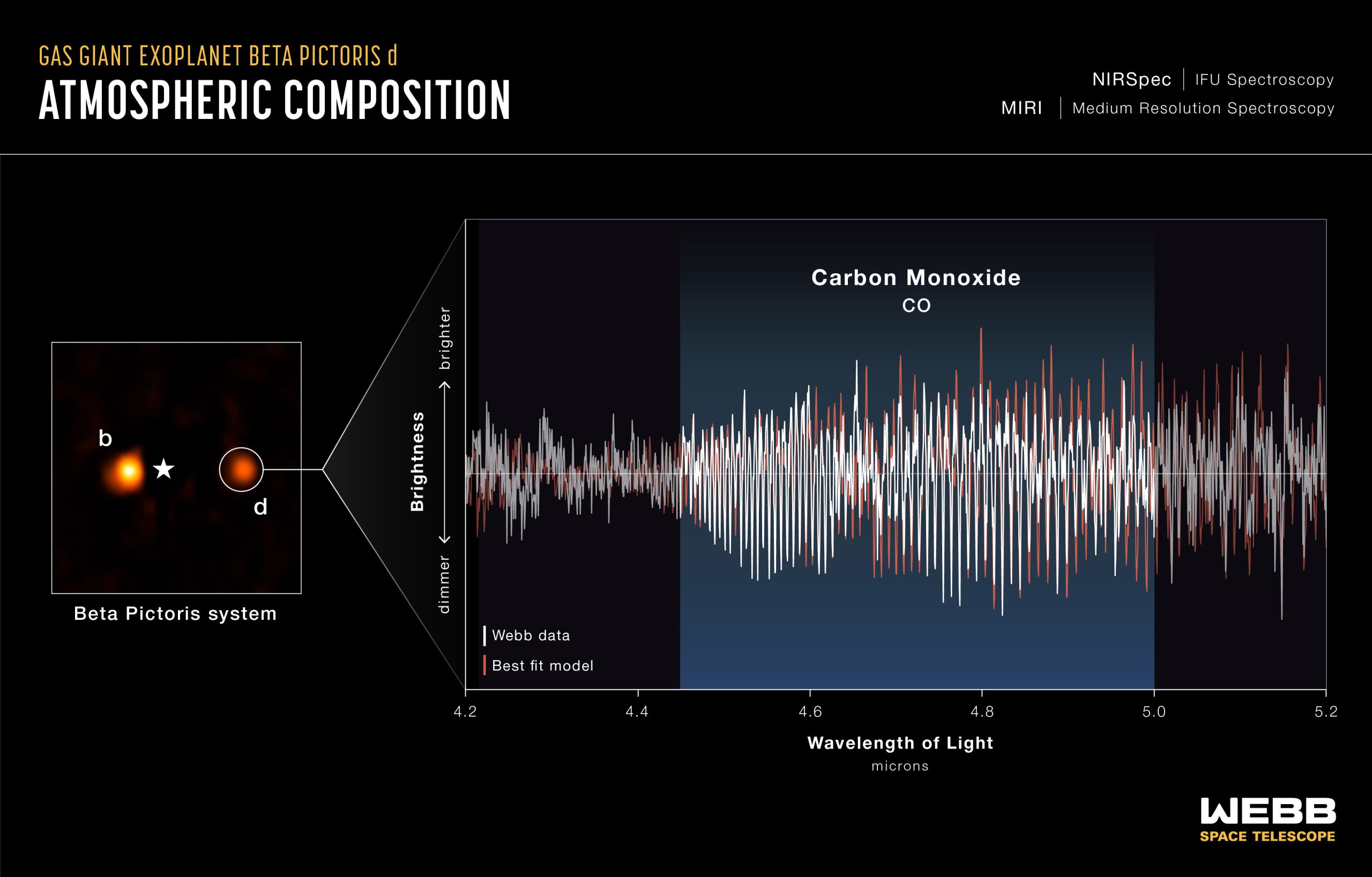
Researchers estimate that Beta Pictoris d has at least twice Jupiter’s mass, making it the least massive of the system’s three known giant planets. Models place its orbit about 30 astronomical units from the star, similar to Neptune’s position in our solar system. It follows the widest orbit of the three planets but remains inside the debris disk’s inner boundary.
A chemical barcode exposes the planet
The researchers did not set out to find another planet. They were using Webb’s NIRSpec (Near-Infrared Spectrograph) to examine the atmosphere of Beta Pictoris b when evidence of Beta Pictoris d appeared. The observation relied on NIRSpec’s Integral Field Unit, which records an image while collecting a spectrum from every pixel.
“We weren’t looking for a new planet,” said Gibbs. “We were trying to understand one we already knew existed. Then, this telltale signal appeared in the data where we didn’t expect it.”
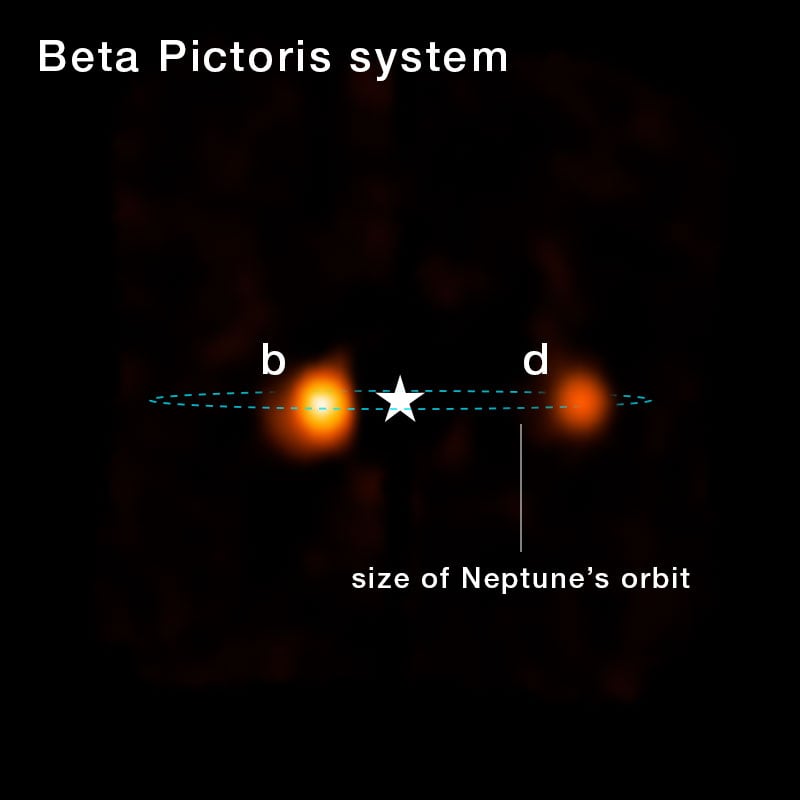
Where reflected light from dust should have produced a smooth spectrum, the researchers instead saw repeated peaks and dips. The pattern came from carbon monoxide absorption lines, arranged like a barcode and characteristic of the atmospheres of giant planets.
Spectroscopy can reveal both an object’s chemical makeup and its movement. By measuring radial velocity, the researchers determined that the source’s speed, location and alignment with the debris disk matched an object orbiting Beta Pictoris. The evidence did not fit a distant background star or a brown dwarf containing carbon monoxide.
“There was an unexpected bright source of light within the Integral Field Unit imaging, but we’ve learned not to trust bright blobs in images,” said Jean-Baptiste Ruffio, a research scientist at the University of California, San Diego and principal investigator of the first Webb observations where the discovery was made. “They can be instrumental artifacts or other structures in the debris disk. By obtaining a spectrum at the same time as the image, we were able to quickly confirm our suspicions.”
Follow-up observations obtained through a Director’s Discretionary Time request used Webb’s MIRI (Mid-Infrared Instrument) to detect methane and water vapor. Those molecules provided additional confirmation that the object was a planet and revealed more about its atmosphere.
Because the planet was identified spectroscopically, astronomers could begin investigating its atmospheric properties during the same observation that revealed it.
“A spectrum contains an incredible amount of information,” Ruffio said. “You don’t just learn that something is a planet; you immediately begin learning about its temperature, chemistry, and motion.”
An independent imaging analysis led by Ben Sutlieff of the University of Edinburgh and Markus Bonse of the European Southern Observatory supported the discovery. That work used observations from the European Southern Observatory’s Very Large Telescope and Webb’s NIRCam (Near-Infrared Camera) to confirm Beta Pictoris d separately.
Spectroscopy sees through the debris
Beta Pictoris d avoided detection for so long because it lies within one of the brightest debris disks astronomers have observed.
Dust scattered the star’s light like fog, obscuring the difference between an actual planet and features within the disk. Webb’s spectroscopic approach largely bypassed that confusion by isolating the narrow molecular signals produced by a planetary atmosphere.
The planet may also explain several unusual features of the disk, including its sharply defined inner boundary. Astronomers had previously proposed that an unseen planet resembling Beta Pictoris d could be shaping the disk into its observed structure.
Atmospheric fingerprints expand the search
The finding does more than add another planet to the Beta Pictoris system. It demonstrates a new strategy for detecting exoplanets in environments where dust or other structures interfere with conventional imaging.
Beta Pictoris d is the first directly imaged planet found primarily through moderate-resolution spectroscopy. The result shows that atmospheric fingerprints can reveal planets in visually complex systems without relying entirely on traditional coronagraphic imaging.
The researchers will continue examining Webb’s data to refine estimates of the planet’s orbit, temperature and atmospheric composition. Those measurements should provide a more complete picture of one of the best-known young planetary systems in astronomy.
Reference: “Discovery of an Exterior Third Planet Orbiting β Pictoris” by Aidan Gibbs, Jean-Baptiste Ruffio, Alexis Bidot, Travis S. Barman, Clarissa R. Do Ó, Quinn M. Konopacky, Marshall D. Perrin, Aneesh Baburaj, Beck Dacus, Bruce Macintosh, Alex Madurowicz and Jerry W. Xuan, 15 July 2026, The Astrophysical Journal Letters.
DOI: 10.3847/2041-8213/ae801b
Support for program 8063 was provided by NASA through a grant from the Space Telescope Science Institute, which is operated by the Association of Universities for Research in Astronomy, Inc., under NASA contract NAS 5-03127.
Never miss a breakthrough: Join the SciTechDaily newsletter.
Follow us on Google and Google News.