
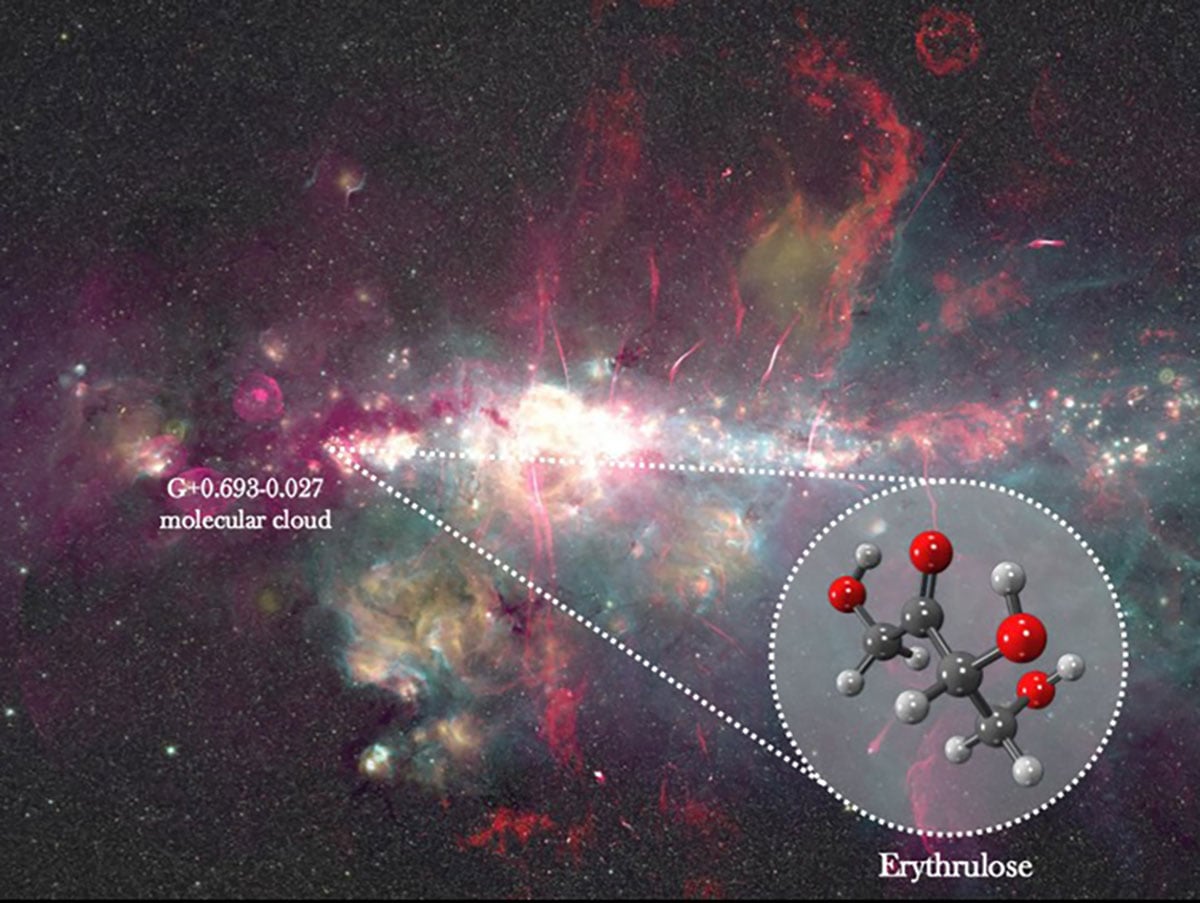
Researchers have detected a sugar in the interstellar medium for the first time.
Sugars are central to life. They help form the structural backbone of DNA and RNA and participate in essential metabolic reactions.
They are also thought to have been necessary for the formation of the earliest nucleic acids. Yet researchers studying life’s origins still face a major puzzle: laboratory experiments indicate that prebiotic conditions on early Earth would not have produced enough sugar.
Ribose and glucose have been found in meteorites and asteroid material, raising the possibility that some sugars formed in the ancient molecular cloud that gave rise to the Solar System. Until now, however, no sugar had been identified directly in interstellar space.
A four-carbon sugar appears in space
An international group led by CAB researcher Izaskun Jiménez-Serra has detected erythrulose, the first sugar identified in the interstellar medium. Erythrulose is the only possible ketose containing four carbon atoms. On Earth, it occurs naturally in raspberries and is also used in sunless tanning products.
Researchers found it toward G+0.693−0.027, a molecular cloud near the center of the Milky Way. The detection relied on highly sensitive broadband spectroscopic surveys conducted with the 40-m Yebes radio telescope and the 30-m telescope operated by the Institute for Radio Astronomy in the Millimeter Range (IRAM).
The researchers detected 12 spectral lines that matched the laboratory spectrum of erythrulose measured at the University of the Basque Country. Their analysis indicated that erythrulose is at least eight times more abundant than comparable sugars containing three carbon atoms, none of which appeared in the same cloud.
“This finding was unexpected, as the prevailing view in astrochemistry is that interstellar molecules grow in size through the sequential addition of carbon atoms,” says Izaskun Jimenez Serra (CAB), leading author of this work.
In experiments conducted with chemists from the University of Extremadura and Radboud University (the Netherlands), the CAB researchers also found that erythrulose can develop inside interstellar ice from simpler alcohols and aldehydes containing two carbon atoms.
Ancient impacts may have delivered sugars
Using the measured abundance of erythrulose in G+0.693−0.027, the researchers estimated that roughly 0.5 million to 50 million tons of the sugar may have reached Earth during the Late Heavy Bombardment, approximately 4.1 to 3.8 billion years ago. Its presence in interstellar space points to another possible supply of sugars that may have contributed to the earliest metabolic and replication processes on Earth.
“The detection of erythrulose is very exciting because it opens up the possibility of discovering in space other sugars such as ribose, which is part of RNA, and other important molecules for the origin of life,” says Carlos Briones, co-author of the study.
Reference: “Detection of a four-carbon sugar in interstellar space” by Izaskun Jiménez-Serra, Juan García de la Concepción, Herma M. Cuppen, Marta Rey-Montejo, Miguel Sanz-Novo, Víctor M. Rivilla, Jesús Martín-Pintado, Andrés Megías, Carlos Briones, David San Andrés, Laura Colzi, Shaoshan Zeng, Sergio Martín, Joseph Salaris, Antonio Martínez-Henares, Álvaro López-Gallifa, Miguel Angel Requena-Torres, Belén Tercero, Pablo de Vicente, Aran Insausti, Elena R. Alonso and Emilio J. Cocinero, 13 July 2026, Nature Astronomy.
DOI: 10.1038/s41550-026-02905-7
This work is supported by ERC grant OPENS, GA no. 101125858, funded by the European Union.
Never miss a breakthrough: Join the SciTechDaily newsletter.
Follow us on Google and Google News.