
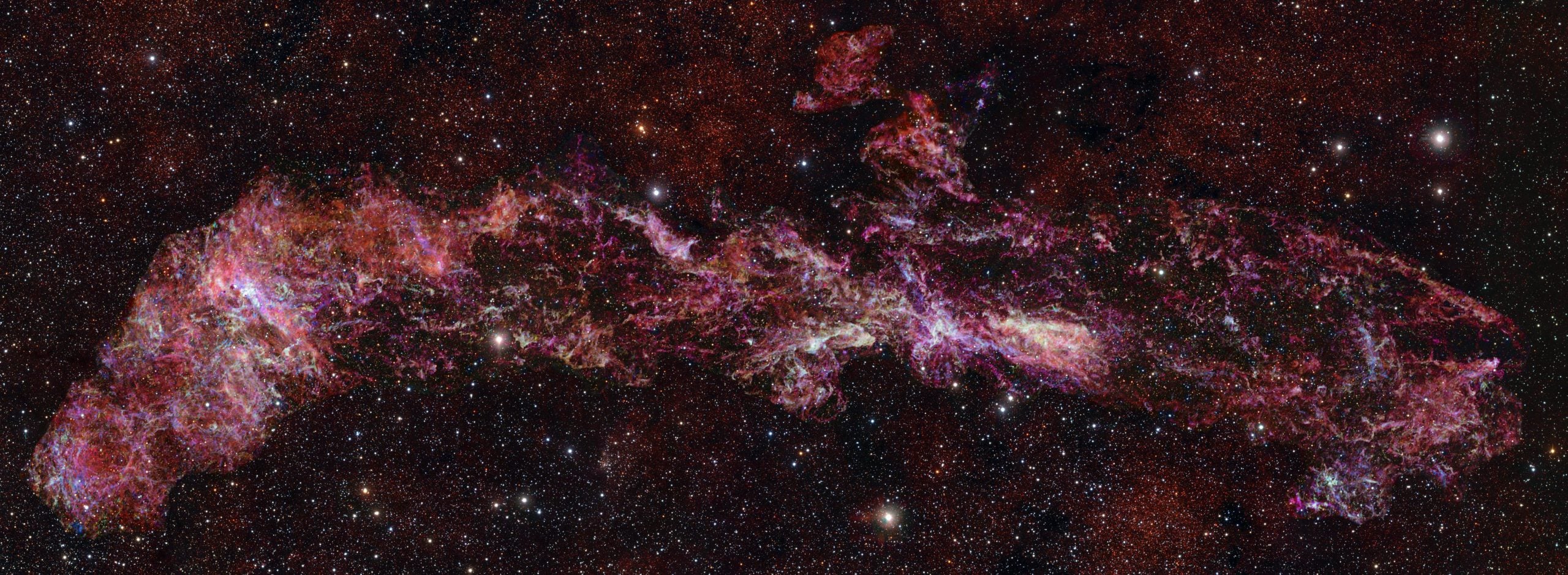
ALMA’s most ambitious galactic survey yet exposes a wild, filament-filled stellar nursery at the very heart of the Milky Way.
Astronomers have produced a remarkable new view of the center of the Milky Way, exposing an intricate web of cosmic gas in greater detail than ever before. The image was created using the Atacama Large Millimeter/submillimeter Array (ALMA) and represents the most extensive ALMA image assembled so far. This massive dataset gives researchers a powerful new way to study how stars live and die in one of the harshest environments in our galaxy, near its supermassive black hole.
“It’s a place of extremes, invisible to our eyes, but now revealed in extraordinary detail,” says Ashley Barnes, an astronomer at the European Southern Observatory (ESO) in Germany and a member of the research team. The observations focus on cold gas in the Central Molecular Zone (CMZ), the dense inner region of the Milky Way where stars are born. For the first time, scientists have mapped this cold gas across the entire region with such precision.
This video explores the molecular gas in the center of the Milky Way in unprecedented detail.
A 650 Light-Year Region Around a Supermassive Black Hole
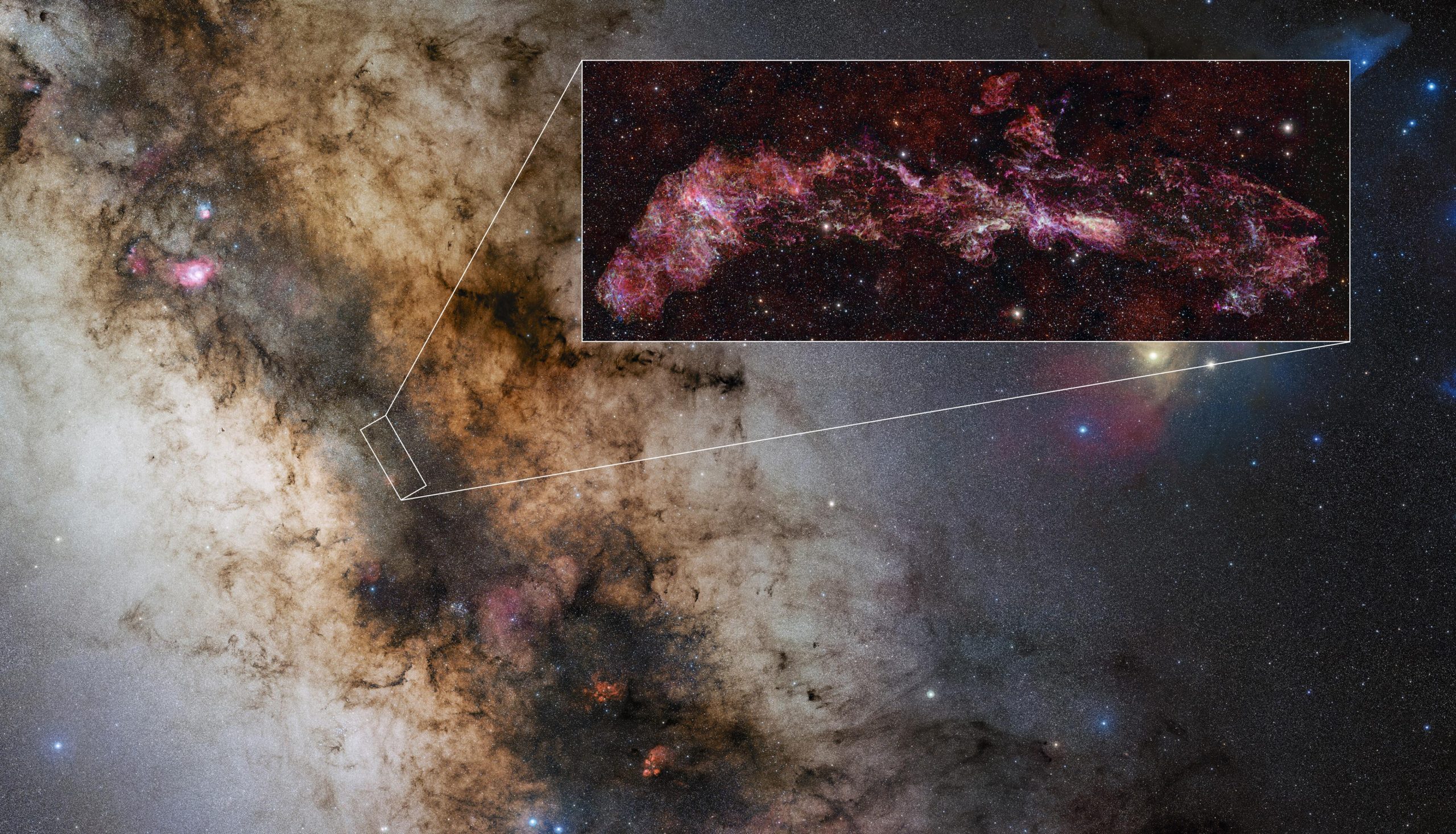
The newly imaged area stretches more than 650 light-years across. It contains thick clouds of gas and dust that surround the supermassive black hole at the heart of our galaxy. “It is the only galactic nucleus close enough to Earth for us to study in such fine detail,” Barnes explains. The dataset captures structures ranging from enormous gas formations dozens of light-years wide down to much smaller clouds clustered around individual stars.
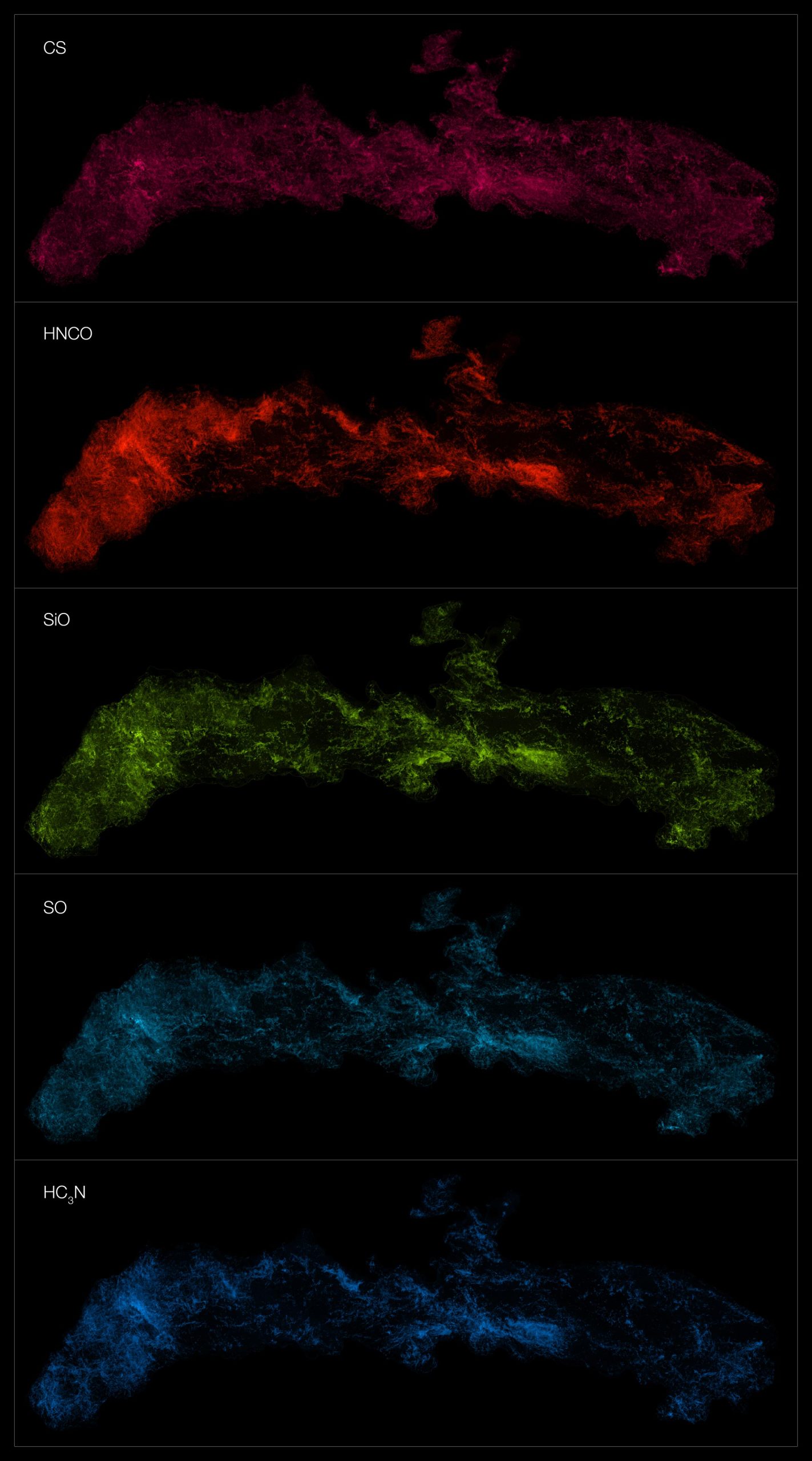
The ACES project, short for the ALMA CMZ Exploration Survey, targets cold molecular gas in particular. This material serves as the foundation for star formation. By analyzing it, researchers uncovered a surprisingly rich chemical environment, identifying dozens of molecules. These range from relatively simple compounds such as silicon monoxide to more complex organic substances like methanol, acetone, or ethanol.
Cold Molecular Gas and Extreme Star Formation
In the CMZ, cold molecular gas streams along long filaments and gathers into dense clumps where new stars can form. While astronomers understand this process well in calmer regions of the Milky Way, conditions near the galactic center are far more intense.
“The CMZ hosts some of the most massive stars known in our galaxy, many of which live fast and die young, ending their lives in powerful supernova explosions, and even hypernovae,” says ACES leader Steve Longmore, a professor of astrophysics at Liverpool John Moores University, UK. Through ACES, scientists aim to learn how these dramatic events affect star birth and whether existing models of star formation still apply under such extreme conditions.
“By studying how stars are born in the CMZ, we can also gain a clearer picture of how galaxies grew and evolved,” Longmore adds. “We believe the region shares many features with galaxies in the early Universe, where stars were forming in chaotic, extreme environments.”
This video zooms into the complex molecular gas in the center of the Milky Way – a chaotic and extreme environment where stars don’t necessarily form in the same way as they do in the outskirts of our galaxy.
Record-Breaking ALMA Mosaic
To gather this data, researchers relied on ALMA, operated by ESO and its partners in Chile’s Atacama Desert. This marks the first time ALMA has scanned such a vast portion of the galactic center, resulting in its largest image ever. The final mosaic was built by combining numerous individual observations, much like assembling pieces of a puzzle. On the sky, the completed image spans a length equivalent to three full Moons placed side by side.
“We anticipated a high level of detail when designing the survey, but we were genuinely surprised by the complexity and richness revealed in the final mosaic,” says Katharina Immer, an ALMA astronomer at ESO and a member of the team. The ACES findings are detailed in five papers accepted for publication in Monthly Notices of the Royal Astronomical Society, with a sixth currently in final review.
What Comes Next for ALMA and the Extremely Large Telescope
“The upcoming ALMA Wideband Sensitivity Upgrade, along with ESO’s Extremely Large Telescope, will soon allow us to push even deeper into this region — resolving finer structures, tracing more complex chemistry, and exploring the interplay between stars, gas, and black holes with unprecedented clarity,” says Barnes. “In many ways, this is just the beginning.”
This video shows footage from an interview with Ashley Barnes, an astronomer at the European Southern Observatory, on the ACES research.
Research Papers and Data Access
The ACES results will appear in a series of papers in Monthly Notices of the Royal Astronomical Society:
- Paper I – ALMA Central Molecular Zone Exploration Survey (ACES) I: Overview paper
- Paper II – ALMA Central Molecular Zone Exploration Survey (ACES) II: 3mm continuum images
- Paper III – ALMA Central Molecular Zone Exploration Survey (ACES) III: Molecular line data reduction and HNCO & HCO+ data
- Paper IV – ALMA Central Molecular Zone Exploration Survey (ACES) IV: Data of the two intermediate-width spectral windows
- Paper V – ALMA Central Molecular Zone Exploration Survey (ACES) V: CS(2-1), SO 2_3-1_2, CH3CHO 5_(1,4)-4_(1,3), HC3N(11-10) and H40A lines data
- Paper VI – ALMA Central Molecular Zone Exploration Survey (ACES) VI: ALMA Large Program Reveals a Highly Filamentary Central Molecular Zone (undergoing minor revision)
The data will be publicly available through the ALMA Science Portal at https://almascience.org/alma-data/lp/aces.
This video shows footage of Steve Longmore (Liverpool John Moores University) talking about ACES and the latest data release.
International Collaboration Behind ACES
The ACES collaboration includes more than 160 scientists, from Master’s students to retired researchers, representing over 70 institutions across Europe, North and South America, Asia, and Australia. The project was initiated and led by Principal Investigator Steven Longmore (Liverpool John Moores University, UK), alongside co-PIs Ashley Barnes (European Southern Observatory, Germany), Cara Battersby (University of Connecticut, USA [Connecticut]), John Bally (University of Colorado Boulder, USA), Laura Colzi (Centro de Astrobiología, Madrid, Spain [CdA]), Adam Ginsburg (University of Florida, USA [Florida]), Jonathan Henshaw (Max Planck Institute for Astronomy, Heidelberg, Germany), Paul Ho (Academia Sinica Institute of Astronomy and Astrophysics, Taiwan), Izaskun Jiménez-Serra (CdA), J. M. Diederik Kruijssen (COOL Research DAO), Elisabeth Mills (University of Kansas, USA), Maya Petkova (Chalmers University of Technology, Sweden), Mattia Sormani (Dipartimento di Scienza e Alta Tecnologia (DiSAT), University of Insubria, Italy), Robin Tress (École Polytechnique Fédérale de Lausanne, Switzerland & Institut für Theoretische Astrophysik, Universität Heidelberg, Germany), Daniel Walker (UK ALMA Regional Centre Node, University of Manchester, UK), and Jennifer Wallace (Connecticut).
This video shows footage from an interview with Katharina Immer, an astronomer at the European Southern Observatory, on the ACES research.
Within ACES, the ALMA data reduction working group is coordinated by Adam Ginsburg, Daniel Walker, and Ashley Barnes. Team members include Nazar Budaiev (Florida), Laura Colzi (CdA), Savannah Gramze (Florida), Pei-Ying Hsieh (National Astronomical Observatory of Japan, Mitaka, Tokyo, Japan), Desmond Jeff (Florida), Xing Lu (Shanghai Astronomical Observatory, Chinese Academy of Sciences, China), Jaime Pineda (Max-Planck-Institut für extraterrestrische Physik, Germany), Marc Pound (University of Maryland, USA), and Álvaro Sánchez-Monge (Institut de Ciències de l’Espai, CSIC, Bellaterra, Spain; Institut d’Estudis Espacials de Catalunya, Castelldefels, Spain), along with more than 30 additional contributors who supported the data reduction process.
Never miss a breakthrough: Join the SciTechDaily newsletter.
Follow us on Google and Google News.