
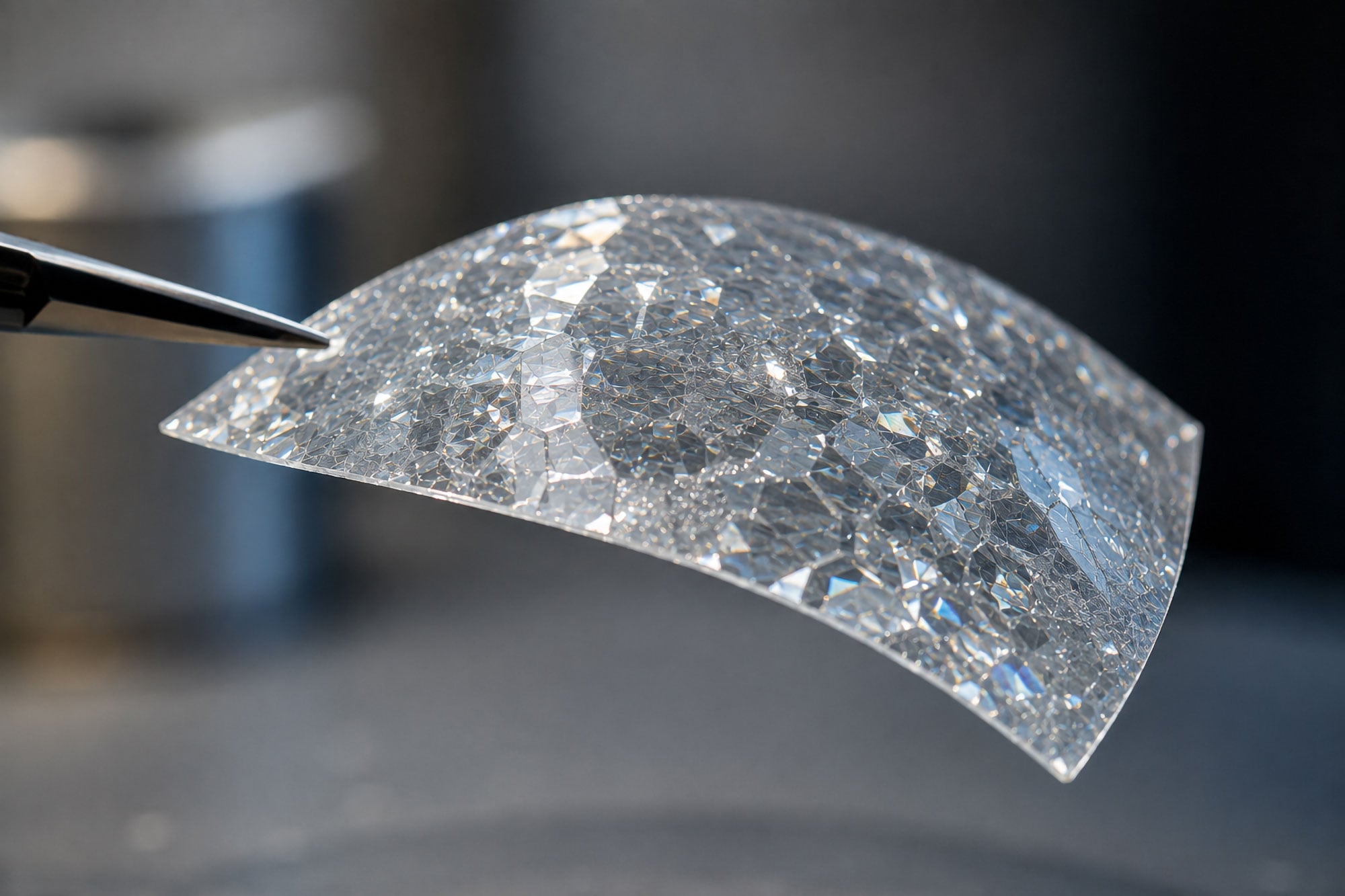
Researchers have uncovered an unexpected electrical response in ultrathin diamond membranes, challenging a century-old assumption about the material.
Diamond is renowned for resisting pressure, heat, chemicals, and wear. But researchers have now shown that, when made thin enough, it can also generate electricity when bent. An ultrathin diamond membrane produced stable voltage signals under mechanical strain, overturning the long-standing assumption that diamond is fundamentally non-piezoelectric.
The work was led by Professor Zhiqin Chu of the Department of Electrical and Computer Engineering and Professor Yuan Lin of the Department of Mechanical Engineering at the University of Hong Kong (HKU).
For more than a century, diamond was excluded from the class of materials that convert mechanical deformation into electrical charge. Its exceptional hardness, strength, thermal conductivity, chemical stability, acoustic velocity, dielectric breakdown strength, and ultrawide bandgap made it valuable in advanced devices, but usually only as a durable structural platform for separate piezoelectric layers in microelectromechanical systems (MEMS). As a result, the idea of generating electricity directly from diamond was widely considered unrealistic.
Flexible membranes make diamond responsive
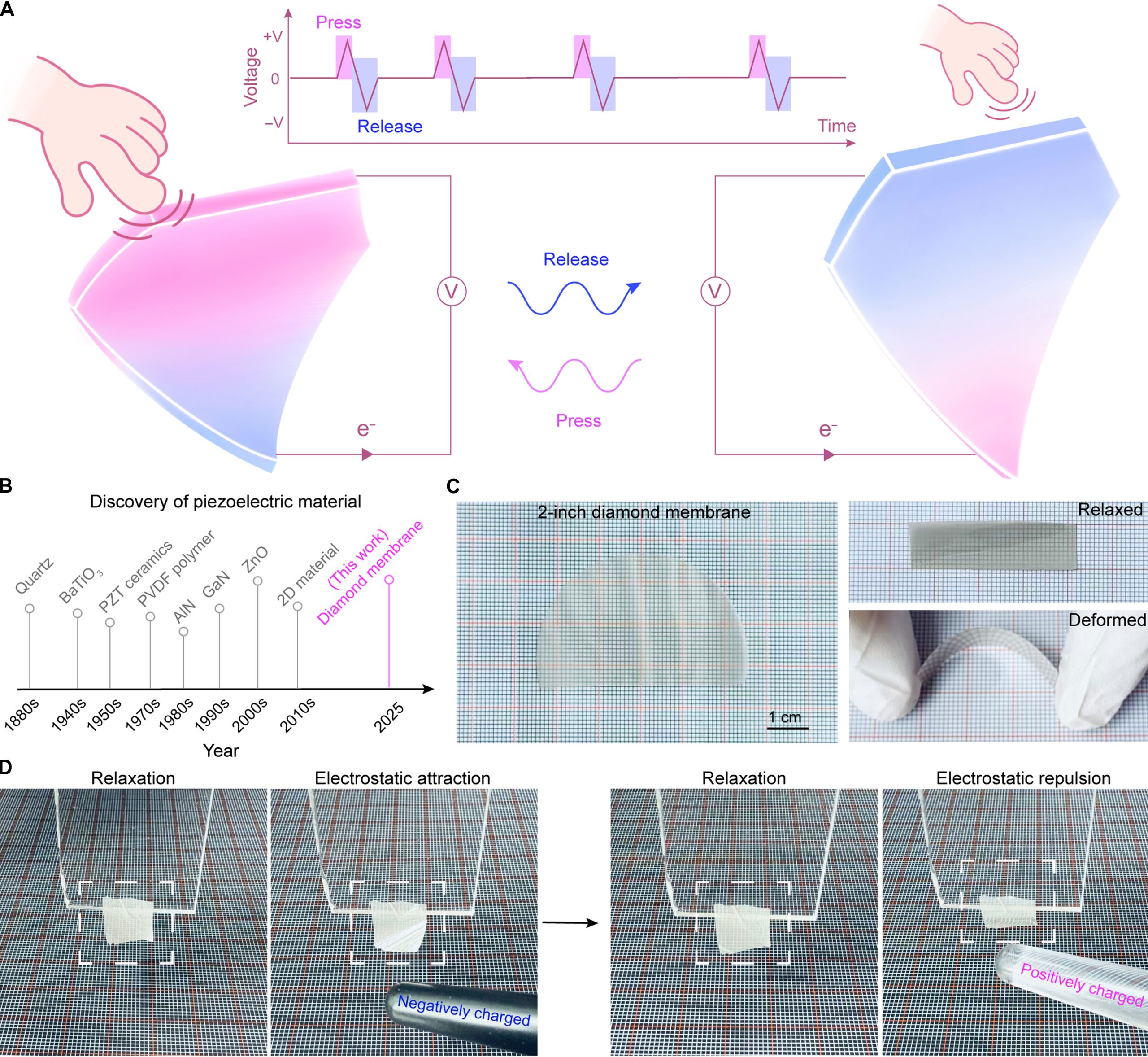
Using a recently developed edge-exfoliation method, the HKU researchers created an ultrathin and flexible polycrystalline diamond membrane. Making the material this thin allowed normally rigid diamond to bend substantially, and that deformation consistently produced measurable voltage signals.
To ensure the signals did not come from environmental interference or triboelectric artifacts caused by contact and friction, the researchers repeatedly bent the membrane under several controlled conditions. The stable and reproducible electrical output confirmed that the diamond membrane displayed a piezoelectric response.

Grain boundaries generate the voltage
First-principles calculations traced the effect mainly to asymmetrical grain boundaries, the interfaces where individual diamond crystals meet within the membrane. As bending increased, electrical charge accumulated along these boundaries, producing a voltage difference between the membrane’s upper and lower surfaces.
Diamond is biocompatible, chemically stable, and nontoxic, making the effect potentially useful in medical and energy technologies. Future implantable devices, for example, could use piezoelectric diamond membranes as deformation sensors or as power sources that generate their own electricity.
The findings expand diamond’s possible uses beyond its traditional role as a mechanical support material. They could also inform the development of reliable miniature energy systems and sensing devices that operate without an external power supply.
Reference: “Uncovering piezoelectric effect in polycrystalline diamond membranes” by Jixiang Jing, Bicong Wang, Yumeng Luo, Yicheng Wang, Zhongqiang Wang, Yiyao Liu, Dong-Keun Ki, Xinghua Shi, Qi Wang, Kwai Hei Li, Yuan Lin and Zhiqin Chu, 18 March 2026, Science Advances.
DOI: 10.1126/sciadv.aea8318
Never miss a breakthrough: Join the SciTechDaily newsletter.
Follow us on Google and Google News.
1 Comment
Excellent work, and the grain boundary finding is more significant than it may appear.
Bulk single-crystal diamond is symmetric — non-piezoelectric. At the grain boundaries, that symmetry breaks and electrical charge appears under strain. This suggests the piezoelectric character was always present in the material but magnetically balanced in the bulk crystal. The grain boundary didn’t create a new property — it revealed one that the symmetric lattice was hiding.
This pattern shows up elsewhere. Recent work on kagome lattice metals (Suetsugu et al., Nature Physics, 2026) found spontaneous magnetic fields in a material whose triangular lattice geometry prevents atomic magnetic moments from canceling. Same principle: break the symmetry, and the electromagnetic character that was always there becomes measurable.
Two follow-up variables worth testing on your membranes:
1. Controlled hydrostatic pressure during bending — recent Cambridge research (Wang et al., Nature Energy, 2026) showed that maintaining specific mechanical pressure on crystal structures dramatically improved electrochemical coupling. Pressure stiffens the lattice, and a stiffer lattice transfers energy more cleanly. Your grain boundary response could be pressure-tunable.
2. Engineered grain boundary density and geometry — if the boundaries are where the effect lives, then varying their density, orientation, and spacing could let you control the magnitude and direction of the piezoelectric output.
We’ve been mapping how lattice geometry and lattice spacing independently determine the electromagnetic output of materials across the full spectrum. Some of that work is at spectrumenergy.one if you’re interested in the broader research.