
Close Menu
    Facebook X (Twitter) Instagram
    SciTechDaily
    • Biology
    • Chemistry
    • Earth
    • Health
    • Physics
    • Science
    • Space
    • Technology
    Facebook X (Twitter) Pinterest YouTube RSS
    SciTechDaily
    Home»Space»Tantrums of a Baby Star: Herbig-Haro Objects
    Space

    Tantrums of a Baby Star: Herbig-Haro Objects

    By ESA/HubbleFebruary 14, 20211 Comment2 Mins Read
    Facebook Twitter Pinterest Telegram LinkedIn WhatsApp Email Reddit
    Share
    Facebook Twitter LinkedIn Pinterest Telegram Email Reddit
    Herbig Haro Objects
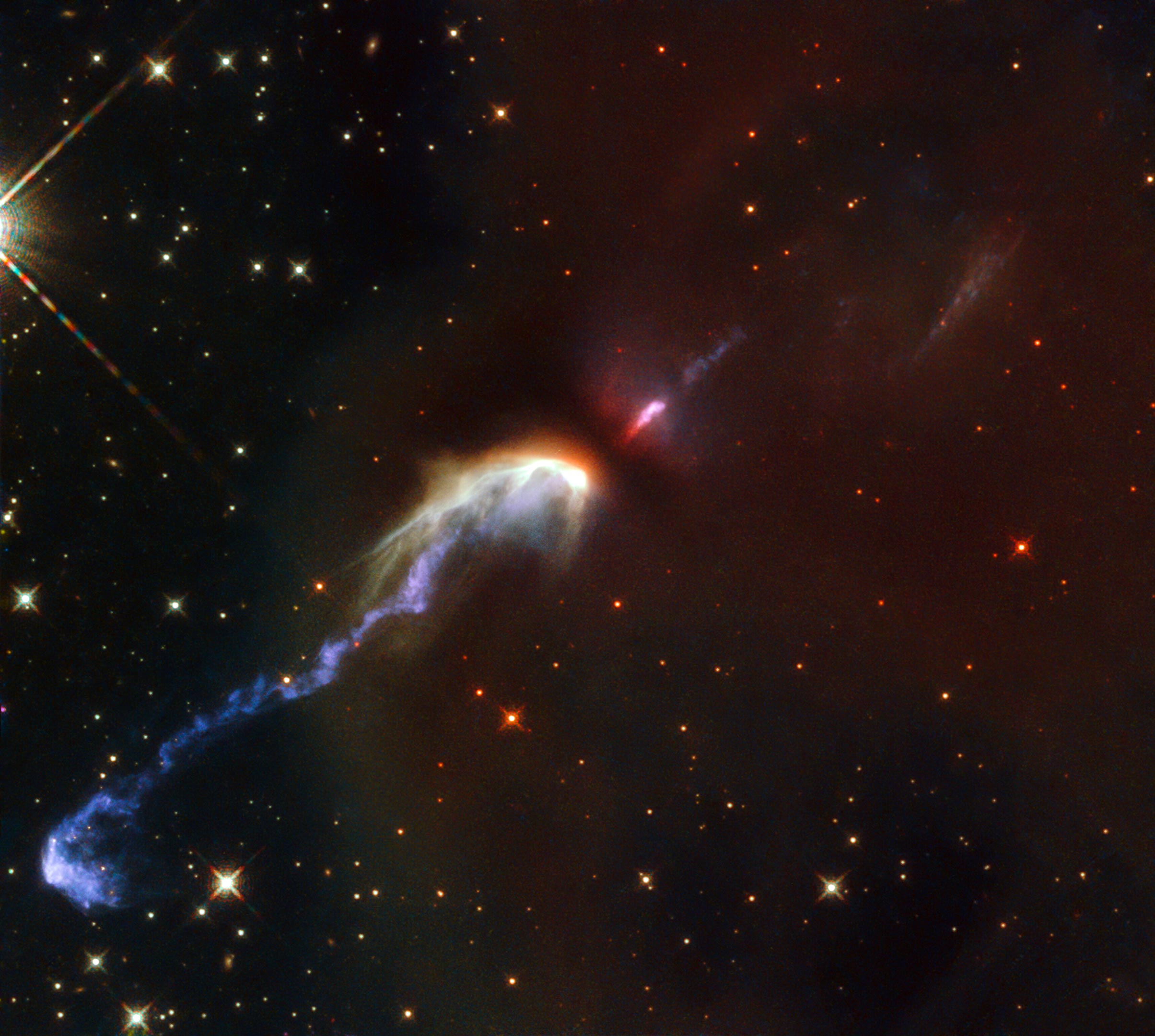
    This image, taken with the NASA/ESA Hubble Space Telescope, captures the two Herbig-Haro objects cataloged as HH46 and HH47, spotted in the constellation of Vela (The Sails), at a distance of over 1400 light-years from Earth. Credit: ESA/Hubble & NASA, B. Nisini

    Once a mystery, Herbig-Haro objects HH46 and HH47 are now known to be fast-moving jets from a newborn star, lighting up the surrounding gas with brilliant shock waves.

    Herbig-Haro objects are some of the rarer sights in the night sky, taking the form of thin spindly jets of matter floating amongst the surrounding gas and stars. The two Herbig-Haro objects cataloged as HH46 and HH47, seen in this image taken with the NASA/ESA Hubble Space Telescope, were spotted in the constellation of Vela (The Sails), at a distance of over 1400 light-years from Earth. Prior to its discovery in 1977 by the American astronomer R. D. Schwartz, the exact mechanism by which these multi-colored objects formed was unknown.

    Before 1997 it was theorized by Schwartz and others that the objects could be a type of reflection nebula, or a type of shock wave formed from the gas emitted from a star interacting with the surrounding matter. The mystery was finally solved when a protostar, unseen in this image, was discovered at the center of the long jets of matter. The outflows of matter, some 10 light-years across, were ejected from the newly born star and violently propelled outwards at speeds of over 150 kilometers (93 miles) per second. Upon reaching the surrounding gas, the collision created the bright shock waves seen here.

    Never miss a breakthrough: Join the SciTechDaily newsletter.
    Follow us on Google and Google News.

    Astronomy Astrophysics European Space Agency Hubble Space Telescope
    Share. Facebook Twitter Pinterest LinkedIn Email Reddit

    Related Articles

    Stellar Tantrum: An Energetic Outburst From an Infant Star Streaks Across Space

    Hubble Captures a Dangerous Dance Over 100 Million Light-Years From Earth

    Hubble Captures the Final Acts of a Monster Star

    Hubble Find Surprises Astronomers: White Dwarfs Can Still Undergo Stable Thermonuclear Activity

    First Evidence of Water Vapor at Jupiter’s Moon Ganymede – May Hold More Water Than All of Earth’s Oceans

    Our Giant Universe: Hubble Spots Massive Galaxy Cluster With a Wealth of Exciting Possibilities

    Unexpected Discovery: Hubble Space Telescope Uncovers Concentration of Small Black Holes

    “Unprecedented” – Unusual Planetary Nebula Fades Mere Decades After It Arrived

    Hubble Captures Unprecedented Fading of Stingray Nebula – “This Is Very, Very Dramatic, and Very Weird”

    1 Comment

    1. Joe Milosch on February 15, 2021 1:16 am

      I lost the illusion of being safe on earth after reading this. Earth is destroyed by the temper-tantrum of a baby star. Gamma Ray burst… galactic debris storm, only deep sealife survives. It could theoretically occur at any microsecond, like NOW.

      Reply
    Leave A Reply Cancel Reply

    • Facebook
    • Twitter
    • Pinterest
    • YouTube

    Don't Miss a Discovery

    Subscribe for the Latest in Science & Tech!

    Trending News

    289-Million-Year-Old Reptile Mummy Reveals Origin of Human Breathing System

    New Brain Discovery Challenges Long-Held Theory of Teenage Brain Development

    Scientists Discover Plants “Scream” – We Just Couldn’t Hear Them Until Now

    Scientists Discover a Surprising Reason Intermittent Fasting Extends Life

    This Simple Fruit Wash Could Make Produce Safer and Last Days Longer

    Scientists Say Adding This Unusual Seafood to Your Diet Could Reverse Signs of Aging

    Scientists Say a Hidden Structure May Exist Inside Earth’s Core

    Doctors Surprised by the Power of a Simple Drug Against Colon Cancer

    Follow SciTechDaily
    • Facebook
    • Twitter
    • YouTube
    • Pinterest
    • Newsletter
    • RSS
    SciTech News
    • Biology News
    • Chemistry News
    • Earth News
    • Health News
    • Physics News
    • Science News
    • Space News
    • Technology News
    Recent Posts
    • Breakthrough Bowel Cancer Trial Leaves Patients Cancer-Free for Nearly 3 Years
    • New Immune Pathway Could Supercharge mRNA Cancer Vaccines
    • Natural Compound Shows Powerful Potential Against Rheumatoid Arthritis
    • 100,000-Year-Old Neanderthal Fossils in Poland Reveal Unexpected Genetic Connections
    • Unexpected Hormone Discovery Could Change How We Treat Arthritis
    Copyright © 1998 - 2026 SciTechDaily. All Rights Reserved.
    • Science News
    • About
    • Contact
    • Editorial Board
    • Privacy Policy
    • Terms of Use

    Type above and press Enter to search. Press Esc to cancel.