
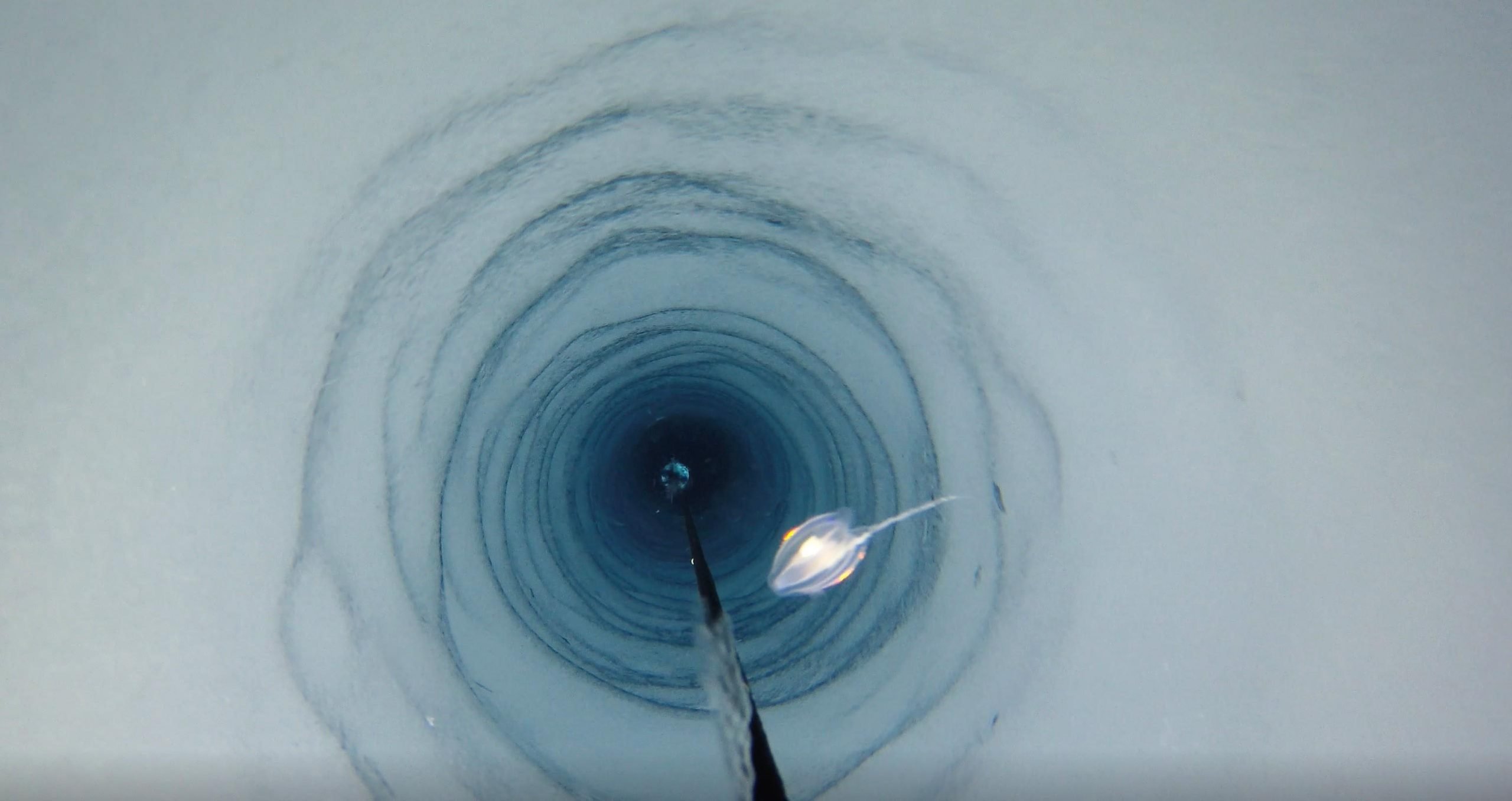
Far underneath the ice shelves of the Antarctic, there’s more life than expected, finds a recent study in the journal Frontiers in Marine Science.
During an exploratory survey, researchers drilled through 900 meters (3,000 feet) of ice in the Filchner-Ronne Ice Shelf, situated on the south eastern Weddell Sea. At a distance of 260 km (160 mi) away from the open ocean, under complete darkness and with temperatures of -2.2°C (28°F), very few animals have ever been observed in these conditions.
But this study is the first to discover the existence of stationary animals — similar to sponges and potentially several previously unknown species — attached to a boulder on the seafloor.
“This discovery is one of those fortunate accidents that pushes ideas in a different direction and shows us that Antarctic marine life is incredibly special and amazingly adapted to a frozen world,” says biogeographer and lead author, Dr. Huw Griffiths of British Antarctic Survey.
More Questions Than Answers
“Our discovery raises so many more questions than it answers, such as how did they get there? What are they eating? How long have they been there? How common are these boulders covered in life? Are these the same species as we see outside the ice shelf or are they new species? And what would happen to these communities if the ice shelf collapsed?”
Floating ice shelves represent the greatest unexplored habitat in the Southern Ocean. They cover more than 1.5m km² of the Antarctic continental shelf, but only a total area similar in size to a tennis court has been studied through eight prior boreholes.

Current theories on what life could survive under ice shelves suggest that all life becomes less abundant as you move further away from open water and sunlight. Past studies have found some small mobile scavengers and predators, such as fish, worms, jellyfish, or krill, in these habitats. But filter-feeding organisms — which depend on a supply of food from above — were expected to be amongst the first to disappear further under the ice.
So, it came as a surprise when the team of geologists, drilling through the ice to collect sediment samples, hit a rock instead of mud at the bottom of the ocean below. They were even more surprised by the video footage, which showed a large boulder covered in strange creatures.
New Antarctic Expedition Needed
This is the first-ever record of a hard substrate (ie a boulder) community deep beneath an ice shelf and it appears to go against all previous theories of what types of life could survive there.
Given the water currents in the region, the researchers calculate that this community may be as much as 1,500 km (900 mi) upstream from the closest source of photosynthesis. Other organisms are also known to collect nutrients from glacial melts or chemicals from methane seeps, but the researchers won’t know more about these organisms until they have the tools to collect samples of these organisms–a significant challenge in itself.
“To answer our questions we will have to find a way of getting up close with these animals and their environment — and that’s under 900 meters of ice, 260km away from the ships where our labs are,” continues Griffiths. “This means that as polar scientists, we are going to have to find new and innovative ways to study them and answer all the new questions we have.”
Griffiths and the team also note that with the climate crisis and the collapse of these ice shelves, time is running out to study and protect these ecosystems.
Reference: “Breaking All the Rules: The First Recorded Hard Substrate Sessile Benthic Community Far Beneath an Antarctic Ice Shelf” by Huw J. Griffiths, Paul Anker, Katrin Linse, Jamie Maxwell, Alexandra L. Post, Craig Stevens, Slawek Tulaczyk and James A. Smith, 15 February 2021, Frontiers in Marine Science.
DOI: 10.3389/fmars.2021.642040
Never miss a breakthrough: Join the SciTechDaily newsletter.
Follow us on Google and Google News.
4 Comments
Wow, as an amateur scientist, I would love to see a DNA mapping of the creature’s genome. Where do they fit in to the web of life and resevoir of earth’s DNA?
very good thanks
I think it is a rock
I think it is very interesting and I cant wait for the future and whatever comes from this hopefully it is funded well enough to get all the research it needs