
New research calls for aquatic deoxygenation to be recognized as a critical planetary process under threat.
Oxygen is declining across oceans, coastal waters, rivers, lakes and streams, threatening the organisms and chemical processes that depend on it. A review led by researchers at UC San Diego’s Scripps Institution of Oceanography warns that this widespread deoxygenation is moving Earth toward an “unsafe space,” with some effects potentially lasting beyond human timescales.
The researchers examined how aquatic deoxygenation, meaning the loss of dissolved oxygen from marine and freshwater environments, interacts with the nine processes included in the Planetary Boundaries framework. Introduced in 2009, the framework identifies major Earth systems and evaluates how human activity is pushing them beyond the conditions that support a stable and resilient planet.
Those nine boundaries cover climate change, ocean acidification, biodiversity loss, atmospheric aerosol loading, stratospheric ozone depletion, freshwater change, land use change, chemical pollution and biogeochemical flows (including the nitrogen cycle). The authors argue that dissolved oxygen should also be included.
Oxygen loss threatens planetary stability
“The health and stability of our planet depends on the health and stability of aquatic ecosystems, which need oxygen to function normally,” said lead author Erica Ferrer, a Scripps Oceanography alumna and current postdoctoral scholar at UC Santa Barbara’s National Center for Ecological Analysis and Synthesis. “This study is designed to elevate the profile of aquatic deoxygenation as a global threat and show that it does not operate in isolation.”
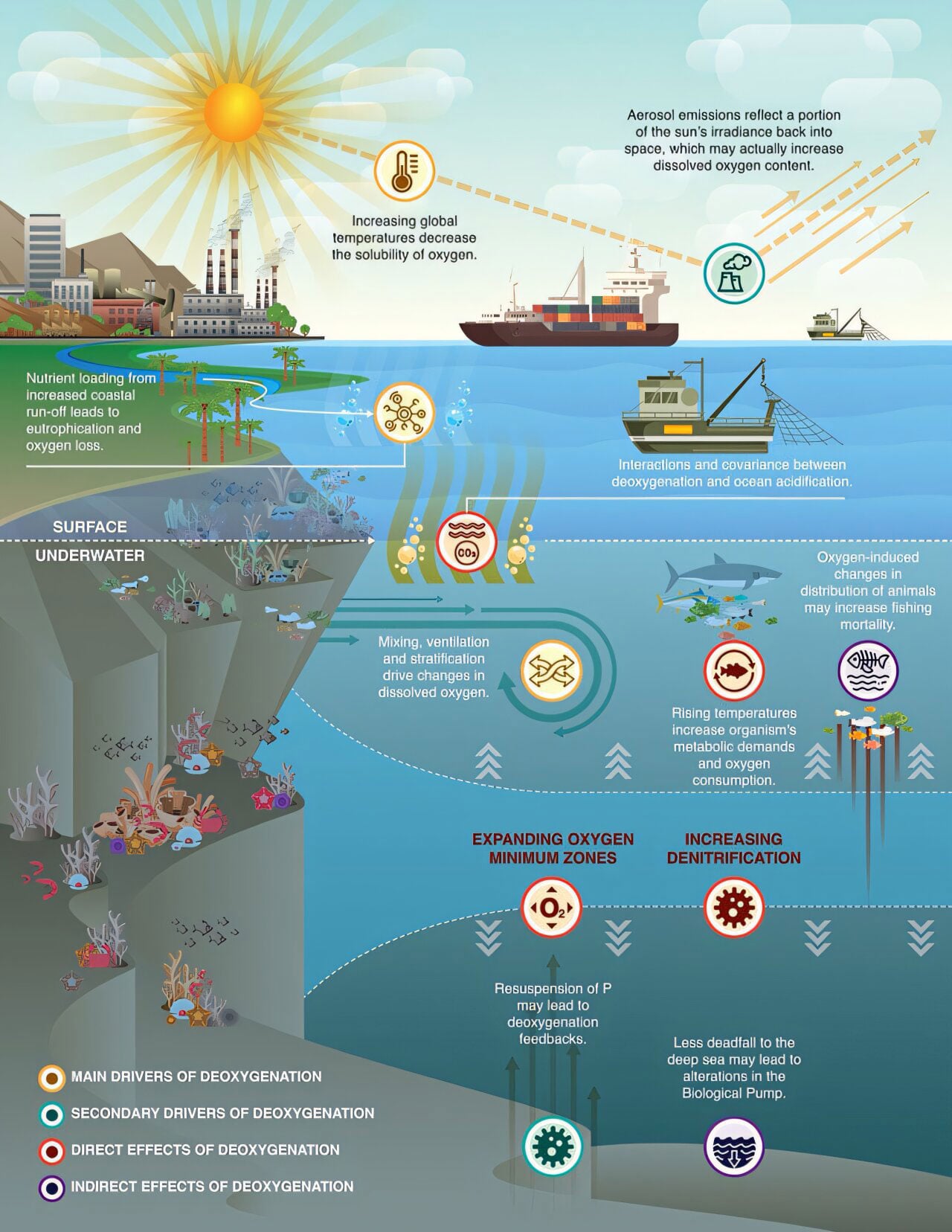
Human-caused warming, excess nutrient pollution and changes in the circulation that carries oxygen into deeper waters are the primary drivers of aquatic deoxygenation. Declining oxygen interferes with biological and chemical processes that help regulate Earth’s climate while threatening organisms ranging from microbes to fish and sharks. Marine mammals can also be affected despite breathing at the surface because oxygen loss changes their habitats, prey, and surrounding food webs.
Scientists call for a new boundary
Ferrer and senior author Lisa Levin, a biological oceanographer at Scripps, developed the idea for the review after attending COP25, the United Nations Climate Change Conference held in Madrid in 2019. They hope the work encourages researchers and policymakers to address aquatic deoxygenation together with the other pressures affecting Earth’s systems.
“Adding aquatic deoxygenation to the Planetary Boundaries framework will help us understand its impacts on Earth system stability,” said Ferrer. “Mitigating its impacts represents a critical component of maintaining biodiversity and climate.”
Reference: “Abundant interactions and feedbacks between aquatic deoxygenation and the other planetary boundaries suggest “unsafe” levels of oxygen loss with far-reaching impacts” by Erica M. Ferrer, Yassir A. Eddebbar, Shailja Gangrade, Lillian R. McCormick, Ariel K. Pezner, De’Marcus Robinson, Véronique Garçon, Kevin C. Rose and Lisa A. Levin, 30 June 2026, Limnology and Oceanography.
DOI: 10.1002/lno.70434
Ferrer conducted this review as part of her doctoral research at Scripps, supported by the National Science Foundation’s Graduate Research Fellowship Program and graduate funds from Scripps and UC San Diego, followed by postdoctoral support from UC Santa Cruz and UC Santa Barbara.
Never miss a breakthrough: Join the SciTechDaily newsletter.
Follow us on Google and Google News.
11 Comments
Just goes to show we are a freak of the universe. We have no right to be here.
Do your part to correct what you see to be a problem.
From the linked source article:
“Aquatic deoxygenation is largely driven by global warming, nutrient loading, reduced physical mixing, and changes in interior ventilation; however, the control variables used to describe these processes within the planetary boundary framework do not entirely explain observed patterns of oxygen loss, nor their effects on Earth System stability.”
That being the case, I would suggest that the authors spend their time researching the situation to make a compelling case that aquatic deoxygenation needs to be added to the list. It is somewhat difficult to believe that deoxygenation is actually a serious problem considering the very high specific heat capacity of water, resulting in a much slower response to heating (and cooling) of water compared to the atmosphere. Much higher temperatures have been estimated from the geologic past, primarily using 18O ratios, without finding evidence of local extirpations. Even more dubious is the role played by humans because there is no agreement on the Climate Sensitivity to CO2 doubling, ranging from negligible to nearly double digits. Work I have done suggests little impact from the reduction of anthropogenic CO2 from the COVID-19 shutdowns:
https://wattsupwiththat.com/2022/03/22/anthropogenic-co2-and-the-expected-results-from-eliminating-it/
Instead, it appears that the impact from photosynthetic plankton and terrestrial vegetation leads to the seasonal ramp-up exceeding the length of time of the photosynthetic draw-down. The NASA-documented ‘Greening’ of Earth demonstrates an increase in detritus that, with a time delay of at least 6-months, provides an annual increase in food for microbial decomposition, and along with out-gassing from slowly warming seas, allows for an increase in atmospheric CO2. However, the evidence for humans being the sole source, or even the primary source, is weak. The General Circulation Models (aka Climate Models) have as their goal, the ability to quantify all the interrelated feedback loops. However, even the modelers acknowledge that their models run warm, and regional precipitation forecasts are often so wrong as to be contradictory. See my analysis of James Hansen’s 1988 testimony to Congress:
https://wattsupwiththat.com/2018/06/30/analysis-of-james-hansens-1988-prediction-of-global-temperatures-for-the-last-30-years/
“It is somewhat difficult to believe that deoxygenation is actually a serious problem considering the very high specific heat capacity of water, resulting in a much slower response to heating (and cooling) of water compared to the atmosphere.” -Clyde
Sea surface temperatures (the surface being where we’d expect a warming atmosphere to have the most immediate effect) have been measurably warming over the last century. Also the thermocline depth has been decreasing but strengthening, measurably. Your mental model consisting of a single fact about water’s heat capacity was missing many important things, including a time scale as well as any notion of density layering due to differences in salinity and temperature.
There is a practical distinction between a “measurable warming” and a warming that is significantly changing the marine environment. Yes, the oceans appear to be warming. However, there is little in the way of solid evidence that the warming is impacting hurricane frequency, the jet stream, or the terrestrial Tmax; the record temperature for land has stood for 113 years.
Do you have a citation for the thermocline getting shallower? If true, it suggests that it may be getting less windy because the thermocline is also known as the lower boundary for the “Mixing Zone.” That might also explain a sharper contrast at the thermocline — assuming that your claim can be substantiated. It is acknowledged that the Arctic is warming more rapidly than the rest of the globe and it is thermal and pressure differences that drive winds.
The Specific Heat Capacities of air and water have been and will be true for all time, as well as the thermal conductivities. Yes, there are surface differences in salinity and pH that are the result wind and temperature. Actually, there are several interrelated feedback loops that make it difficult to generalize the situation.
Did you see this recent article?
https://scitechdaily.com/underwater-drones-find-dead-coral-reefs-teeming-with-life/
Sedentary corals cannot move as easily as fish if the temperature or oxygen level are not to their liking.
“However, there is little in the way of solid evidence that the warming is impacting hurricane frequency, the jet stream, or the terrestrial Tmax; the record temperature for land has stood for 113 years.” -Clyde
Not relevant to a discussion of ocean oxygenation, but the Tmax comment is interesting. Tmax is a weak argument. Global warming is an increase in the average global temperature over decadal timescales and doesn’t disallow momentary temperature extremes at point locations. But more importantly, the meteorological community views the July 10, 1913 Death Valley high temperature with great suspicion. It is an outlier in just about any statistical sense, including not being in concordance with data from neighboring stations on the same day. But also, there’s the method of data collection, which involved relying on a new, poorly-trained volunteer, Oscar Denton, to walk several hundred meters to the screened thermometer in absurdly hot, dry conditions to make observations. Denton made exaggerated claims to guests of temperatures of 145 degrees in the shade and 160 degrees in the sun, and other data recorded by Denton are also regarded with some suspicion. I recommend reading Steinacker, “The 1913 maximum temperature world record at Death Valley: should we expect a new record in the near future?” Oxford Open Climate Change, 2025
The authors remark that “Aquatic deoxygenation and ocean acidification often co-occur due to coupled biological and biogeochemical processes, including photosynthesis and respiration. Nutrient-driven increases in respiration tend to reduce oxygen and lower pH, and their combined effects can negatively impact organisms.”
But for different reasons. The so-called (erroneously) “ocean acidification” is primarily linked to up-welling of abyssal cold water that has been been enriched in CO2 by decomposition and digestion of the organic detritus falling to the bottom of the oceans. The cold water and high pressure drive the solution of CO2, leading to a pH approaching neutrality. (See the Monterey Bay Aquarium Institute’s archival record of the pH of inlet water.)
According to the Father of Geochemistry, Stanford Professor Konrad Krauskopf, because of (bi)carbonate/borate buffering, the oceans have probably never been acidic and probably never will be. It is an oxymoron to characterize something by a state it will never achieve. He allows that some deep, stagnant pools enriched in hydrogen sulfide may achieve a state of neutrality. But without the copious production of sulfurous/sulfuric acids (strong acids) during the End Permian times, when the Large Igneous Province we now call Siberia was erupting and intruding Carboniferous coal beds, carbonic acid alone is too weak to overcome the chemical buffering and drive the oceans to a state of acidity. Note additional comments from Dr. Krauskopt here:
http://wattsupwiththat.com/2015/09/15/are-the-oceans-becoming-more-acidic/
“As a general rule, oxygen solubility in water decreases as temperature rises. Since the Industrial Revolution, the ocean (and other bodies of water) has absorbed over 90% of the total excess heat trapped in our atmosphere by anthropogenic greenhouse gases (IPCC 2019), …”
That statement from the article source is really a non sequitur. It jumps from temperature to heat without mentioning Specific Heat Capacity of seawater and does not demonstrate that either are the result of anthropogenic CO2.
I like your technical level.
Thank you, Steve. I try to walk the line between not talking over people’s heads and avoiding sounding like I don’t know what I’m talking about. I’ve never worked as a technical writer, but I did spend more than a decade teaching geology, physical geography, and chemistry at the college level. Therefore, I do have some experience with communicating new information to people who may be lacking the specialist’s jargon or vocabulary. As long as the reader isn’t put off by learning some new vocabulary, I’ll endeavor to try to present the situation as I understand it and in a way that maintains the reader’s trust that I’m being truthful and unbiased. I’m always open to being challenged or corrected. I can make mistakes — but not very often! 🙂
I’ll only address 2 aspects of this article:
1. It appears to be yet another attempt to create a crisis. I’ve lived through, the “new ice age.” We’re “running out” of fossil fuels. The population bomb. Reagan caused WWIII; was just listening to a Prince song from ’81 about that. Let’s see, AIDS gets airborne. All the bees die. Allowing right to carry firearms will lead to war in the streets; crime rates now lower than 1900. All BS crises.
2. Seems someone wants a grant.