
Close Menu
    Facebook X (Twitter) Instagram
    SciTechDaily
    • Biology
    • Chemistry
    • Earth
    • Health
    • Physics
    • Science
    • Space
    • Technology
    Facebook X (Twitter) Pinterest YouTube RSS
    SciTechDaily
    Home»Earth»It’s Impossible to Stop the Seas From Rising Completely
    Earth

    It’s Impossible to Stop the Seas From Rising Completely

    By SciTechDailyNovember 5, 20122 Comments3 Mins Read
    Facebook Twitter Pinterest Telegram LinkedIn WhatsApp Email Reddit
    Share
    Facebook Twitter LinkedIn Pinterest Telegram Email Reddit
    Extreme Weather Flooding
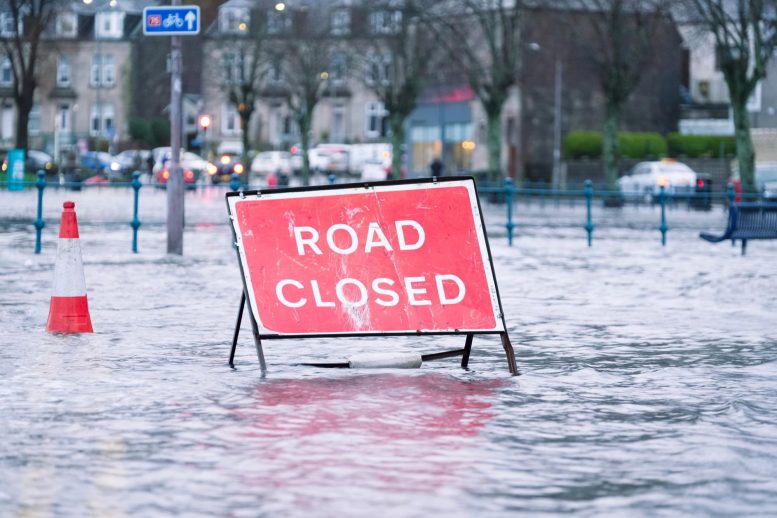
    Scientists project that if the planet keeps warming at the current pace, sea levels will rise between two and seven feet by 2100.

    Global sea levels have risen about seven inches (18 centimeters) in the past hundred years, and that pace is steadily accelerating thanks to climate change. This rise in sea levels threatens most coastal areas, and makes storm surges much worse, as in the case of hurricanes as well as smaller storms.

    Scientists published their findings in the journal Nature Climate Change. The oceans are likely to keep rising. Scientists project that if the planet keeps warming at the current pace, sea levels will rise between two and seven feet (0.6 to 2 meters) by 2100.
    seal-level-rise-worldwide
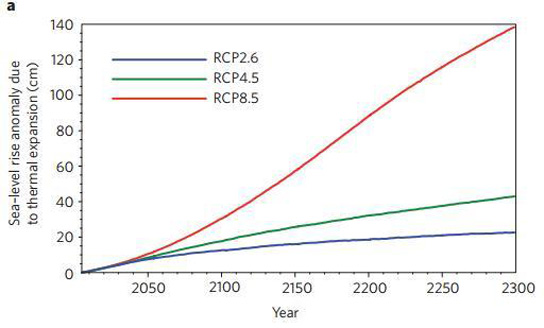
    The projected thermal expansion of the oceans. The red line is the unchecked emissions scenario. The blue line is the aggressive carbon-reducing scenario. The green line is a less aggressive cut.

    Reducing emissions would help slow down the rate of sea-level rise, but it’s unlikely that it could be stopped altogether. Aggressive steps to cut emissions could help reduce the sea-level rise predictions by 6 to 20 inches (15 to 50 centimeters) in 2100, according to a recent study from the National Center on Atmospheric Research (NCAR). But the scientists believe the sea levels will continue to rise for centuries no matter what humans do.

    It’s easier to stabilize global temperatures by cutting carbon emissions than stabilizing sea-level rise, since the carbon dioxide that’s loaded into the atmosphere will likely have an effect on the oceans for centuries to come.

    When carbon dioxide traps more heat on the planet, the oceans get warmer and expand in volume and the ice caps start to melt, pouring more water into the oceans. These processes can’t be stopped quickly, even if we cease putting carbon dioxide into the atmosphere immediately.

    The NCAR paper estimates that if emissions go unchecked, the planet could warm by 4°C (7.2°F) over pre-industrial levels by 2100, causing sea levels to rise between two and five feet (0.6 to 1.5 meters). If emissions are cut and temperatures increase by below 2°C (3.6°F), the paper suggests that the sea levels would rise by 11 inches to 3.5 feet (0.28 to 1.1 meters).

    Reference: “Relative outcomes of climate change mitigation related to global temperature versus sea-level rise” by Gerald A. Meehl, Aixue Hu, Claudia Tebaldi, Julie M. Arblaster, Warren M. Washington, Haiyan Teng, Benjamin M. Sanderson, Toby Ault, Warren G. Strand and James B. White III, 1 July 2012, Nature Climate Change.
    DOI: 10.1038/nclimate1529

    Never miss a breakthrough: Join the SciTechDaily newsletter.
    Follow us on Google and Google News.

    Climate Change Environment Global Warming Meteorology Sea Level
    Share. Facebook Twitter Pinterest LinkedIn Email Reddit

    Related Articles

    Tropical Oceans Role in Climate Change

    Carbon Sequestration Likely to Cause Intraplate Earthquakes

    Southern Ocean Research Shows Decrease in Dense Antarctic Bottom Water

    Particulate Pollution Created ‘Warming Hole’ that Delayed Climate Change

    Study Blames Warm Ocean Currents for Majority of Ice Loss in Antarctica

    Cloud Forests are at Risk of Destruction from Global Warming

    Past Estimates of Sea-Level Rise Lowered

    New Models Hone Picture of Climate Impact on Earth

    Research Shows Roughly 150 Billion Tons of Ice Lost Annually

    2 Comments

    1. jorgen on November 5, 2012 10:50 am

      Scientists project that if the planet keeps warming at the current pace

      Other scientists realise that global warming stopped 16 years ago, so problem solved.

      Reply
    2. Madanagopal.V.C. on November 6, 2012 9:01 am

      I can’t understand the former’s comment. The article states that global warming is responsible for swelling seas and since the temperature has already risen by few degrees the act of melting of arctic ice would continue even if the global warming is stopped because already the globe is heated to such an extent that calamity is sure to follow. Any further global warming would only speed up the calamity by raising the temperature further. It never states that problem is solved. Thank You.

      Reply
    Leave A Reply Cancel Reply

    • Facebook
    • Twitter
    • Pinterest
    • YouTube

    Don't Miss a Discovery

    Subscribe for the Latest in Science & Tech!

    Trending News

    The Best Exercise Combination for Longevity, According to a 30-Year Study

    Popular Weight-Loss Drug Found To Slow Biological Aging in Landmark Human Trial

    NASA’s Fermi Telescope Caught a Supernova Doing Something Never Seen Before

    This Dinosaur Had the Claws of a Raptor but Hunted Like a Heron

    Doctors May Need To Rethink Calcium and Vitamin D Recommendations After Major Review

    Scientists Discover a Hidden Cause of Cellular Aging That Can Be Reversed

    Archaeologists Have Found Something Unexpected Inside a 1,600-Year-Old Egyptian Mummy

    Scientists May Have Found a Completely New Way To Treat Depression

    Follow SciTechDaily
    • Facebook
    • Twitter
    • YouTube
    • Pinterest
    • Newsletter
    • RSS
    SciTech News
    • Biology News
    • Chemistry News
    • Earth News
    • Health News
    • Physics News
    • Science News
    • Space News
    • Technology News
    Recent Posts
    • Chemists Capture a Bizarre Molecular Structure Never Seen Before
    • Mass Spectrometry Breakthrough Detects Billions of Molecules at Once
    • Don’t Miss: Venus Is About To Disappear Behind the Moon
    • Cambridge Scientists Just Reversed a Form of Nerve Damage Once Thought Permanent
    • A Surprising Discovery Inside Fish Could Change What We Know About the Ocean
    Copyright © 1998 - 2026 SciTechDaily. All Rights Reserved.
    • Science News
    • About
    • Contact
    • Editorial Board
    • Privacy Policy
    • Terms of Use

    Type above and press Enter to search. Press Esc to cancel.