
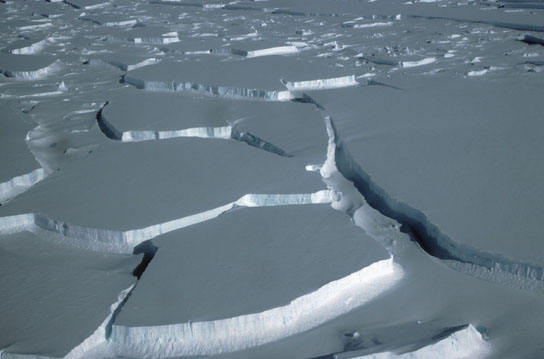
Using new techniques with satellite measurements to differentiate between the warm ocean currents attacking the underside ice shelves and warm air melting it from above, a team of scientists established that warm ocean currents are the dominant cause of recent ice loss from Antarctica. Their findings are being published this week (Thursday, April 26) in the journal Nature.
Researchers used 4.5 million measurements made by a laser instrument mounted on NASA’s ICESat satellite to map the changing thickness of almost all the floating ice shelves around Antarctica, revealing the pattern of ice-shelf melt across the continent. Of the 54 ice shelves mapped, 20 are being melted by warm ocean currents, most of which are in West Antarctica.
In every case, the inland glaciers that flow down to the coast and feed into these thinning ice shelves have accelerated, draining more ice into the sea and contributing to sea level rise.
This animation shows the circulation of ocean currents around the western Antarctic ice shelves. The shelves are indicated by the rainbow color; red is thicker (greater than 550m), while blue is thinner (less than 200m). The ocean flow runs from the surface to 900 m, colored white at the surface and fading to light blue at depth, and is based on the ECCO2 model over a representative two-month period. Bathymetry, topography, and ice thickness were derived from the RTopo-1 dataset of Timmermann, et al. (https://doi.pangaea.de/10.1594/PANGAEA.741917). Ground color is from MODIS/Blue Marble. Credit: NASA/Goddard Space Flight Center Scientific Visualization Studio
Lead author Dr. Hamish Pritchard from British Antarctic Survey, which is funded by the UK’s Natural Environment Research Council (NERC), said:
“In most places in Antarctica, we can’t explain the ice-shelf thinning through melting of snow at the surface, so it has to be driven by warm ocean currents melting them from below.
“We’ve looked all around the Antarctic coast and we see a clear pattern: in all the cases where ice shelves are being melted by the ocean, the inland glaciers are speeding up. It’s this glacier acceleration that’s responsible for most of the increase in ice loss from the continent and this is contributing to sea-level rise.
“What’s really interesting is just how sensitive these glaciers seem to be. Some ice shelves are thinning by a few meters a year and, in response, the glaciers drain billions of tons of ice into the sea. This supports the idea that ice shelves are important in slowing down the glaciers that feed them, controlling the loss of ice from the Antarctic ice sheet. It means that we can lose an awful lot of ice to the sea without ever having summers warm enough to make the snow on top of the glaciers melt — the oceans can do all the work from below.
“But this does raise the question of why this is happening now. We think that it’s linked to changes in wind patterns. Studies have shown that Antarctic winds have changed because of changes in climate, and that this has affected the strength and direction of ocean currents. As a result, warm water is funneled beneath the floating ice. These studies and our new results, therefore, suggest that Antarctica’s glaciers are responding rapidly to a changing climate.”
A different picture is seen on the eastern Antarctic Peninsula (the long stretch of land pointing towards South America). Here, the ice-shelf thinning found by this study can be explained by warm summer winds directly melting the snow on the ice-shelf surfaces. Both patterns, of widespread ocean-driven melting and this summer melting on the Antarctic Peninsula, can therefore be attributed to Antarctica’s changing wind patterns.
This research is part of international efforts to improve understanding of the interactions between ice and climate in order to improve the reliability of sea-level rise projections. Professor David Vaughan is the leader of ice2sea — a major EU-funded FP7 program. He said,
“This study shows very clearly why the Antarctic ice sheet is currently losing ice, which is a major advance. But the real significance is that it also shows the key to predicting how the ice sheet will change in the future is in understanding the oceans. Perhaps we should not only be looking to the skies above Antarctica, but also into the surrounding oceans.”
Reference: “Antarctic ice-sheet loss driven by basal melting of ice shelves” by H. D. Pritchard, S. R. M. Ligtenberg, H. A. Fricker, D. G. Vaughan, M. R. van den Broeke and L. Padman, 25 April 2012, Nature.
DOI: 10.1038/nature10968
The study was carried out by an international team from British Antarctic Survey, Utrecht University, University of California in San Diego and Earth & Space Research in Corvallis, Oregon. NASA’s ICESat — Ice, Cloud and Land Elevation Satellite — measurements were collected during the period 2003 – 2008 to detect changes in ice-shelf thickness through time.
Never miss a breakthrough: Join the SciTechDaily newsletter.
Follow us on Google and Google News.