
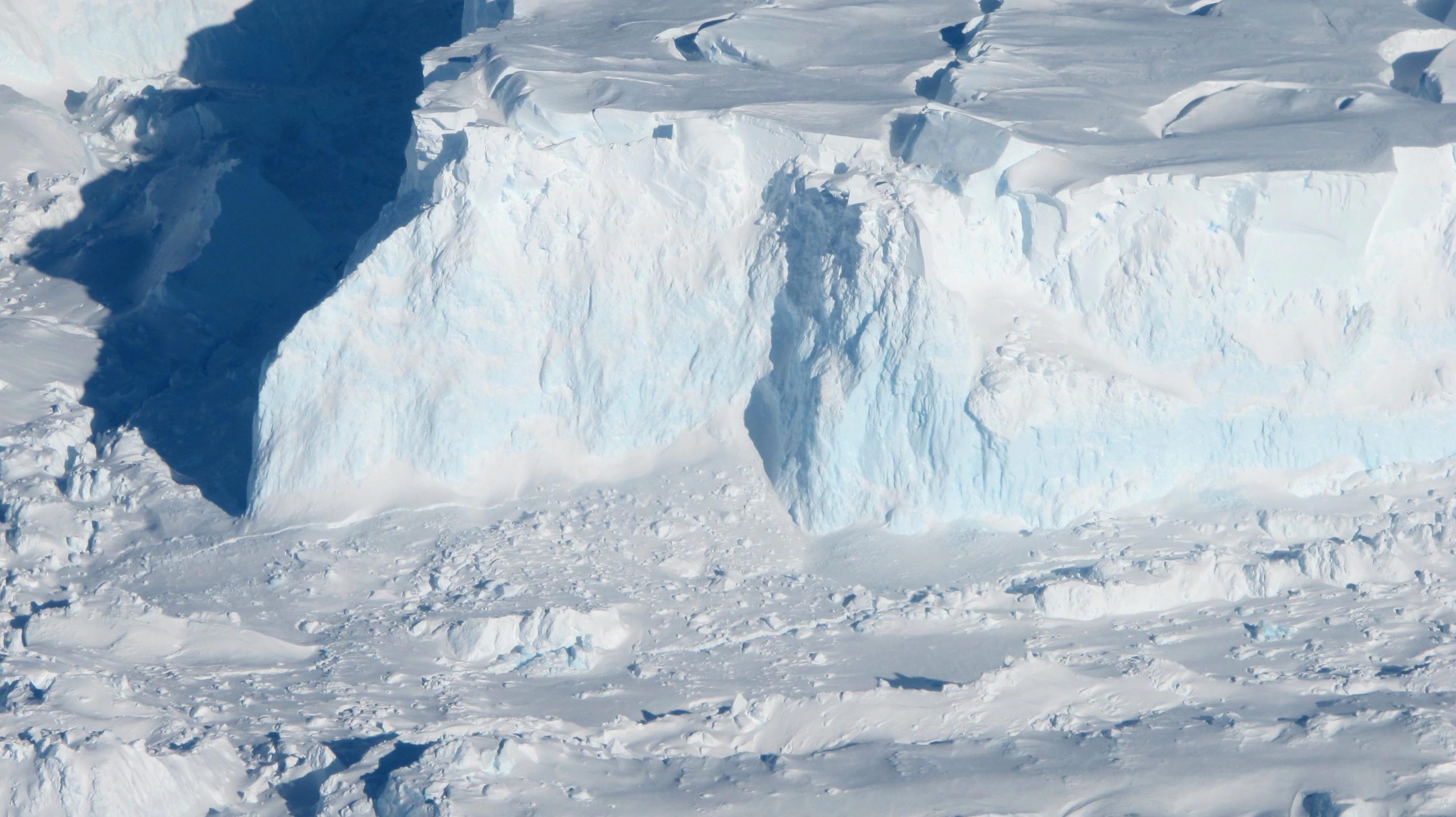
Satellite radar data shows substantial seawater intrusion beneath Antarctica’s Thwaites Glacier, causing ice to rise and fall.
Using high-resolution satellite radar data, a team of glaciologists led by researchers at the University of California, Irvine uncovered evidence of the intrusion of warm, high-pressure seawater many kilometers beneath the grounded ice of West Antarctica’s Thwaites Glacier. This glacier is often referred to as the “Doomsday Glacier” because of its critical role in potential global sea level rise and the catastrophic implications such a rise would have worldwide. This nickname reflects the glacier’s vast size and its significant melting rate, which scientists believe could substantially contribute to sea level rise if it were to collapse or melt entirely.
The UC Irvine-led team said that widespread contact between ocean water and the glacier – a process that is replicated throughout Antarctica and in Greenland – causes “vigorous melting” and may require a reassessment of global sea level rise projections. Their study was published on May 20 in Proceedings of the National Academy of Sciences,
Data and Observations
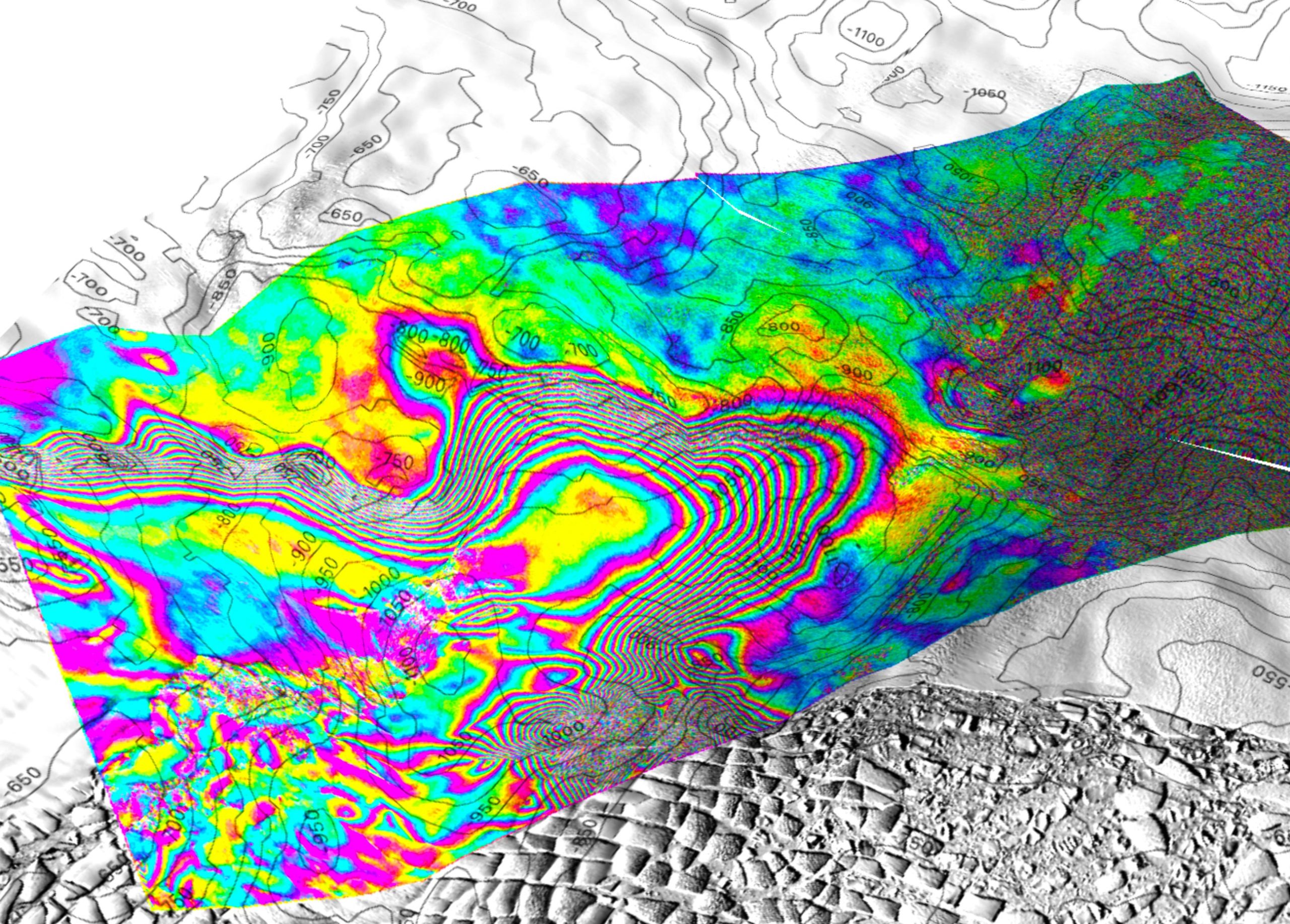
The glaciologists relied on data gathered from March to June of 2023 by Finland’s ICEYE commercial satellite mission. The ICEYE satellites form a “constellation” in polar orbit around the planet, using InSAR – interferometer synthetic aperture radar – to persistently monitor changes on the Earth’s surface. Many passes by a spacecraft over a small, defined area render smooth data results. In the case of this study, it showed the rise, fall, and bending of Thwaites Glacier.
“These ICEYE data provided a long-time series of daily observations closely conforming to tidal cycles,” said lead author Eric Rignot, UC Irvine professor of Earth system science. “In the past, we had some sporadically available data, and with just those few observations it was hard to figure out what was happening. When we have a continuous time series and compare that with the tidal cycle, we see the seawater coming in at high tide and receding and sometimes going farther up underneath the glacier and getting trapped. Thanks to ICEYE, we’re beginning to witness this tidal dynamic for the first time.”
Advanced Satellite Observations
ICEYE Director of Analytics Michael Wollersheim, co-author, said, “Until now, some of the most dynamic processes in nature have been impossible to observe with sufficient detail or frequency to allow us to understand and model them. Observing these processes from space and using radar satellite images, which provide centimeter-level precision InSAR measurements at daily frequency, marks a significant leap forward.”
Rignot said the project helped him and his colleagues develop a better understanding of the behavior of seawater on the undersides of Thwaites Glacier. He said that seawater coming in at the base of the ice sheet, combined with freshwater generated by geothermal flux and friction, builds up and “has to flow somewhere.” Water is distributed through natural conduits or collects in cavities, creating enough pressure to elevate the ice sheet.
“There are places where the water is almost at the pressure of the overlying ice, so just a little more pressure is needed to push up the ice,” Rignot said. “The water is then squeezed enough to jack up a column of more than half a mile of ice.”
And it’s not just any seawater. For decades, Rignot and his colleagues have been gathering evidence of the impact of climate change on ocean currents, which push warmer seawater to the shores of Antarctica and other polar ice regions. Circumpolar deep water is salty and has a lower freezing point. While freshwater freezes at zero degrees Celsius, saltwater freezes at minus two degrees, and that small difference is enough to contribute to the “vigorous melting” of basal ice as found in the study.
Impact on Sea Level Rise and Future Research
Co-author Christine Dow, professor in the Faculty of Environment at the University of Waterloo in Ontario, Canada, said, “Thwaites is the most unstable place in the Antarctic and contains the equivalent of 60 centimeters of sea level rise. The worry is that we are underestimating the speed that the glacier is changing, which would be devastating for coastal communities around the world.”
Rignot said that he hopes and expects the results of this project to spur further research on the conditions beneath Antarctic glaciers, exhibitions involving autonomous robots, and more satellite observations.
“There is a lot of enthusiasm from the scientific community to go to these remote, polar regions to gather data and build our understanding of what’s happening, but the funding is lagging,” he said. “We operate at the same budget in 2024 in real dollars that we were in the 1990s. We need to grow the community of glaciologists and physical oceanographers to address these observation issues sooner rather than later, but right now we’re still climbing Mount Everest in tennis shoes.”
Conclusion and Implications for Modeling
In the near term, Rignot, who is also a senior project scientist at NASA’s Jet Propulsion Laboratory (JPL), said this study will provide a lasting benefit to the ice sheet modeling community.
“If we put this type of ocean-ice interaction into ice sheet models, I expect we will be able to do a much better job of reproducing what has happened in the past quarter century, which will lead to a higher level of confidence in our projections,” he said. “If we could add this process we outlined in the paper, which is not included in most current models, the model reconstructions should match observations much better. It would be a big win if we could achieve that.”
Dow added, “At the moment we don’t have enough information to say one way or the other how much time there is before the oceanwater intrusion is irreversible. By improving the models and focusing our research on these critical glaciers, we will try to get these numbers at least pinned down for decades versus centuries. This work will help people adapt to changing ocean levels, along with focusing on reducing carbon emissions to prevent the worst-case scenario.”
For more on this research, see The Silent Surge Threatening the “Doomsday Glacier.”
Reference: “Widespread seawater intrusions beneath the grounded ice of Thwaites Glacier, West Antarctica” by Eric Rignot, Enrico Ciracì, Bernd Scheuchl, Valentyn Tolpekin, Michael Wollersheim and Christine Dow, 20 May 2024, Proceedings of the National Academy of Sciences.
DOI: 10.1073/pnas.2404766121
Rignot, Dow, and Wollershiem were joined in this project by Enrico Ciraci, UC Irvine assistant specialist in Earth system science and NASA postdoctoral fellow; Bernd Scheuchl, UC Irvine researcher in Earth system science; and ICEYE’s Valentyn Tolpekin. ICEYE is headquartered in Finland and operates from five international locations, including the United States. The research received financial support from NASA and the National Science Foundation.
Never miss a breakthrough: Join the SciTechDaily newsletter.
Follow us on Google and Google News.
7 Comments
“This work will help people adapt to changing ocean levels, along with focusing on reducing carbon emissions to prevent the worst-case scenario.”
Adaptation and infrastructure preparations should be the focus. Reducing carbon emissions will take none of the CO2 already added out of the atmosphere to have any effect on global temperatures. That would be counterproductive to finishing the transition to renewables and EVs. There is essentially nothing practical or realistic that can be done about this glacier except monitor it.
Enough already with the climate fear-porn
If “rivers of meltwater,” as some stories have phrased it, are flowing beneath Thwaites, it almost certainly isn’t due to climate change, which may have caused a fraction of a degree increase in ocean and air temperatures. Far more likely to be responsible are the many subglacial active volcanoes that dot the region. As it turns out, Western Antarctica is home to the worlds greatest concentration of active volcanoes, 137 of them at last count. In total they release staggering amounts of heat, which is what you need if you want to melt vast quantities of ice at -50C.
This crucial fact is almost always left out of stories about the “Doomsday” glacier, which has a long history of erratic behavior. This story, alas, is no exception.
“which has a long history of erratic behavior”
How long is long?
“Each interferometric fringe color cycle is a 360 degree change in phase, equivalent to a 1.65 cm displacement in line-of-sight distance of the ice surface.”
I count 13 red rings, amounting to about 21 cm of surface-elevation change or, I assume, a wedge of seawater about the same magnitude. That doesn’t carry much heat energy compared to a deep or thick wedge of water. Might the authors be overstating the potential impact?
“equivalent to a 1.65 cm displacement in line-of-sight distance of the ice surface.”
Anyone else find that to be a peculiar clause? Displacements may be lateral, or vertical or a bit of both and thus resolvable into components. Am not sure what a line- of- sight displacement might be, other than that it is visible to the eye.
“While freshwater freezes at zero degrees Celsius, saltwater freezes at minus two degrees, and that small difference is enough to contribute to the “vigorous melting” of basal ice…..”
And assuming that the ice at the base of the glacier is salt-free and therefore melts at 0 degrees C, how does salt-water at -2 degree C melt that ice? Must have missed something about colder things melting warmer things: or that the basal glacier ice is colder than the sea-water, which is no doubt possible, although surely it would then freeze the incoming sea-water. if the sea-water were to hang around for long enough……………..?
,
What’s the point in talking about it, it seems scientist is focused more on what’s going on in space rather than trying to actually come up with solutions to fix these kind of problems. I am just tired of worrying about something that’s gonna happen anyway.