
Close Menu
    Facebook X (Twitter) Instagram
    SciTechDaily
    • Biology
    • Chemistry
    • Earth
    • Health
    • Physics
    • Science
    • Space
    • Technology
    Facebook X (Twitter) Pinterest YouTube RSS
    SciTechDaily
    Home»Earth»Tidal Extremes: Ecological Insights From Australia’s Dynamic Montgomery Reef
    Earth

    Tidal Extremes: Ecological Insights From Australia’s Dynamic Montgomery Reef

    By Adam Voiland, NASA Earth ObservatoryMay 21, 2024No Comments4 Mins Read
    Facebook Twitter Pinterest Telegram LinkedIn WhatsApp Email Reddit
    Share
    Facebook Twitter LinkedIn Pinterest Telegram Email Reddit
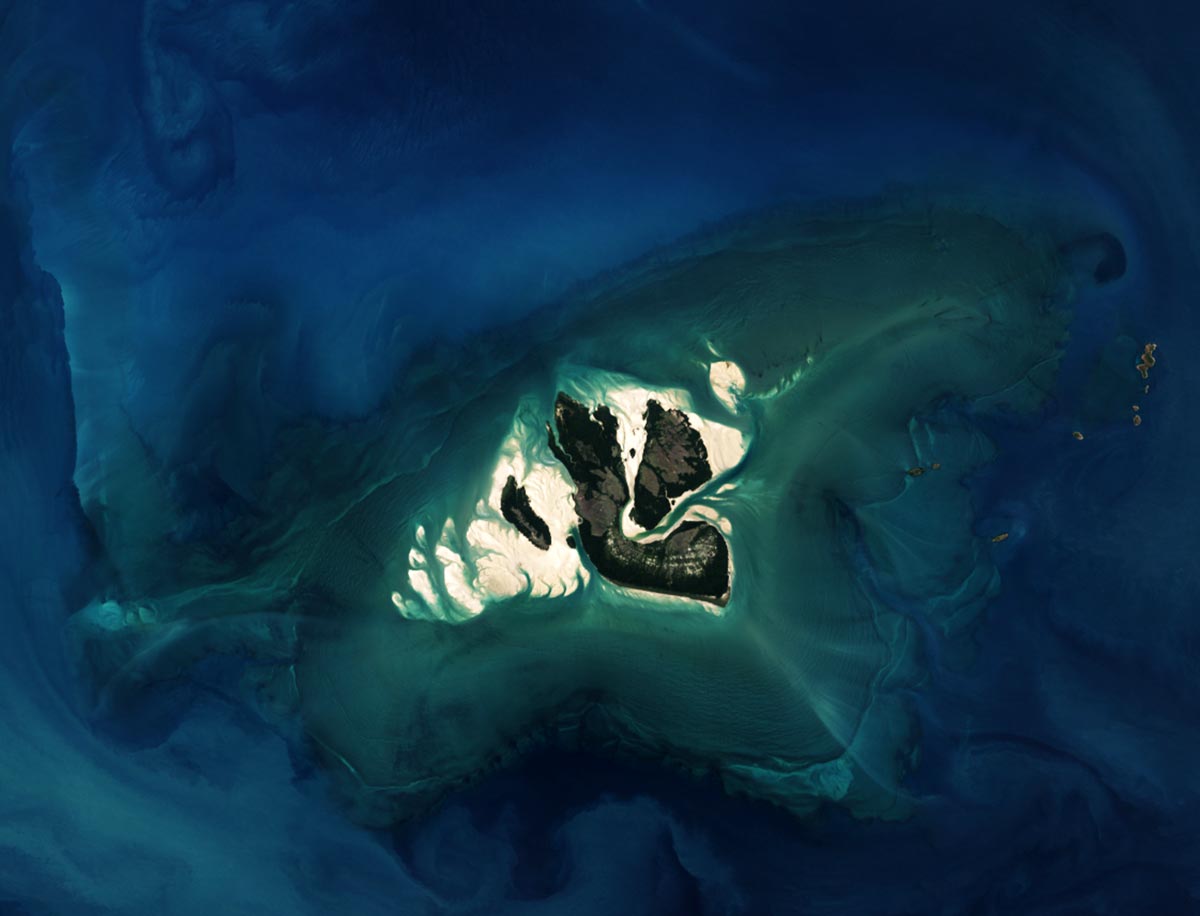
    Montgomery Reef Collier Bay Australia High Tide Annotated
    Satellite image of Montgomery Reef around Australia’s Yawajaba island captured at high tide on April 21, 2024, by the Operational Land Imager-2 on Landsat 9.
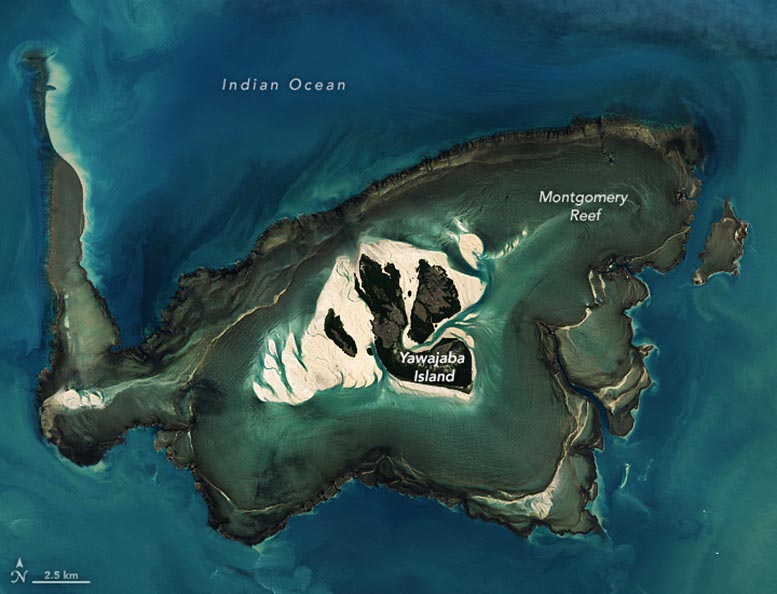
    Montgomery Reef Collier Bay Australia Low Tide Annotated
    Satellite image of Montgomery Reef around Australia’s Yawajaba island captured at low tide on April 29, 2024, by the Operational Land Imager on Landsat 8.

    Large tidal swings expose a plateau-shaped reef around Australia’s Yawajaba island at low tide.

    The Kimberley coast of Western Australia has one of the largest tidal ranges in Australia and the world. At Montgomery Reef, in Collier Bay, water levels drop sharply at low tide, allowing the plateau-shaped reef to emerge several meters above the water level.

    Tidal shifts are particularly noticeable in this area because of the flat, shelf-like terrain along the Kimberley coast. This pair of images shows the reef when the tide was high (left) and low (right) in 2024. The high tide image was captured by the OLI-2 (Operational Land Imager-2) on Landsat 9 on April 21; the OLI (Operational Land Imager) on Landsat 8 acquired the low tide image on April 29.

    Ecological Dynamics at Low Tide

    When the tide rises, the sandy islets and main mangrove-covered island, Yawajaba, within Montgomery Reef are visible, but the reef is mostly underwater and out of view. During low tides, the water level can drop by as much as 10 meters (33 feet), revealing the expansive terraced structure of the reef and the network of shallow lagoons surrounding Yawajaba.

    As the tide pours off the structure, the outward flow of water can grow tumultuous. At times, whitewater cascading off the reef forms dozens of rivulets and small waterfalls that flow into deeper channels within the reef, a spectacle for tourists and a hazard for wildlife. Fish, sea snakes, turtles, blacktop reef sharks, dugongs, and other creatures can be seen thrashing and tumbling off the coral platform as the water drains. Animals are occasionally left stranded on exposed reef during low tide.

    Geological and Biological Features of Montgomery Reef

    The structure of Montgomery Reef is not entirely a product of coral. The feature was once a flat-topped terrestrial mesa made of dolomite and sandstone that formed some 1.8 billion years ago. More recently, this ancient structure has been encrusted with a veneer of marine life, especially rhodolith—a free-floating type of coralline algae that adds much of the structure to the perimeter of the reef.

    Communities of several types of hard and soft corals cover about 20 percent of the reef’s surface, particularly along the edges of pools and channels where the water is deeper. Corals along the Kimberley coast, like those found on Montgomery Reef, are known for being unusually resilient compared to corals in other parts of Australia and the world. They have adapted to withstand the swings in temperature that come with tidal variations, and to endure the exposure to elevated ultraviolet light and winds during low tide.

    But even these rugged corals are not indestructible. Following a marine heat wave in 2016, which was part of the third global bleaching event, scientists reported widespread coral bleaching at Montgomery Reef and other coral communities on the Kimberley coast.

    Monitoring and Future Concerns

    In April 2024, the National Oceanic and Atmospheric Administration (NOAA) confirmed the world’s corals were in the midst of a fourth global bleaching event, but local reports of bleaching at Montgomery Reef have not emerged yet. Heat stress maps from NOAA’s Coral Reef Watch indicate that corals to the southwest in Western Australia and those closer to the equator faced a greater risk of bleaching in mid-May 2024.

    NASA Earth Observatory images by Lauren Dauphin, using Landsat data from the U.S. Geological Survey.

    Never miss a breakthrough: Join the SciTechDaily newsletter.
    Follow us on Google and Google News.

    Coral Reefs Geography NASA NASA Earth Observatory
    Share. Facebook Twitter Pinterest LinkedIn Email Reddit

    Related Articles

    Can Culebra’s Coral Survive the Climate Crisis?

    Bioluminescence and Biodiversity: Insights From La Parguera’s Marine Ecosystem

    Sea Ice in Denmark Strait – Drifted More Than 1,000 Km (600 Miles) From the Arctic Ocean

    NASA Scientists Map Beirut Blast Damage – Devastating Explosion Rocked Port Area

    NASA Advanced Rapid Imaging Satellite Maps Blast Damage: Beirut Explosion Aftermath

    NASA/NOAA Satellites Observe Surprisingly Rapid Increase in Scale and Intensity of Fires in Siberia

    Mars Terraforming: Cultivating Ideas for Mars on Earth

    Meandering Mississippi River: Photo Taken by Astronaut on Space Station Shows Divergence From State Boundaries

    Incredible Rare Peek at Patagonia in Winter

    Leave A Reply Cancel Reply

    • Facebook
    • Twitter
    • Pinterest
    • YouTube

    Don't Miss a Discovery

    Subscribe for the Latest in Science & Tech!

    Trending News

    These Toads Are Surviving a Deadly Fungus – Scientists May Finally Know Why

    These Brain Cells May Explain Why We Eventually Have To Sleep

    Tomatoes Contain an Invisible Ingredient With Surprising Effects on Liver Health

    World’s First Heat-Powered Cooling System Turns Waste Heat Into Cold

    Antarctica Gained a Record 695 Billion Tons of Ice in Just Two Years

    Don’t Miss: A Brilliant Venus and Glowing Harvest Moon Light Up the Sky

    New Twist on the Einstein Problem Reveals Unexpected Physics

    JWST Captures Stunning Evidence of How Supermassive Black Holes Feed

    Follow SciTechDaily
    • Facebook
    • Twitter
    • YouTube
    • Pinterest
    • Newsletter
    • RSS
    SciTech News
    • Biology News
    • Chemistry News
    • Earth News
    • Health News
    • Physics News
    • Science News
    • Space News
    • Technology News
    Recent Posts
    • Scientists Discover a Hidden Defect That Could Explain Why IBD Keeps Coming Back
    • Millions Take Blood Pressure Drugs, but Many May Be Missing Their Heart-Protective Benefits
    • Could Alien Life Be Conscious in Ways We Can’t Imagine?
    • Scientists Develop a Fruit Wash That Removes Pesticide Residues and Keeps Produce Fresh Longer
    • Scientists May Have Finally Explained Why Astronauts Get Constipated in Space
    Copyright © 1998 - 2026 SciTechDaily. All Rights Reserved.
    • Science News
    • About
    • Contact
    • Editorial Board
    • Privacy Policy
    • Terms of Use

    Type above and press Enter to search. Press Esc to cancel.