
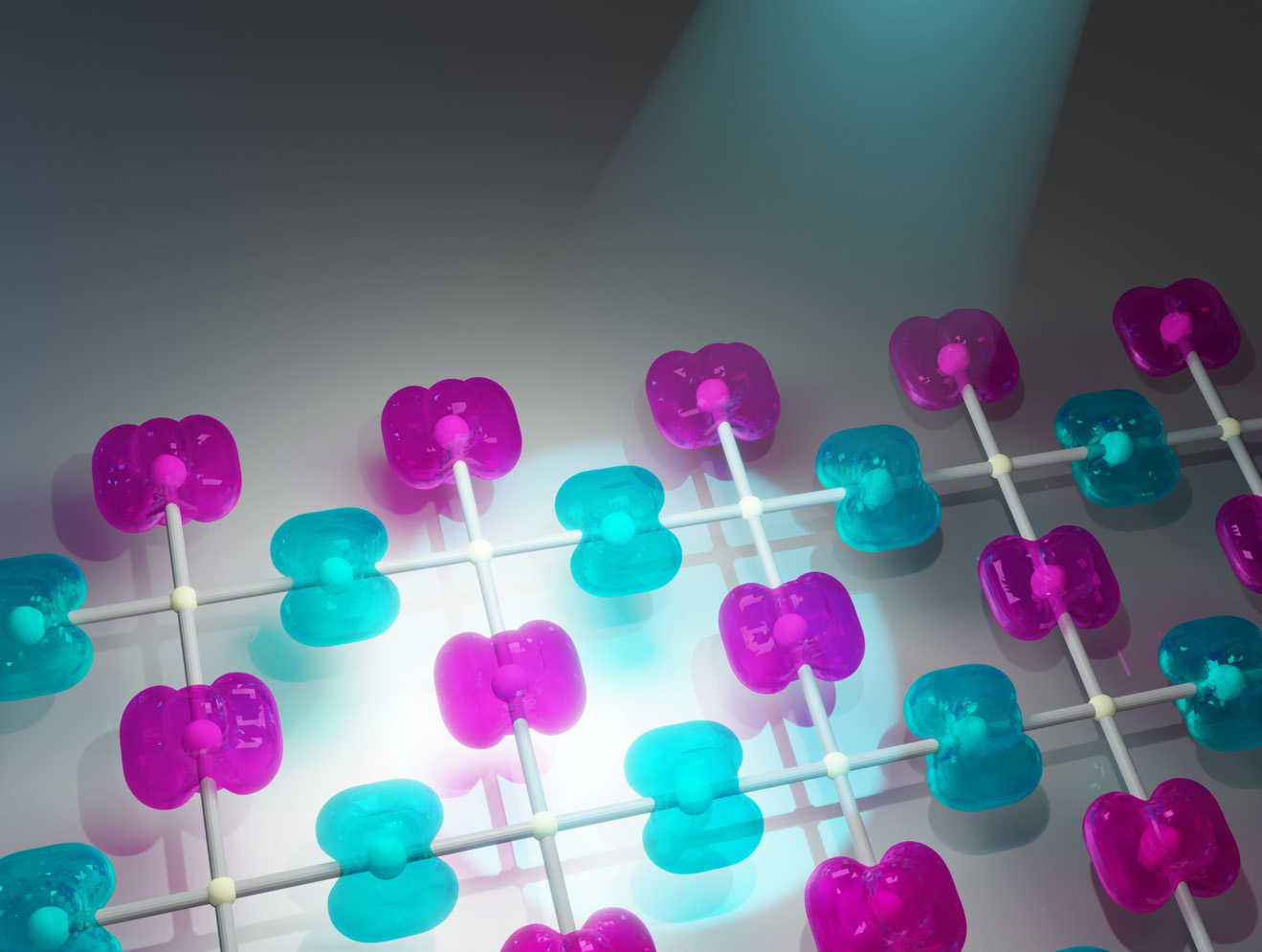
The third branch of magnetism has been experimentally demonstrated in manganese telluride, opening up opportunities for new research directions.
A recent study published in Nature reveals that an international team of scientists has challenged the conventional division of magnetism into two types: ferromagnetism, known for thousands of years, and antiferromagnetism, identified roughly a century ago. The researchers have now successfully demonstrated, through direct experiments, a third type of magnetism—altermagnetism—which had been theoretically predicted by scientists from Johannes Gutenberg University Mainz and the Czech Academy of Sciences in Prague several years earlier.
Limitations of the previously known magnetic branches for information technologies
We usually think of a magnet as a ferromagnet, which has a strong magnetic field that keeps a shopping list on the door of a refrigerator or enables the function of an electric motor in an electric car. The magnetic field of a ferromagnet is created when the magnetic field of millions of its atoms is aligned in the same direction. This magnetic field can also be used to modulate the electric current in information technology (IT) components.
At the same time, however, the ferromagnetic field poses a serious limitation to the spatial and temporal scalability of the components. Thus, a significant research focus in recent years has been on the second, antiferromagnetic branch of magnets. Antiferromagnets are lesser known but much more common materials in nature, where the directions of the atomic magnetic fields on adjacent atoms are staggered like white and black colors on a chessboard. Thus, antiferromagnets as a whole do not create undesirable magnetic fields, but unfortunately, they are so antimagnetic that they have not yet found active applications in information technology.
Altermagnets combine “incompatible” advantages
Recently predicted altermagnets combine the advantages of ferromagnets and antiferromagnets, which were thought to be fundamentally incompatible, and also have other unique benefits not found in the other branches. Altermagnets can be thought of as magnetic arrangements where not only the atomic moments on neighboring atoms alternate, but also the orientation of the atoms in the crystal. Thus, altermagnets do not create a magnetic field on the outside, but the electrons inside feel a magnetic field that is effectively 1,000 times stronger than the field of the magnet on the fridge. These fields can modulate electric currents akin to ferromagnets and are thus potentially very attractive for applications in future ultrascalable nanoelectronics.
In addition, scientists have identified more than 200 candidate materials for altermagnetism with properties covering insulators, semiconductors, metals, and even superconductors. Research groups have investigated many of these materials in the past, but their altermagnetic nature has remained hidden from them.
Theorists predicted the altermagnetic branch five years ago
Starting in 2019, a team from Johannes Gutenberg University Mainz and the Institute of Physics in Prague published a series of papers in which they theoretically identified unconventional magnetic materials. In 2021, the same team of Dr. Libor Šmejkal, Professor Jairo Sinova, and Professor Tomas Jungwirth predicted that these materials form a third fundamental type of magnetism, which they termed altermagnetism and whose crystal and magnetic structure is completely different from conventional ferromagnets and antiferromagnets.
Since altermagnetism opens up wide and unprecedented possibilities for research and application, almost immediately after the theoretical prediction came a wave of follow-up studies by research groups from all over the world. Subsequently, it was a question of when the direct experimental evidence would be forthcoming.
Experimental evidence conducted on a material considered for decades to be a “classical antiferromagnet”
An international team of reseachers has now provided such evidence in a study published in Nature. The researchers decided to examine crystals of a simple two-element altermagnetic candidate – manganese telluride (MnTe). Traditionally, this material has been considered one of the classical antiferromagnets because the magnetic moments on neighboring manganese atoms point in opposite directions, and so do not create an external magnetic field around the material.
Now, for the first time, scientists have been able to directly demonstrate the altermagnetism of MnTe. They used theoretical predictions to navigate in which direction ” the light” would “shine” on high-quality MnTe crystals in a photoemission experiment. The team measured the band structures, which are maps physicists use to describe the properties of electrons in crystals, on a synchrotron. They were then able to show that despite the absence of an external magnetic field the electronic states in MnTe are strongly spin-split. The scale and shape of the spin splitting correspond perfectly to the predicted altermagnetic splitting using quantum mechanical calculations.
Additionally, the researchers were able to detect spin-polarisation of the bands for the first time. “This is direct evidence that MnTe is neither a conventional antiferromagnet nor a conventional ferromagnet but belongs to a new altermagnetic branch of magnetic materials,” said Dr. Libor Šmejkal of JGU, the main author of the theoretical part of the paper.
The study drew on the expertise of researchers at the Institute of Physics at Johannes Gutenberg University Mainz in Germany in collaboration with scientists from the Czech Academy of Sciences in Prague, the Paul Scherrer Institute in Switzerland, the University of West Bohemia in Pilsen, the University of Linz in Austria, the University of Nottingham in the UK, and Charles University in Prague.
The discovery of altermagnetism opens new research directions
“After the first predictions and with the rapidly growing worldwide interest in altermagnetism, we are delighted to have been able to contribute to the experimental demonstration in MnTe,” said Dr. Libor Šmejkal from Mainz University.
Professor Jairo Sinova, director of the Interdisciplinary Spintronics Research Group (INSPIRE) group and the Spin Phenomena Interdisciplinary Center (SPICE) at JGU and co-author of the study, added: “The discovery of altermagnetism has kick-started new directions in global research into new physical and material principles for highly scalable and energy-efficient IT components.” Remarkably, the field is heating up and several other studies appeared recently confirming various other properties of altermagnetic materials. The discovery of altermagnetism thus seems to be just the beginning of an exciting new era in magnetism.
Reference: “Altermagnetic lifting of Kramers spin degeneracy” by J. Krempaský, L. Šmejkal, S. W. D’Souza, M. Hajlaoui, G. Springholz, K. Uhlířová, F. Alarab, P. C. Constantinou, V. Strocov, D. Usanov, W. R. Pudelko, R. González-Hernández, A. Birk Hellenes, Z. Jansa, H. Reichlová, Z. Šobáň, R. D. Gonzalez Betancourt, P. Wadley, J. Sinova, D. Kriegner, J. Minár, J. H. Dil and T. Jungwirth, 14 February 2024, Nature.
DOI: 10.1038/s41586-023-06907-7
Never miss a breakthrough: Join the SciTechDaily newsletter.
Follow us on Google and Google News.
1 Comment
I only believe when the entire scientific community validate!