
Close Menu
    Facebook X (Twitter) Instagram
    SciTechDaily
    • Biology
    • Chemistry
    • Earth
    • Health
    • Physics
    • Science
    • Space
    • Technology
    Facebook X (Twitter) Pinterest YouTube RSS
    SciTechDaily
    Home»Earth»Getz on the Run: Accelerating Pace of Antarctic Glaciers
    Earth

    Getz on the Run: Accelerating Pace of Antarctic Glaciers

    By European Space Agency (ESA)March 9, 2021No Comments6 Mins Read
    Facebook Twitter Pinterest Telegram LinkedIn WhatsApp Email Reddit
    Share
    Facebook Twitter LinkedIn Pinterest Telegram Email Reddit
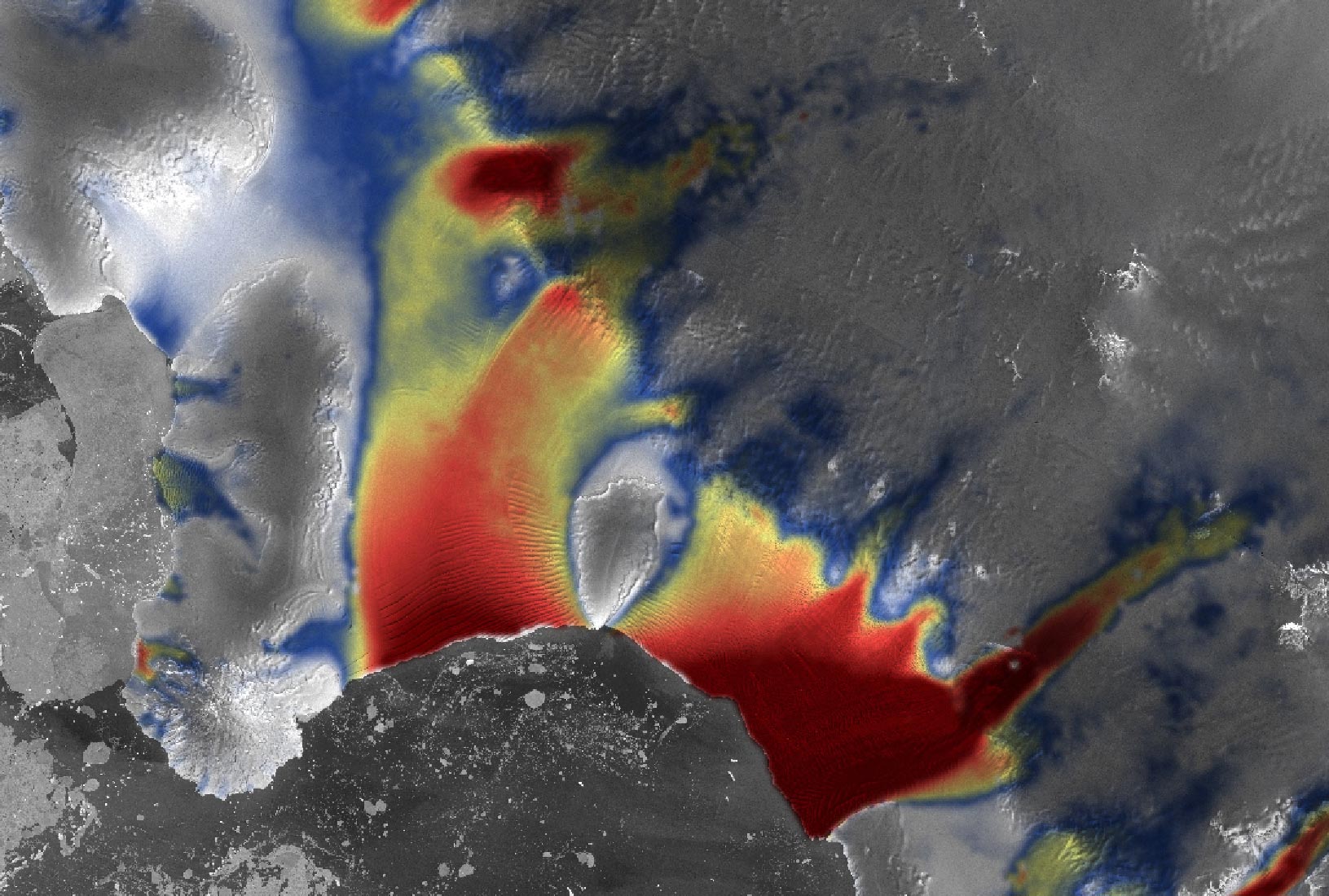
    Getz Glaciers Flowing Faster
    Scientists have discovered that glaciers in the Getz region of Antarctica are increasing in speed as they flow towards the ocean. This new research, which includes data from the Copernicus Sentinel-1 mission, will help determine if these glaciers could collapse in the next few decades and how this would affect future global sea-level rise. Credit: Contains modified Copernicus Sentinel data (2020–21), processed by ESA, University of Leeds

    Warming Oceans Speed Up Antarctic Glaciers, Causing Major Ice Loss and Sea-Level Rise

    Using a 25-year record of satellite observations over the Getz region in West Antarctica, scientists have discovered that the pace at which glaciers flow towards the ocean is accelerating. This new research, which includes data from the Copernicus Sentinel-1 mission and ESA’s CryoSat mission, will help determine if these glaciers could collapse in the next few decades and how this would affect future global sea-level rise.

    Ice lost from Antarctica frequently hits the headlines, but this is the first time that scientists have studied this particular area in depth.

    Led by scientists at the University of Leeds in the UK, the new research shows that between 1994 and 2018, all 14 glaciers in Getz accelerated, on average, by almost 25%, with three glaciers accelerating by over 44%.

    The results, published today in Nature Communications, also reported that the glaciers lost a total of 315 gigatonnes of ice, adding 0.9 mm to global mean sea level – equivalent to 126 million Olympic swimming pools of water.

    Getz Glacier Velocity
    Getz glacier velocity. Credit: University of Leeds/ESA/MEaSUREs version 1, 2016–17 (multimission data), NASA/REMA, PGC/IBCSO, GEBCO

    Heather Selley, lead author of the study and a glaciologist at the Centre for Polar Observation and Modelling at the University of Leeds, said, “The Getz region of Antarctica is so remote that humans have never set foot on the majority of it.

    “However, satellites can tell us what is going on and the high rates of increased glacier speed, coupled with ice thinning, now confirms the Getz basin is in ‘dynamic imbalance’, meaning that it is losing more ice than it gains through snowfall.”

    Tracking Glacier Speed with Satellite Radar

    The scientists used two different types of satellite measurements.

    Radar data from the Copernicus Sentinel-1 mission, legacy data from the ERS mission through ESA’s Climate Change Initiative and NASA’s MEaSUREs data record allowed them to calculate how fast the glaciers have been moving over the 25-year study period.
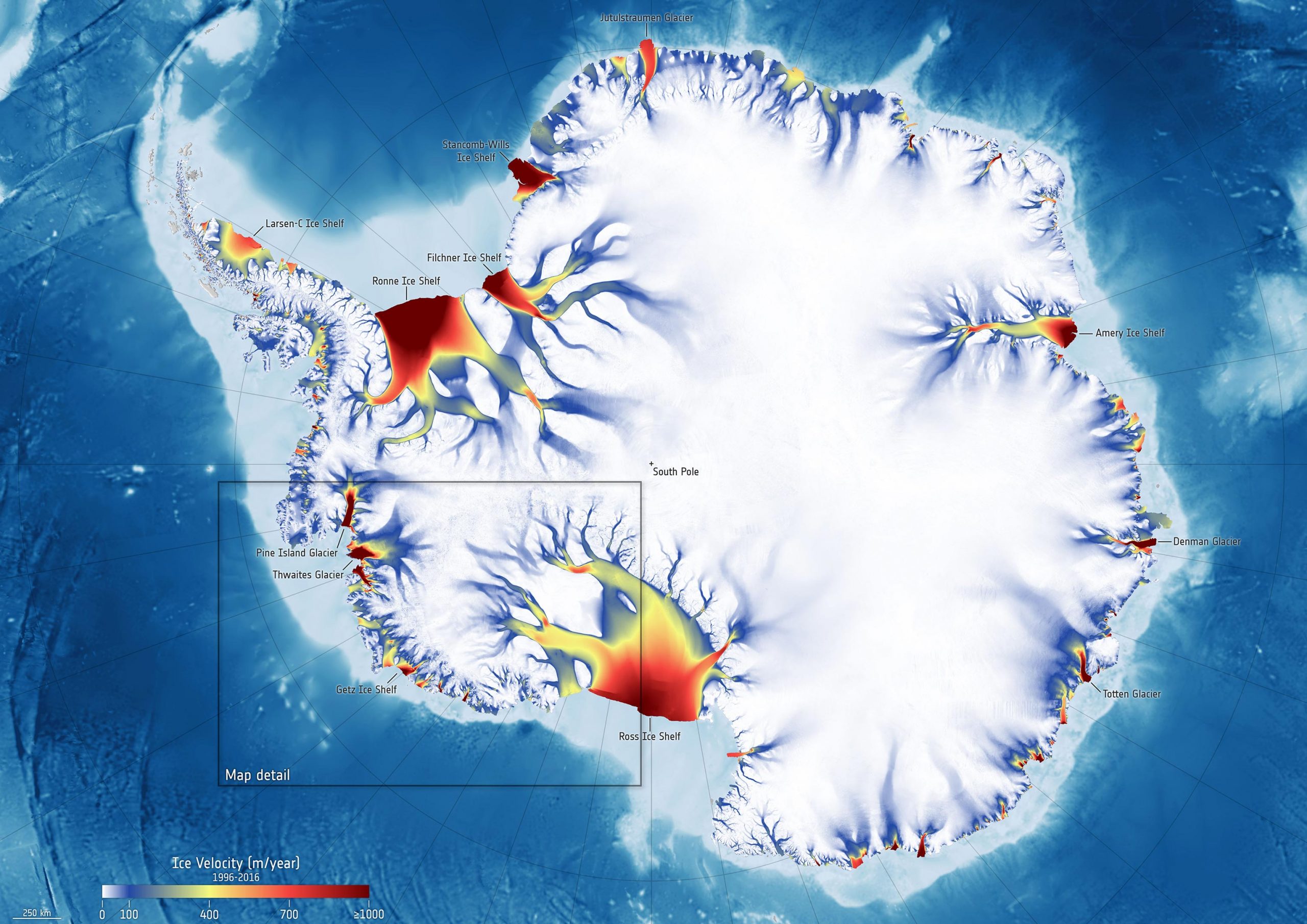
    Antarctic Ice Velocity
    Antarctic ice velocity. The image shows the different rates of glacier flow in Antarctica between 1996 and 2016. Through recent research, scientists have discovered that glaciers in the Getz region (shown within the black rectangle), are accelerating in their flow towards the ocean. Between 1994 and 2018, all 14 glaciers in Getz accelerated, on average, by almost 25%, with three glaciers accelerating by over 44%. Data from multiple missions (ALOS, Envisat, ERS-1, ERS-2, Landsat-8, Radarsat-1, Radarsat-2, Sentinel-1A, TDX, TSX) were used to measure this glacier flow. Credit: ESA/MEaSUREs version 2, 1996–2016 (multimission data), NASA, NSIDC/BAS

    To measure how much the ice has been thinning, they used altimetry data from ESA’s ERS, Envisat, and CryoSat missions through the IMBIE assessment.

    “Using a combination of observations and modeling, we show highly localized patterns of acceleration. For instance, we observe the greatest change in the central region of Getz, with one glacier flowing 391 meters a year faster in 2018 than in 1994. This is a substantial change as it is now flowing at a rate of 669 meters a year, a 59% increase in just two and a half decades,” continued Heather.

    Extending Ice Loss Patterns Beyond Amundsen Sea

    The research, funded by the Natural Environment Research Council and ESA’s Science for Society program, reports how the widely reported thinning and acceleration observed in the neighboring Amundsen Sea glaciers, now extends over 1000 km along the West Antarctic coastline into Getz.

    Anna Hogg, study co-author, said, “The pattern of glacier acceleration shows the highly localized response to ocean dynamics.

    “High-resolution satellite observations from satellites such as Sentinel-1, which collects a repeat image every six-days, means we can measure localized speed changes with ever greater detail.

    “Consistent and extensive sampling of both ice speed and ocean temperature are needed to further our understanding of the dynamic ice loss, which now accounts for 98.8 % of Antarctica’s contribution to sea-level rise.”
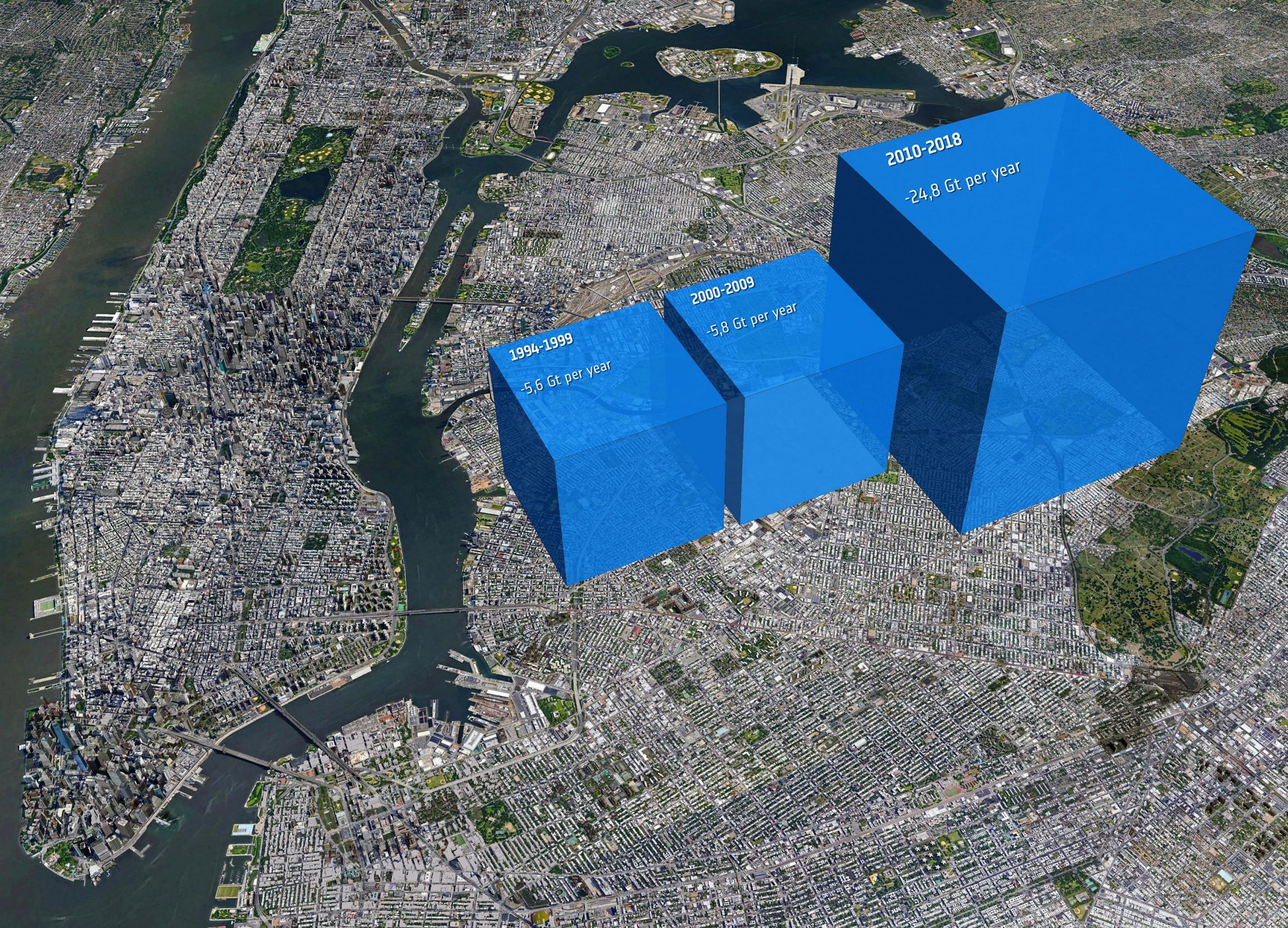
    Visualizing Ice Lost From Getz Glaciers
    Visualizing ice lost from Getz glaciers. Led by scientists at the University of Leeds in the UK, new research shows that between 1994 and 2018, all 14 glaciers in Getz have lost ice. The glaciers lost a total of 315 gigatonnes of ice, adding 0.9 mm to global mean sea level – equivalent to 126 million Olympic swimming pools of water. These cubes positioned over Manhattan represent the ice lost over time, and clearly show that ice loss is increasing. Credit: University of Leeds/ESA/Google basemap

    By examining 25 years of ocean measurements, the research team was able to show complex and annual variations in ocean temperatures. These results suggest that warming ocean waters are largely to blame for this dynamic imbalance.

    ESA’s Marcus Engdahl, added, “Without satellites, we know very little about the remote polar regions, so it’s vital that we keep planning missions for the future. For example, the upcoming Biomass Earth Explorer satellite will be able to make measurements with a completely new instrument that operates in P-band to penetrate deep into the ice. Other missions relevant for the polar regions include the Copernicus Expansion missions CRISTAL, which will carry a dual-band altimeter, and ROSE-L, which will carry an L-band synthetic aperture radar.”

    This activity contributes to the efforts of the ESA Polar Science Cluster to advance our capacity to observe, understand and predict the dramatic changes affecting the polar regions and consequent impacts worldwide.

    Reference: “Widespread increase in dynamic imbalance in the Getz region of Antarctica from 1994 to 2018” by Heather L. Selley, Anna E. Hogg, Stephen Cornford, Pierre Dutrieux, Andrew Shepherd, Jan Wuite, Dana Floricioiu, Anders Kusk, Thomas Nagler, Lin Gilbert, Thomas Slater and Tae-Wan Kim, 23 February 2021, Nature Communications.
    DOI: 10.1038/s41467-021-21321-1

    Never miss a breakthrough: Join the SciTechDaily newsletter.
    Follow us on Google and Google News.

    Antarctica European Space Agency Glacier Global Warming Sea Level
    Share. Facebook Twitter Pinterest LinkedIn Email Reddit

    Related Articles

    Glacier Speeds Up by 87% in a Shocking Case of “Ice Piracy”

    Doomsday Glacier’s Ticking Clock: Satellites Reveal “Vigorous Melting” Beneath Antarctica’s Thwaites Glacier

    Antarctic Glaciers Are Melting Away at the Fastest Rate in 5,500 Years

    “Doomsday Glacier” Threat: Rapid Retreat of Antarctica’s Riskiest Glacier

    Disintegration Fears Grow As Worsening Rifts and Fractures Spotted at Two of Antarctica’s Most Important Glaciers

    Massive Iceberg 5 Times Larger Than Manhattan Shatters Into Pieces – Satellite Video

    CryoSat Discovers Antarctica’s Biggest Glacier’s Ice Loss Pattern Is Evolving

    Study Blames Warm Ocean Currents for Majority of Ice Loss in Antarctica

    Research Shows Roughly 150 Billion Tons of Ice Lost Annually

    Leave A Reply Cancel Reply

    • Facebook
    • Twitter
    • Pinterest
    • YouTube

    Don't Miss a Discovery

    Subscribe for the Latest in Science & Tech!

    Trending News

    Scientists Warn That This Common Pet Fish Can Wreck Entire Ecosystems

    Scientists Make Breakthrough in Turning Plastic Trash Into Clean Fuel Using Sunlight

    This Popular Supplement May Interfere With Cancer Treatment, Scientists Warn

    Scientists Finally Solved One of Water’s Biggest Mysteries

    Could This New Weight-Loss Pill Disrupt the Entire Market? Here’s What You Should Know About Orforglipron

    Earth’s Crust Is Tearing Open in Africa, and It Could Form a New Ocean

    Breakthrough Bowel Cancer Trial Leaves Patients Cancer-Free for Nearly 3 Years

    Natural Compound Shows Powerful Potential Against Rheumatoid Arthritis

    Follow SciTechDaily
    • Facebook
    • Twitter
    • YouTube
    • Pinterest
    • Newsletter
    • RSS
    SciTech News
    • Biology News
    • Chemistry News
    • Earth News
    • Health News
    • Physics News
    • Science News
    • Space News
    • Technology News
    Recent Posts
    • Ancient Roman Ship Coating Reveals Secrets Hidden for 2,200 Years
    • Enormous Prehistoric Insects Puzzle Scientists
    • College Student Identifies Bizarre New Carnivorous Dinosaur Three Times Older Than T. rex
    • The Most Effective Knee Arthritis Treatments Aren’t What You Expect
    • Scientists Develop Bioengineered Chewing Gum That Could Help Fight Oral Cancer
    Copyright © 1998 - 2026 SciTechDaily. All Rights Reserved.
    • Science News
    • About
    • Contact
    • Editorial Board
    • Privacy Policy
    • Terms of Use

    Type above and press Enter to search. Press Esc to cancel.