
Close Menu
    Facebook X (Twitter) Instagram
    SciTechDaily
    • Biology
    • Chemistry
    • Earth
    • Health
    • Physics
    • Science
    • Space
    • Technology
    Facebook X (Twitter) Pinterest YouTube RSS
    SciTechDaily
    Home»Space»The Brightest Flare Ever Observed From Sagittarius A*
    Space

    The Brightest Flare Ever Observed From Sagittarius A*

    By SciTechDailyNovember 6, 2012No Comments3 Mins Read
    Facebook Twitter Pinterest Telegram LinkedIn WhatsApp Email Reddit
    Share
    Facebook Twitter LinkedIn Pinterest Telegram Email Reddit
    sagittarius-A-flare-black-hole
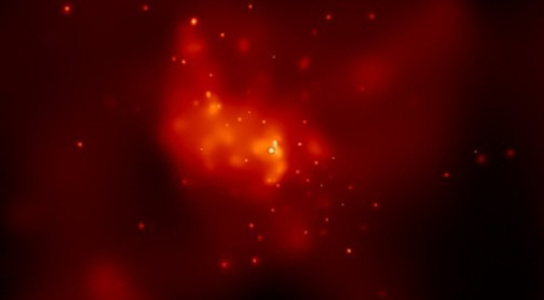
    This false-color image shows the central region of our Milky Way Galaxy as seen by Chandra. The bright, point-like source at the center of the image was produced by a huge X-ray flare that occurred in the vicinity of the supermassive black hole at the center of our galaxy. Credit: NASA/MIT/F. Baganoff et al.

    The supermassive black hole at the center of the Milky Way, Sagittarius A*, emits relatively little energy for its size, as much energy as Sol even though it’s 4 billion times as massive.

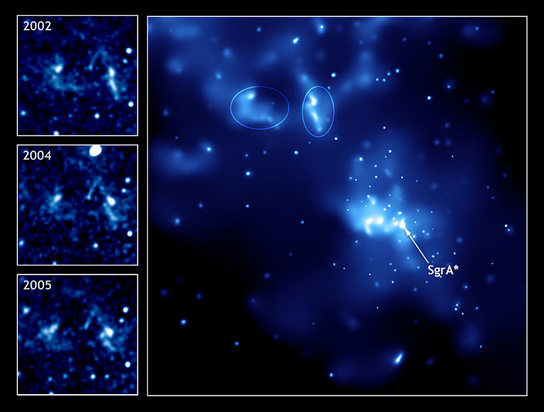
    Astronomers have observed that nearly once a day, the black hole emits a brief burst of light before settling down. It’s yet unclear what causes these flare-ups, and scientists have been trying to characterize these periodic bursts in order to better understand how supermassive black holes evolve.
    sagittarius-A-recent-flares
    Recent flare-ups from the Milky Way’s supermassive black hole, Sagittarius A*. Credit: NASA

    The scientists published their findings in the Astrophysical Journal. In this new study, the NASA Chandra X-Ray Observatory was used to detect the brightest flare ever observed from Sagittarius A+. The flare was located 26,000 light-years away, and was 150 times brighter than the black hole’s normal luminosity. The flare was observed for more than an hour before it faded away, and could give clues at how mature black holes like Sagittarius A* evolve.

    Black holes are detected by the light they give off when they consume nearby matter. The centers of newborn galaxies and quasars are extremely bright, since those black holes give off massive amounts of energy as they devour surrounding matter. As black holes mature, they slow down, consuming less matter and appearing fainter.

    In this low-accretion-rate state, they can blow away most of the energy. Chandra’s High Energy Transmission Gratings Spectrometer (HETGS) was used to analyze the incoming light.

    One hypothesis is that when an asteroid gets close to the black hole, it stretches and consumes it, turning the remnants into radiation, which give off the flares.

    It’s intriguing why Sagittarius A* gives off so little energy. By some estimates, considering the matter that surrounds Sagittarius A*, it should be a million times brighter than it is right now. This suggests that the black hole throws away most of the matter is should consume.
    Chandra-HETGS-observed-the-highest-peak-2-8-keV-X-ray-flux-and-greatest-2-8-keV-X-ray-fluence-from-a-flare-from-Sgr-A
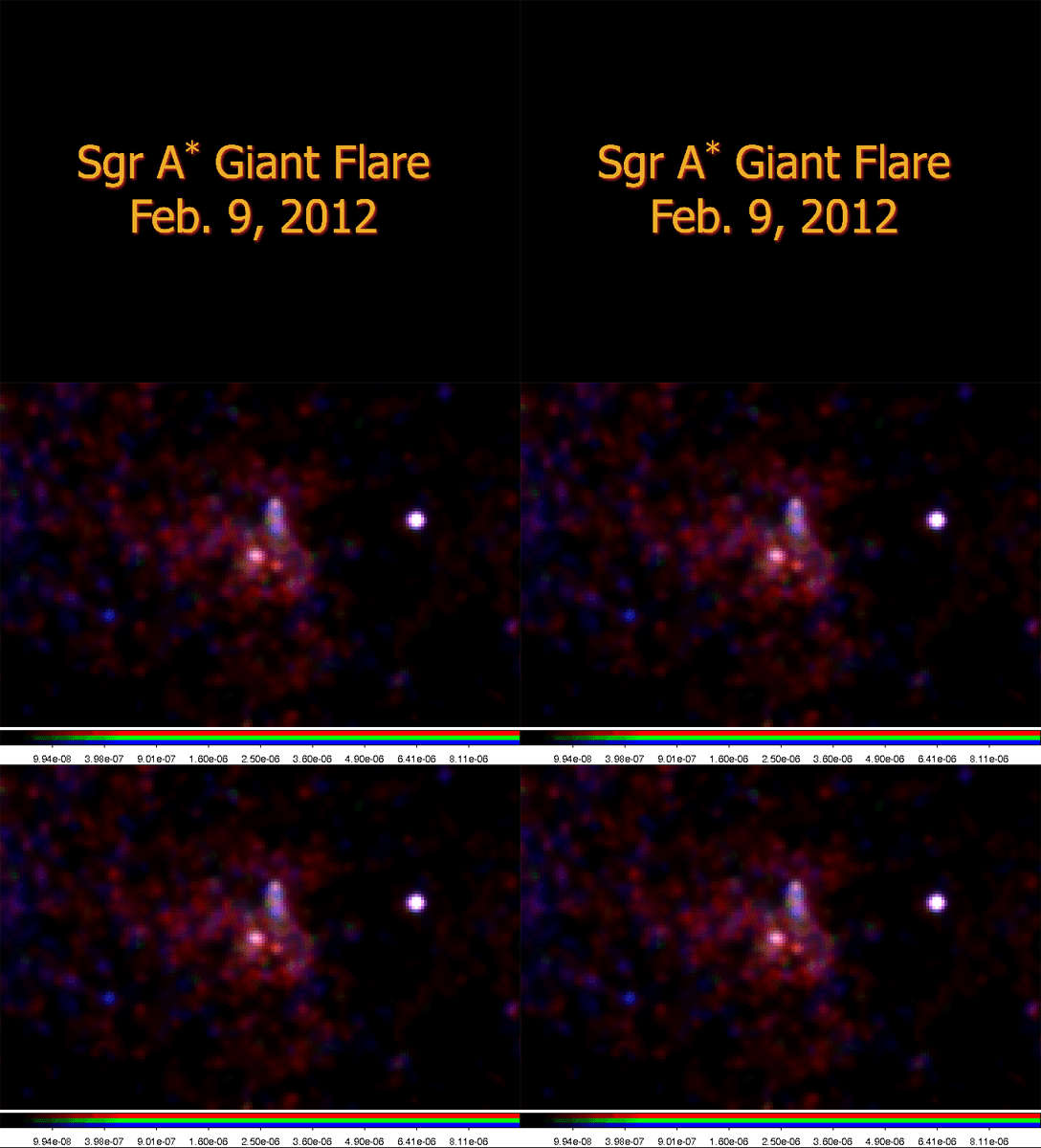
    The above movie was created from the actual Chandra-HETGS observation. Red sources are dominated by low energy X-rays (2-4 keV), while blue sources are dominated by high energy X-rays (6-8 keV). White sources have a more even blend of X-ray energies in the 2-8 keV range. The middle frame of the movie is the 5.6 ksec showing the flare from Sgr A*, the bright white source near the middle of the image.

    Reference: “Chandra/HETGS Observations of the Brightest Flare Seen From Sgr A*” by M. A. Nowak, J. Neilsen, S. B. Markoff, F. K. Baganoff, D. Porquet, N. Grosso, Y. Levin, J. Houck, A. Eckart, H. Falcke, L. Ji, J. M. Miller and Q. D. Wang, 23 October 2012, Astrophysical Journal.
    DOI: 10.1088/0004-637X/759/2/95

    Never miss a breakthrough: Join the SciTechDaily newsletter.
    Follow us on Google and Google News.

    Astronomy Astrophysics Black Hole Cosmology MIT Sagittarius A*
    Share. Facebook Twitter Pinterest LinkedIn Email Reddit

    Related Articles

    Dense Stellar Clusters Are Home to Black Hole ‘Megamergers’

    VLA Reveals a Cosmic Filament Connected to Our Galaxy’s Black Hole

    Astronomers Reveal Most Distant Supermassive Black Hole Ever Observed

    ALMA Observes a Black Hole Producing Star-Making Fuel

    Spitzer Provides Astronomers with a New Way to See the Milky Way’s Giant Black Hole

    Chandra Reveals Echoes of Multiple Outbursts from Sagittarius A

    NASA Data Suggests Black Holes Abundant Among the Earliest Stars

    Supercomputer Simulations Present a New View of Black Hole Jets and Accretion Disks

    Scientists Measure the Radius of a Black Hole at the Center of M87

    Leave A Reply Cancel Reply

    • Facebook
    • Twitter
    • Pinterest
    • YouTube

    Don't Miss a Discovery

    Subscribe for the Latest in Science & Tech!

    Trending News

    Massive Study Warns Marijuana Use in Teens Is Linked to Serious Mental Illness

    Scientists Discover a Completely Unexpected Way T Cells Kill Cancer

    Scientists Just Found the Solar System’s Original “Planet Factory”

    Study Warns Widely Used Food Preservatives Linked to High Blood Pressure and Heart Disease

    New Treatment Could Reverse Osteoarthritis Within Weeks

    Physicists Have Measured “Negative Time” in Bizarre Quantum Experiment

    The Deadly Tapeworm Spreading Across America Has Reached the Pacific Northwest

    Could Low Vitamin D Be Making Your Pain Worse?

    Follow SciTechDaily
    • Facebook
    • Twitter
    • YouTube
    • Pinterest
    • Newsletter
    • RSS
    SciTech News
    • Biology News
    • Chemistry News
    • Earth News
    • Health News
    • Physics News
    • Science News
    • Space News
    • Technology News
    Recent Posts
    • Streetlights Are Trapping Thousands of Isopods in Mysterious “Death Spirals”
    • Scientists Have Discovered These Deadly Parasites Are Secretly Swapping DNA
    • What Scientists Found Inside a 117-Year-Old Woman Reveals New Clues to Long Life
    • Breakthrough Technique Reveals Atomic Secrets of Record-Breaking Superconductors
    • The Future of Work Belongs to People Who Master AI
    Copyright © 1998 - 2026 SciTechDaily. All Rights Reserved.
    • Science News
    • About
    • Contact
    • Editorial Board
    • Privacy Policy
    • Terms of Use

    Type above and press Enter to search. Press Esc to cancel.