
Close Menu
    Facebook X (Twitter) Instagram
    SciTechDaily
    • Biology
    • Chemistry
    • Earth
    • Health
    • Physics
    • Science
    • Space
    • Technology
    Facebook X (Twitter) Pinterest YouTube RSS
    SciTechDaily
    Home»Science»Smilodon’s Distinctive Fangs Still Puzzling to Paleontologists
    Science

    Smilodon’s Distinctive Fangs Still Puzzling to Paleontologists

    By SciTechDailyNovember 8, 20122 Comments2 Mins Read
    Facebook Twitter Pinterest Telegram LinkedIn WhatsApp Email Reddit
    Share
    Facebook Twitter LinkedIn Pinterest Telegram Email Reddit
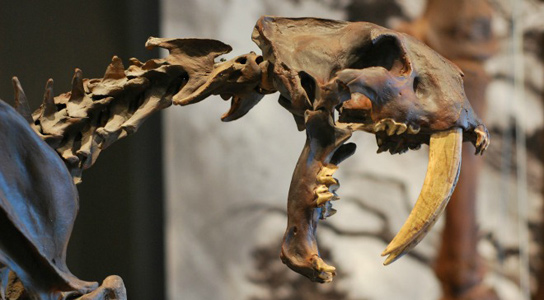
    smilodon-utah-fangs
    A cast of Smilodon at the Natural History Museum of Utah. Credit: Brian Switek/Wired

    The extinct genus Smilodon encompasses three species, and they are part of North American’s vanished megafauna. While the carnivore broadly resembles other Felidae, its fangs have been somewhat of a mystery for paleontologists, especially in the family’s largest species, Smilodon populator, which had 12-inch (30-centimeter) canines.

    Smilodon lived in North and South America during the Early to Late Pleistocene, 2.5 million to 10,000 years ago. Despite being referred colloquially as saber-tooth tigers, Smilidon is not closely related to tigers or any living felids.
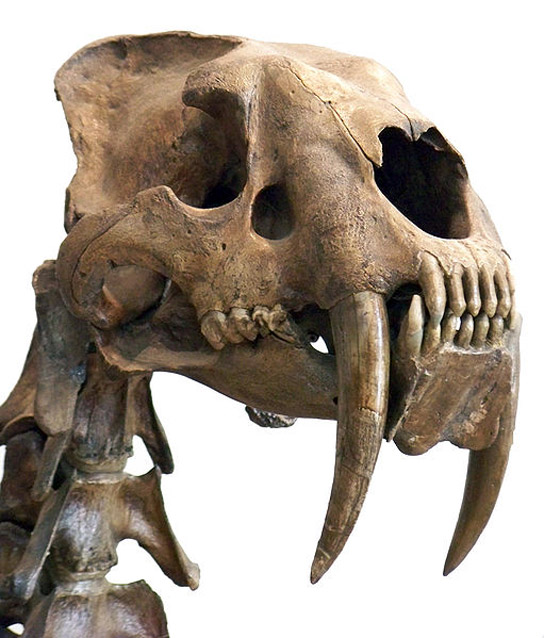
    smilidon-head-wikipedia
    Close-up view of a saber tooth cat head on display at the American Natural History Museum, New York. Credit: Image via Wikipedia

    The canines have been envisioned as slicing and stabbing weapons, but no clear evidence of this has been uncovered. Initially, it was thought that the canines of Smilodon were used like serrated knives, functioning as stabbing weapons in an attack.

    Scientists John Merriam and Chester Stock stated in their 1932 monograph The Felidae of Rancho La Brea that Smilodon had a “heavily corrugated gum which presumably covered the hard palate” and that this feature could have proven “advantageous in blood sucking.”

    There’s no evidence that animals from the Smilodon genus were specialized blood drinkers. This was simply a throw-away comment in a brief and speculative account on how the animal could have fed.

    Many analyses reject the ideas about the stabbing scenario and affirm that Smilodon probably killed horses, camels, bison, mammoths, and other mid-sized herbivores by biting them in the neck or belly. Its canines were fragile, and wouldn’t have been able to penetrate bone, so they would have been used only after a prey was killed.

    Never miss a breakthrough: Join the SciTechDaily newsletter.
    Follow us on Google and Google News.

    Fossils Paleontology Popular Sabre-Toothed Cat Smilodon
    Share. Facebook Twitter Pinterest LinkedIn Email Reddit

    Related Articles

    Sabertooth Secrets: Did These Ancient Beasts Purr or Roar?

    Scientists Discover a New Kind of Extinct Flying Reptile

    Pannoniasaurus inexpectatus, The First Freshwater Mosasaur Discovered

    Fossils Reveal Headbutts May Have Been Used as a Dinosaur Courtship Behavior

    Jaw Structures of Fossils Seems to Suggest That Three Homo Species Roamed Africa Concurrently

    Prehistoric Fossilized Eocene Epoch Turtles Died Locked In Coitus

    Cretaceous Period Sankofa Pyrenaica Fossilized Eggs Are Unusually Shaped

    Microraptor Feathers Were Black With Iridescent Sheen

    Hundreds of Lost Fossils From the Darwin Collection Rediscovered by the British Geological Survey

    2 Comments

    1. walter matera on November 8, 2012 4:58 pm

      Perhaps like deer antlers they were for sexual display. After all, in some deer species the does have antler and in very primitive deer, the male sport long fangs.

      Reply
    2. tony minser on November 9, 2012 4:06 am

      I wonder if woodpeckers had gone extinct a million years ago, and all we had was fossil evidence to work with, would we be able to figure out that the bird slammed its head repeatedly into a tree to feed? Would we be wondering why they have such thick skulls to eat like other birds?
      That leads me to consider that these cats may have used their powerful upper bodies and claws to latch onto prey, and with mouth closed, slammed those 12 inch knives down into the prey a dozen times. Twenty-four deep puncture wounds later the prey item bleeds out letting the cute (deadly) kitty gnaw away at leisure.

      Reply
    Leave A Reply Cancel Reply

    • Facebook
    • Twitter
    • Pinterest
    • YouTube

    Don't Miss a Discovery

    Subscribe for the Latest in Science & Tech!

    Trending News

    Don’t Miss: A Brilliant Venus and Glowing Harvest Moon Light Up the Sky

    New Twist on the Einstein Problem Reveals Unexpected Physics

    JWST Captures Stunning Evidence of How Supermassive Black Holes Feed

    Early Exercise May Permanently Change How Much Energy the Body Uses To Move

    New Molecule Wipes Out Aggressive Lymphoma Tumors in Mice in Just 11 Days

    The Human Family Tree May Need a Major Rewrite

    Scientists Find a Surprising Cancer-Fighting Effect in Dark Sweet Cherries

    New AI Detects Hidden Warning Signs of Solar Eruptions Hours Before They Emerge

    Follow SciTechDaily
    • Facebook
    • Twitter
    • YouTube
    • Pinterest
    • Newsletter
    • RSS
    SciTech News
    • Biology News
    • Chemistry News
    • Earth News
    • Health News
    • Physics News
    • Science News
    • Space News
    • Technology News
    Recent Posts
    • Pomegranates Could Unlock a New Treatment for Heart Failure
    • Africa’s Giant Herbivores Were Disappearing Millions of Years Before Humans Could Hunt Them
    • This Utah Mountain Is Hiding Enough Ice To Fill 600 Olympic Pools
    • Vagus Nerve Stimulation Could Unlock the Brain’s Hidden Learning Potential
    • Your Mother’s Age May Leave a Biological Mark That Lasts for Generations
    Copyright © 1998 - 2026 SciTechDaily. All Rights Reserved.
    • Science News
    • About
    • Contact
    • Editorial Board
    • Privacy Policy
    • Terms of Use

    Type above and press Enter to search. Press Esc to cancel.